Oil price decline takes center stage in markets
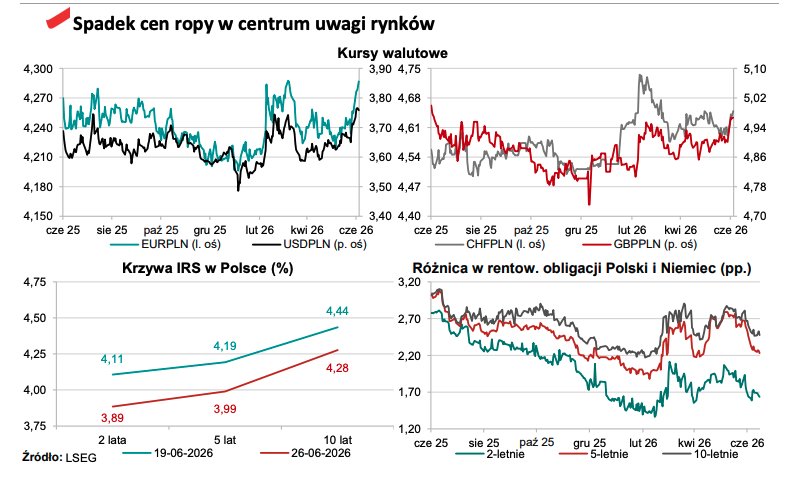
Thus, de-escalation limited the risk of commodity price increases and inflation expectations, leading to further declines in bond yields. Last week, the dollar also strengthened further, weakening the zloty. As a result, over the entire week the EURPLN rate rose to about 4.29, the USDPLN rate rose to about 3.76, while SPW yields and IRS rates fell. In the coming week, market sentiment will be shaped primarily by the situation in the Strait of Hormuz region.
The impact on the zloty and the yield curve may also be influenced by Tuesday’s preliminary CPI inflation data in Poland, which, if our forecast is realized, will move towards strengthening the zloty and increasing bond yields. Conversely, Wednesday’s PMI data for Polish processing, if our forecast materializes, will move towards weakening the zloty and reducing Polish bond yields.
What will 15 years of energy transformation bring?
On 8 June 2026, the Council of Ministers adopted the National Energy and Climate Plan (KPEiK) developed by the Ministry of Energy. It contains a comprehensive action plan for energy transformation, covering many areas and forecasts up to 2040. The document was sent to the European Commission for assessment and additional recommendations.
Below we present the key conclusions from this document in the medium‑term perspective and the main changes introduced compared to the previous version of the plan.

Ambitious scenario implemented, but 2030 target lowered
Like the previous version published in October 2024 (see MAKROmap 21.10.2024), the plan contains two scenarios: the ambitious WAM (with additional measures) scenario, which implies accelerating the current pace of economic transformation, and the passive WEM (with existing measures) scenario, which presents a forecast based on current legal and investment frameworks. The following analysis focuses solely on the WAM scenario, which is most likely to be implemented by the government.
The WAM scenario in the updated KPEiK foresees the share of renewable energy sources (RES) in final gross energy consumption (including electricity, heating, cooling, and transport) rising to 32.0% in 2030 (vs. 32.6% in the original version) and 52.3% in 2040 (58.4% in the original version) from 21.0% in 2025. For the share of RES in electricity, the forecast is an increase to 53.0% (vs. 56.1%) and 68.8% (vs. 69.4%) from 31.3% in 2025.
The drop in the forecasted share in 2030 resulted from an upward revision of total electricity production, while the decline in 2040 was due to lower forecasted production from RES and lower overall electricity production.
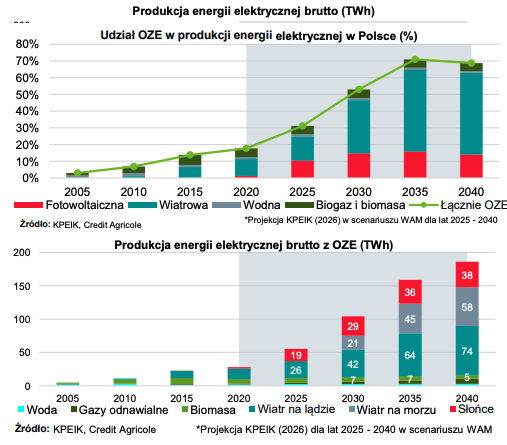
End of coal in 15 years. More than half of Poland’s electricity will come from RES by 2030
It should also be remembered that the scenario outlined in KPEiK assumes a total increase in electricity production of about 10% between 2025‑2030 and another ~38% up to 2040. Note that the final 2040 target was revised down by 12% compared to the previous projection (270 TWh vs. 308 TWh in 2040). Considering the simultaneous gradual phase‑out of fossil‑fuel power plants, including the complete shutdown of coal plants within the next 15 years, this means a significant increase in RES production is required to achieve the stated goals.
KPEiK assumes that electricity production from RES will almost double between 2025 and 2030 and increase by another 79% between 2030 and 2040. This transformation will be based mainly on increasing the share of wind farms (from 14.4% in 2025 to 31.8% in 2030 and 48.9% in 2040) and photovoltaic plants (from 10.4% to 14.8% and 14.1%) in total electricity production. The share of other RES (hydro, biogas, biomass) will not change significantly.
Compared to the assumptions of the previous plan, a larger short‑term increase in photovoltaic production can be expected (29.0 TWh in 2030 vs. 24.6 TWh planned in the previous version), while the short‑term wind production growth will decrease (62.5 TWh in 2030 vs. 69.1 TWh planned). At the same time, both wind and solar production levels increased in 2035, with a decline in 2040.
As a result, by 2030 an increase in photovoltaic plant production of 64% and wind plant production of 143% relative to 2025 is expected. Over 57% of the wind production growth from 2025‑2030 will come from new offshore wind farms in the Baltic Sea, the first of which will likely be commissioned in 2026. It should also be noted that in 2030 the RES share in electricity production will exceed 50% for the first time.
2.9 trillion zlotys for transformation. Nuclear delayed, coal to be phased out, costs hit
It is worth noting that for 2031‑2040 further significant increases in total electricity production are planned while eliminating coal and marginalizing oil and gas to a combined share of about 6% of total production. Implementing such a plan would mean almost doubling RES electricity production again (186 TWh in 2040 vs. 104 TWh in 2030) and about 16% nuclear share in total electricity, whose appearance in the Polish mix would mean a decline in RES share between 2035 and 2040, despite an absolute increase in production. In the previous plan, nuclear was to appear in a limited scope already in 2035, but its implementation was delayed and the 2040 production scale was revised down by 24%.
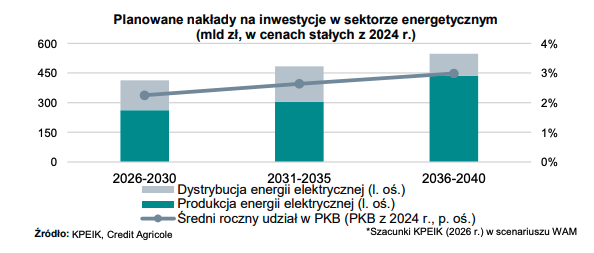
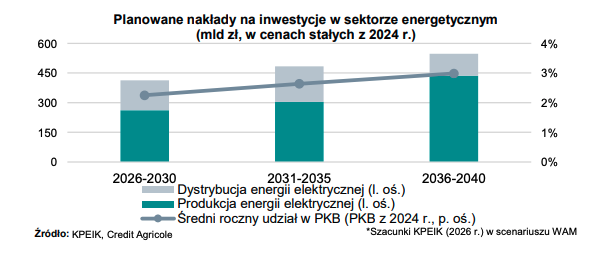
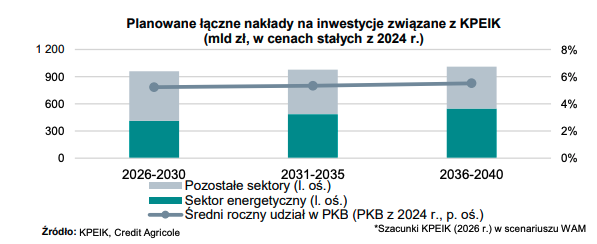
The KPEiK‑planned multiplication of RES electricity production, as well as the creation of nuclear power from scratch in Poland, will require large investment outlays for expanding generation capacity. Additionally, significant spending is planned for distribution and energy storage. According to the WAM scenario, planned spending in these two areas will total 412 billion PLN by 2030 and another 1,032 billion PLN in 2031‑2040. According to the plan presented in KPEiK, the level of average annual investment will rise from 2.2% of GDP (2024) in 2026‑2030 to 3.0% of GDP in 2036‑2040 (see chart).
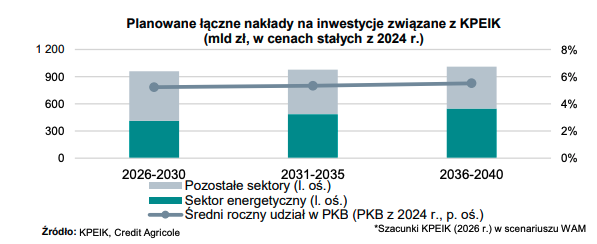
Besides investments in electricity production and distribution, KPEiK also assumes a range of investments in other activity areas, and the planned spending for this purpose (1,501 billion PLN) is close to the spending in the energy sector. The second largest investment after energy is planned for reducing transport emissions (~16% of total), mainly related to supporting electromobility. The third is investments related to households (~10%), focusing mainly on modernizing heating systems and building thermal renovation.
Notable are also investments in the gas sector, accounting for 6% of total, closely linked to increasing Poland’s energy security. The total value of all investments in energy transformation up to 2040 is expected to be about 2.9 trillion PLN, averaging 196.4 billion PLN per year. The average annual share of KPEiK‑related investments in GDP (constant 2024 value) will range from 5.2% to 5.5% up to 2040.
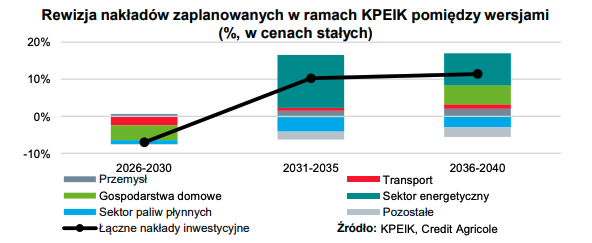
Compared to the previously published plan, the planned total spending has been significantly revised upward. Values in the 2024 plan were given in 2020 prices, while values in the latest plan are in 2024 prices. After accounting for these methodological differences, total spending planned for 2026‑2030 was reduced by 7.0% compared to the previous version. The drop in spending is mainly due to lower planned spending in the household and transport sectors. Conversely, spending planned for 2031‑2040 increased by 10.8% in constant prices. The most significant increases concerned energy (+24.7%), households (+27.9%), transport (6.9%) and industry (41.2%). A clear reduction occurred only in the liquid fuels sector (-56.4%). Changes in other sectors were limited and did not significantly affect total spending.
The main problem of KPEiK is finding financing sources sufficient to cover the planned expenditures above. One of the most important financing elements mentioned in the document is EU funds, especially KPO, FEnIKS, SCF, and cohesion funds. However, note that KPO ends in 2026, and other funds within the current framework end in 2027. Thus, the success of KPEiK will largely depend on negotiations over the new EU budget for 2028‑2034, which will take place over the next year. Another important financing source will be a 72.1 billion PLN loan from the US Export‑Import Bank to support the construction of a Polish nuclear plant. Additional support will come from the state, increasing the share capital of Polish Nuclear Power Plants by 60.2 billion PLN. Due to converging goals, transport spending in KPEiK will likely also be covered by spending in the National Railway Plan and the Central Communication Port investment program. Therefore, caution is needed when summing the total planned investment amount.
It is worth noting that KPEiK foresees a clear acceleration of investment growth in energy transformation (especially in energy) in the second half of the current decade. This scenario aligns with our medium‑term forecast of relatively rapid economic growth in the coming years, supported by an investment boom. The new KPEiK version also assumes maintaining a high pace of investment in transformation throughout 2030‑2040, but sustaining high spending over so many years is subject to many risk factors, the most important of which is the shape of the EU budget for 2028‑2034. The success of the project will also depend on future public finances, Poland’s economic conditions, and political factors.