Tehran ignores Trump’s threats
Given the course of the current part of the conflict, this statement must have met with a response from Tehran. It followed a few hours later. This morning the IRGC reported a tanker hit in the Strait and forced two other units to turn back after attempting to navigate the southern (Oman side – note) waterway.
Moreover, the execution of threats is progressing from Houthi. Supported by Iran, Yemeni rebels reported attacking two Saudi tankers claiming they violated the maritime blockade. The incident was confirmed by the Saudi press agency (SPA) regarding one vessel. The tanker hit was also reported by UKMTO.
USA unleashes heavy artillery, B‑1 bombers in action
Other, less direct reports also point to the potential to increase the intensity of the conflict in the coming days. Axios reported in the morning that U.S. officials said U.S. armed forces used a B‑1 bomber to attack IRGC targets.
This is the first use of this strategic aircraft since the conflict resumed 12 days ago. The unit launched from a British air base, coinciding with the British government’s decision to temporarily withdraw embassy staff in Iran due to worsening security and rising regional tensions.
The Wall Street Journal, meanwhile, reported a significant reinforcement of military presence in the Middle East. In recent days, special forces, additional combat aircraft, air tankers, and over 150 medics were moved to the U.S. military hospital in Landstuhl, Germany, which treats wounded soldiers from the Middle East. According to the journal, these actions give the Trump administration a broader range of military options in the context of a possible escalation with Iran.
Iraqi Prime Minister in Tehran and Ankara. The shadow of a diplomatic solution
Given the above information, news about a potential diplomatic path to resolve the conflict is rather modest. The Iraqi prime minister announced a visit to Iran. He is to meet, among others, with President Masoud Phezeskian.
One of the visit’s goals is to support de-escalation efforts in the region – the head of the Iraqi government recently visited the U.S., and after Tehran he will go to Turkey. Iraqi officials, however, emphasized that the prime minister “does not convey any formal message from the United States.”
Given the above information, news about a potential diplomatic path to resolve the conflict is rather modest. The Iraqi prime minister announced a visit to Iran. He is to meet, among others, with President Masoud Phezeskian (Al Jazeera, here). One of the visit’s goals is to support de-escalation efforts in the region – the head of the Iraqi government recently visited the U.S., and after Tehran he will go to Turkey. Iraqi officials, however, emphasized that the prime minister “does not convey any formal message from the United States.”
Strong second quarter
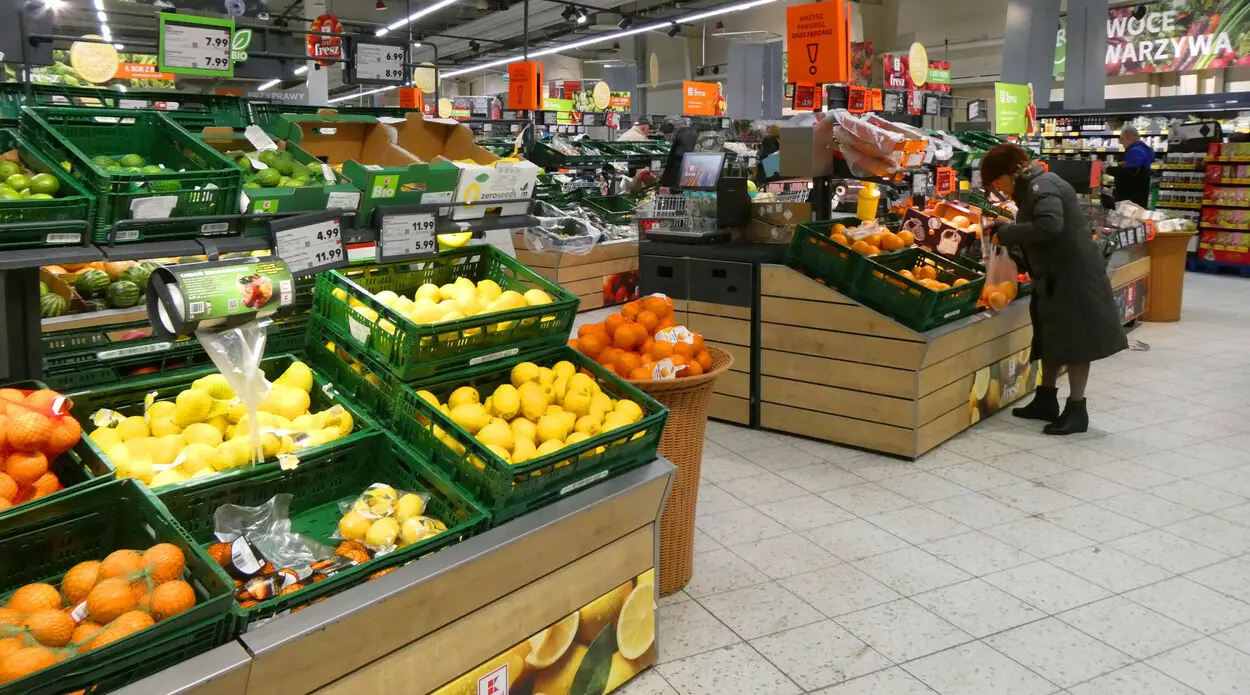
The annual retail sales growth accelerated from 3.0% to 6.2%. In monthly terms, after seasonality, the increase was +0.5% m/m, remaining above the threshold for the second month in a row. The bulk of this result was driven by durable goods (automotive +1.3% m/m, furniture +2.1% m/m). The volume of purchases in these categories is almost back to historical peaks. However, there was also a dip in spending.
Health spending, which had remained in a strong, almost unaltered upward trend, did not rise this time after seasonality (0.0% m/m). This is a fairly significant slowdown compared to previous increases of +0.8% m/m month‑on‑month. From a household budget perspective, this is good news as it may increase the household savings rate.
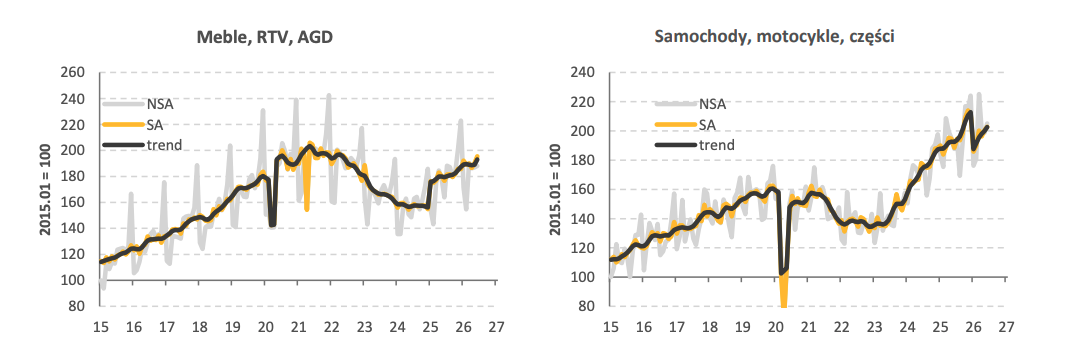
Yesterday’s published data close the set of monthly data for Q2. Combined with data on industry, construction, and the labor market, they form a solid picture of the economy in this period. Additionally, they increase the likelihood of good results in the second half of the year.
Credit drives M3 growth
The annual growth of M3 money supply accelerated from 11.0% to 11.8%. This is significantly above our forecast (11.2%). The surprise was driven by a notably faster-than-expected rise in credit for the non‑financial private sector – it accelerated from 8.7% y/y to 9.8% y/y. This is the highest since May 2012, just before the 2012/2013 slowdown (in Q4 2012 and Q1 2013 the real GDP growth fell below the threshold).
In June, the credit growth for enterprises slowed slightly, but it remains at a solidly high level (+9.1% y/y), while other segments accelerated (household credit +6.6% y/y, credit for other non‑financial sectors +5.9% y/y). Bank sector receivables (MIF) also grew against non‑monetary financial institutions (nMIF), rising from 160 bn PLN at the start of the year to 209.7 bn PLN in June. Credit sector expansion is therefore fully underway.
From deposits, this results in a 14.4% y/y increase in cash in circulation and a 10.1% y/y rise in total deposits, of which household +9.2% y/y and private non‑financial +13.8% y/y. JST also have a moment, as their available deposits in the banking system rise after seasonality to 3.1% of GDP at historical highs (nominally to 125.7 bn PLN). Central government special central deposits (IRSC) are at a historical maximum of 223.9 bn PLN (after seasonality).
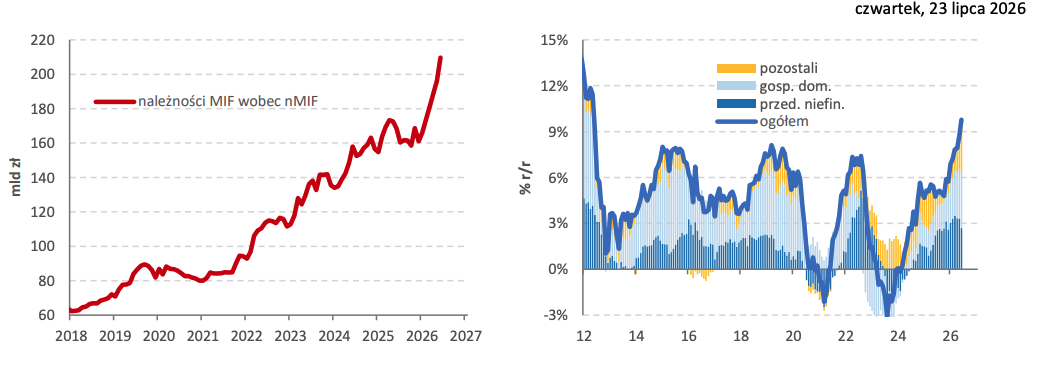
Thus the data indicate an acceleration of the banking sector’s expansion to rarely seen levels. Finally, this cannot remain without an impact on CPI, so the tone of these data is slightly pro‑inflationary.
UST again under pressure. Today the ECB decision
Yesterday’s session differed little from Tuesday’s. The opening of trade on the other side of the Atlantic weakened U.S. securities. It was more a reflection of the energy commodity market and the impact of higher fuel prices on the FOMC decision than a macroeconomic impulse.
Ultimately, on the main U.S. nodes, the yield curve moved up in a flattening move by 5, 4, and 2 basis points to 4.31% (2Y), 4.67% (10Y), and 5.15% (30Y). In the case of Bunds, the short end weakened mainly, while longer maturities remained relatively stable. Finally, the change in yields on the main German securities was +5, +1, and 0 basis points to 2.84% (2Y), 3.18% (10Y), and 3.67% (30Y).
Today in the afternoon the market will focus on the ECB decision. With consensus, we assume the Governing Council will keep rates unchanged (deposit 2.25%). In the context of further decisions, current market valuations assume two more hikes this year by 25 basis points – one in September and another in December. We remain skeptical about this path and forecast the benchmark to stay unchanged.
However, the realization of market valuations is mainly possible in a scenario of high energy commodity prices and sustained good economic conditions that will favor wage pressure. The combination of these factors at this moment seems unlikely to us.
This time the conditions for weakening the Polish government bond market are partially positive
In recent days, bond yields in the region rose mainly due to higher energy commodity prices. The situation in Hungarian and Czech bonds was similar – on the long end of their curves yields rose by 6 and 5 basis points to 5.51% and 4.96% respectively. National debt also fell on Wednesday, but part of this weakening was due to higher-than-expected retail sales growth.
This suggests a temporal convergence of data publication with an upward shift of the short end of the PLN IRS curve and FRA rates. The reaction of longer tenors, however, indicated fewer market concerns about the scale of fiscal pressure, which can be linked to better-than-expected economic conditions.
As a result, the Polish government bond curve moved up, but in a distinctly flattening move. The change in yields on POLGBs was +9, +9, and +3 basis points to 4.34% (2Y), 5.13% (5Y), and 5.67% (10Y).
In a broader view, we still do not see the potential for the Polish government bond market to recover losses. External conditions are so unfavorable that the chance of a yield decline remains small.
A significant reduction in Middle East tension could change the current trend. However, recent signals from the region do not indicate this (details in the first paragraph).
Currency markets are quiet
In contrast to the heightened volatility of FI and energy commodities, the FX market is calm. EURUSD closed yesterday’s session at a tie (1.1407).
Low volatility also accompanied EURGBP and EURJPY. Only the franc slightly lost value against the euro (0.3%), which we interpret as a growing differential in future interest rates between the Swiss currency and others.
Today, the ECB meeting may slightly attract attention to EURUSD.
In the base scenario, we do not anticipate a reversal in the ECB narrative. We also do not see the Governing Council’s potential to “fight” market valuations. In current conditions, they should be comfortable for euro‑zone monetary policy makers.
Polish zloty stable
The past day did not bring increased volatility to EURPLN. The domestic currency was “protected” by both better economic conditions and rising Polish government bond yields.
As a result, the pair closed the day at a tie (4.33). Similarly, the Czech crown’s quotations were shaped. The forint, however, remained under pressure, losing 0.5% against the euro.
We still expect stable EURPLN quotes. We assume the pair will stay around 4.33 and the ECB meeting will not have a major impact on its valuation.