









All the focus in UK economics circles right now is on the jobs market – and whether Thursday’s jobs figures are bad enough to pressure the Bank of England into a faster pace of easing.
But the latest inflation figures, which show headline inflation rising up to 3.6%, suggest the Bank will continue to tread carefully when it comes to rate cuts.
Importantly, services inflation – a key metric for the BoE – stayed at 4.7%, against expectations it would ease off. There have been plenty of occasions where this data has been driven by volatile or less relevant areas of the service sector, but this doesn’t appear to be one of them. Indeed, our metrics of “core services” generally picked up in June.
Rail fares unexpectedly rose (having fallen at the same time last year), while catering prices, which represent a quarter of the services basket, have been rising a little more quickly as of late. That may be related to the National Insurance hike on employers, as well as the hefty rise in the National Living Wage.
It is still worth saying that services inflation is being kept elevated in large part by regulated price increases or categories that are inherently backwards-looking. April’s rise in road tax, for instance, is adding about 0.3ppt to overall services inflation. Rents are also adding close to a percentage point, but this contribution is set to almost halve over the course of the next few months. Private sector rental growth is slowing, while local authority/social housing rents are capped at much lower growth rates this year.
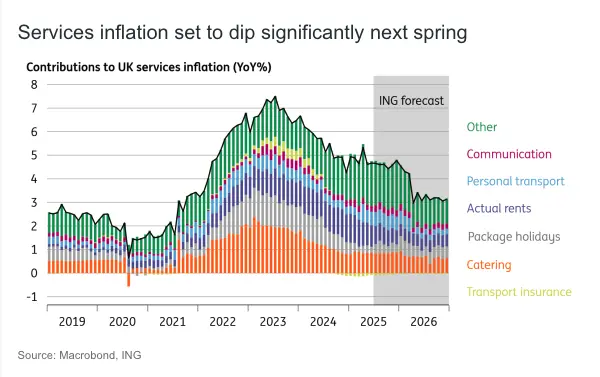
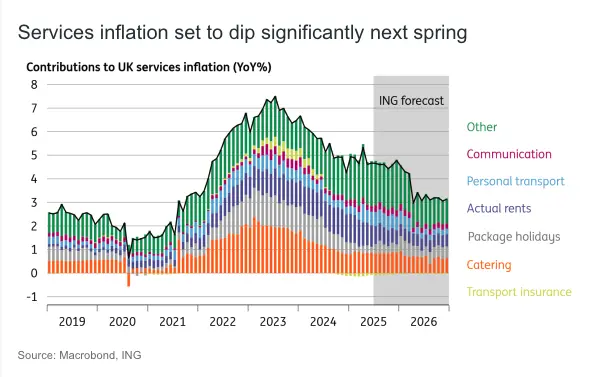
The fact that so much of the services basket is reset only once per year in April means services inflation will struggle to move significantly lower before next spring. But by then, we think it will be much closer to 3% than 4%, and that’s something the Bank of England, we suspect, is well aware of.
Still, this latest data appears to set the bar fairly high for faster rate cuts. The fact that headline inflation is edging closer to 4% doesn’t help. BoE Chief Economist Huw Pill has recently spoken of internal research, which shows that inflation has a habit of becoming more entrenched when CPI reaches these levels.
We are more sceptical about that, at least in the current economic environment, not least because the jobs market is visibly deteriorating. Thursday’s payroll data is absolutely key. If May’s shockingly bad figures aren’t revised up and/or if June’s numbers are as bad, that could be a catalyst for the Bank to rethink its current cautious approach to rate cuts. For now, though, we expect “gradual” cuts in August and November.