In the country
The Monetary Policy Council does not mandate any actions; the economy shows resilience, and inflation remains within the central bank’s tolerance band – NBP President Adam Glapiński said, quoted by Bloomberg.
Scope Ratings confirmed Poland’s long‑term rating at "A"; the agency also changed its outlook from stable to negative – the agency’s statement says.
State budget capital expenditures after March totaled 9.77 billion PLN and currently account for 13.4% of the 2026 planned amount – the finance ministry said.
Funding for the KPO grant rose in March by about 4.365 billion PLN – the finance ministry said in the operational budget report.
Revenue from the coal tax after March was 1.8 billion PLN, which is 56.5% of the 2026 plan – the finance ministry said in the operating budget execution.

From the world
Retail sales in China rose 0.2% year‑over‑year in April – the Beijing statistical office said. Analysts had forecast 2.0% year‑over‑year, after 1.7% the month before.
China’s industrial production year‑over‑year rose 4.1% in April – the Beijing statistical office said in a statement.

Core inflation is clearly accelerating
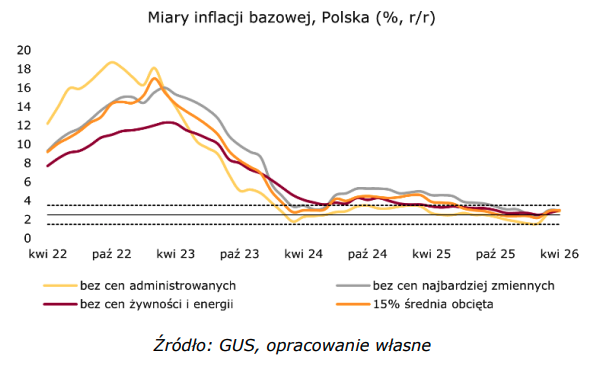
In April core inflation (excluding food and energy) rose to 3.0% year‑over‑year from 2.7% year‑over‑year, slightly above expectations, and the overall CPI rose to 3.2% year‑over‑year. Monthly momentum remains high. Core inflation prices rose 0.9% month‑over‑month, indicating a rebound of inflationary pressure after a weaker start to the year. Other core inflation measures also deteriorated: the admin‑free index (2.9% year‑over‑year), trimmed average (3.0% year‑over‑year) and the measure excluding the most volatile prices (3.0% year‑over‑year).
In most cases this means a break in the previous falling trend. The data suggest a gradual widening of price pressure in the economy and the transfer of earlier cost shocks to subsequent categories. Core inflation is approaching the upper bound of the NBP target band (3.5%). In the coming months it will be crucial whether the current acceleration proves transitory or triggers a longer‑term inflation rebound.
Demand dampening growth in China
According to the latest data from the Chinese economy, the activity dynamics in industry, consumption and the labour market in the first months of 2026 remain varied. Industrial production in the January–April period rose 5.6% year‑over‑year, but in April the dynamic fell to 4.1% year‑over‑year (below expectations), which may signal a gradual fading of earlier momentum. At the same time retail sales rose 1.9% year‑over‑year in the January–April 2026 period, indicating only a modest improvement in domestic demand. Recent monthly data show a clear weakening.
In April sales rose only 0.2% year‑over‑year, the lowest dynamic for a long time, although partly due to a high base a year earlier. Against this backdrop the labour market remains relatively stable. The unemployment rate in cities was 5.2% in April, slightly lower than the previous month, and averaged 5.3% in the first four months of the year.
The comparison of these data indicates the persistence of the known imbalance in China’s economy – relatively stable industrial supply against still weaker consumer demand. The slowdown in retail sales dynamics alongside a stabilised labour market suggests that demand constraints stem more from low consumption propensity than from a deterioration of household income.
EUR‑USD up
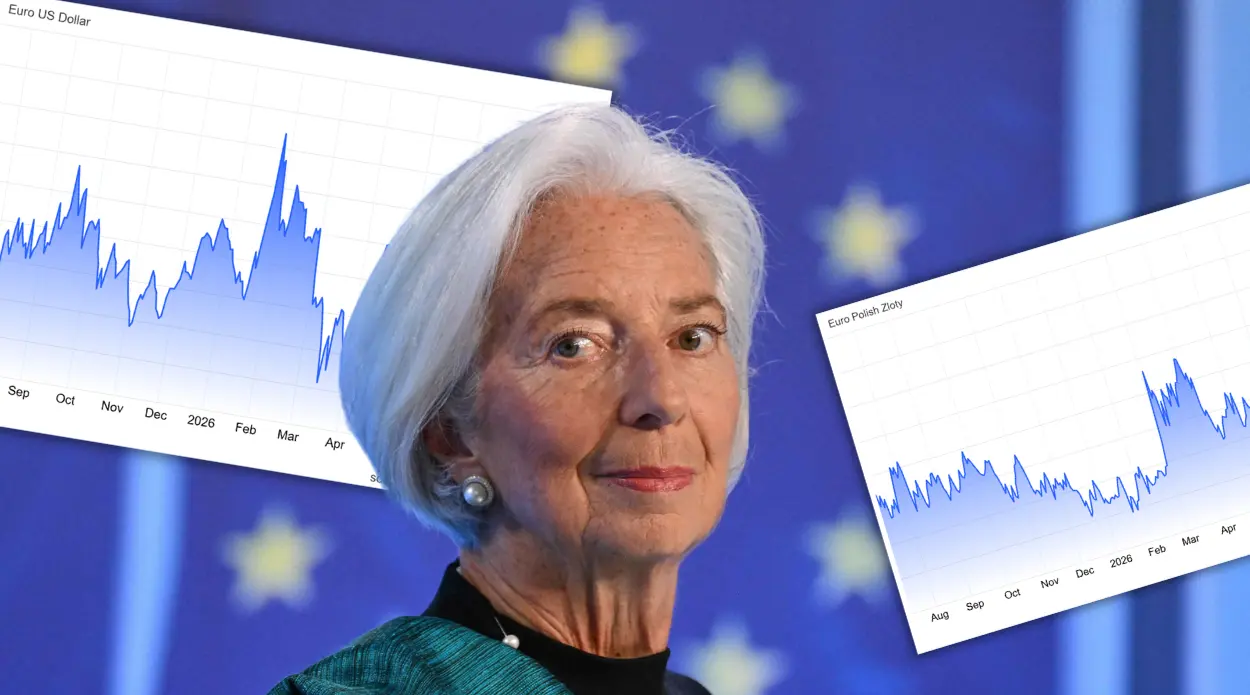
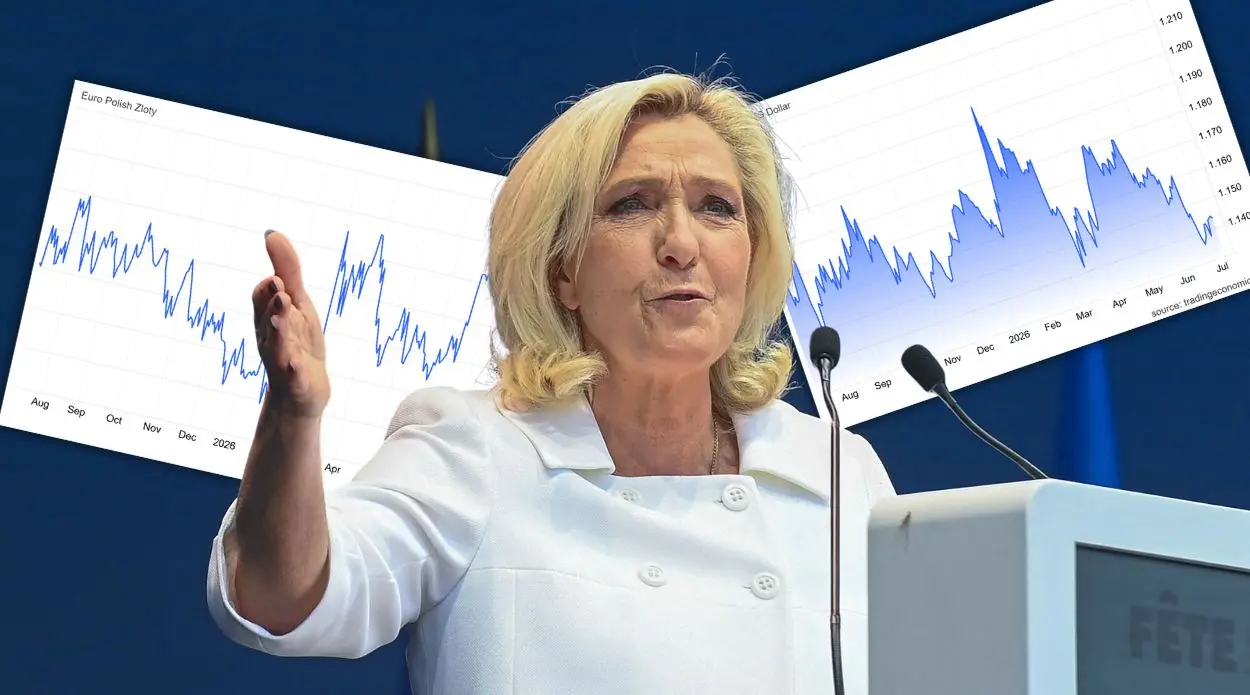
After four days of dollar strengthening, yesterday’s session favoured the euro. The EUR‑USD rate rebounded from a more than month‑low to about 1.166 at the close. The euro’s strength was helped by optimism about the possibility of resolving the Middle East conflict, including the US temporarily lifting sanctions on Iranian oil exports.
EUR‑PLN down
The EUR‑PLN rate fell yesterday by almost one digit to 4.24 at the close. Higher than expected core inflation shifts risks toward a hawkish stance on monetary policy.
Debt calm
After clear rises in yields in recent days, yesterday’s session brought stability to the domestic debt market. On Bunds there was a slight downward correction of about 2‑3 basis points along the entire curve. A similar scale drop for US 2‑year and 10‑year was stable.