The U.S.-Iran dispute remains alive
The situation in the Middle East remains tense at the beginning of the week after the United States carried out another series of missile attacks on Iranian targets on Sunday.
According to a statement from the U.S. Central Command (CENTCOM), U.S. forces carried out precision strikes on dozens of targets in multiple locations.
The goal of the operation, as reported, was to "weaken Iran’s ability to further attack international shipping passing through the Strait of Hormuz."
"CENTCOM forces struck Iranian military air defense systems, coastal radar stations, rocket and drone assets and small boats, using U.S. fighter aircraft, warships, single‑use aerial drones and single‑use maritime drones for the first time," the statement read.
In recent days, both Washington and Tehran have presented divergent positions regarding the availability of the Strait of Hormuz for international shipping, leading to a heightened dispute.
The CENTCOM statement emphasized that the Strait of Hormuz is a key maritime corridor for global trade, and that "Iran does not control it".
"U.S. forces are ready and prepared to ensure that freedom of navigation remains available for commercial vessels despite ongoing, unjustified aggression, harassment, threats and arbitrary declarations from Iran," the statement added.
According to Bloomberg, this was the fourth U.S. attack on Iran in about a week, and the operation followed one of the most intense bombings since the June agreement.
On Saturday, CENTCOM reported that, at the direction of Donald Trump, U.S. forces struck about 140 targets.
Meanwhile, the Iranian news agency IRNA reported that Iran continues retaliatory actions in response to U.S. attacks.
Despite Iran’s announcement of closing the strategic route "to be rescinded", the Joint Maritime Information Center informed on Sunday that the southern transit route through the Strait of Hormuz remains open for maritime traffic.
"Numerous reports indicate that in the last few days movement in the Strait of Hormuz has fallen almost to zero, and neither side has shown any signs of easing tensions," analysts from ING Think said.
"The United States supposedly carried out attacks on Iranian bridges for the first time since April, and Iran threatens a new total blockade of the Strait of Hormuz. Nevertheless, investors likely remain focused on the fact that technical talks between both sides are ongoing", they added.
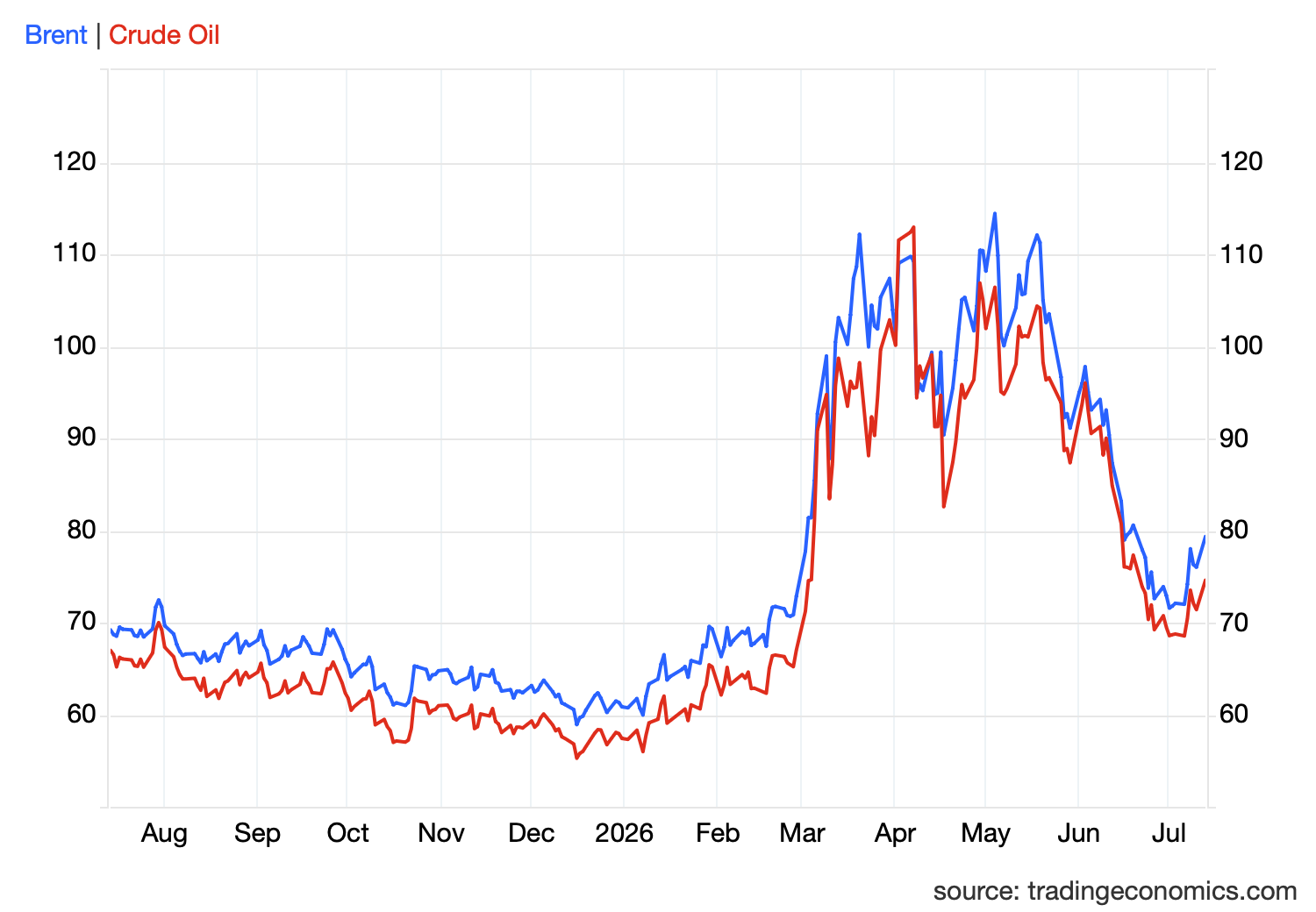
Brent crude prices rose on Monday by almost 5% to 79,5 USD and 74,8 USD per barrel, as the renewed U.S.-Iran fire exchange raised concerns about potential supply disruptions.
Chart. Futures prices for Brent and WTI (West Texas Intermediate) crude
Source: Trading Economics.
Read also: The dollar’s long‑term path to 4 PLN? The expert issued forecasts for USD/PLN and EUR/USD. "The dollar could gain"
See also: Will the dollar surprise again? The expert issued a forecast for USD/PLN and EUR/USD. "I can’t believe there will be no more fires"
Dollar to zloty rate on Monday, July 13
The dollar to zloty rate on Monday, July 13 is at 3,80 PLN (+0.48%).
Chart. Dollar to zloty rate (USD/PLN)
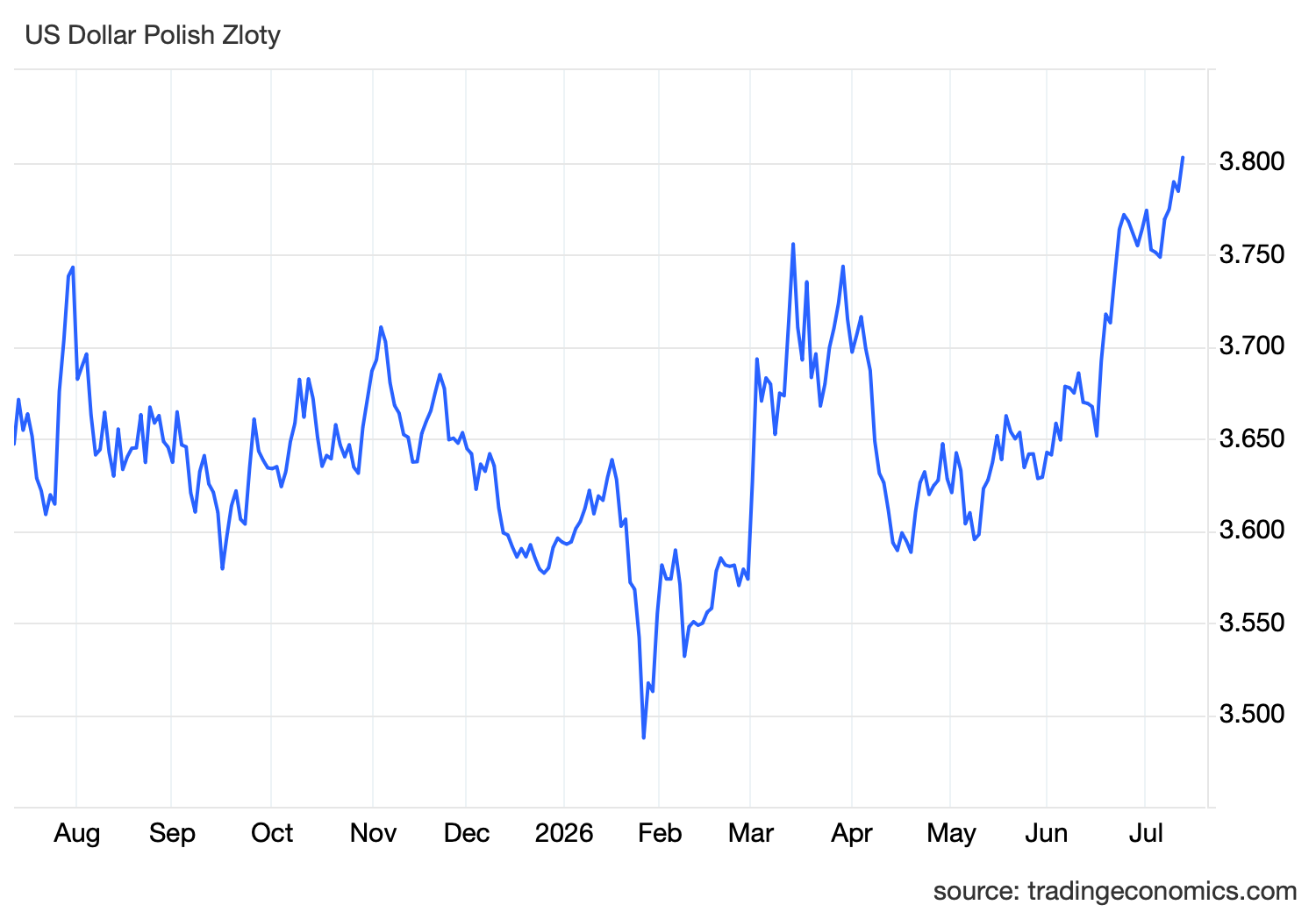
Source: Trading Economics.
The euro to dollar rate reaches 1,13 USD (-0.17%).
Chart. Euro to dollar rate (EUR/USD)

Source: Trading Economics.
Read also: Dollar before the chance to break out? Expert: "Capital will flow back to USD"
See also: Dollar before "nervous and dynamic" movement, euro waiting for a drop? Expert issued a forecast for USD/PLN and EUR/USD
Sources: Bloomberg, ING Think.