The political landscape in the British Isles has changed dramatically in just 72 hours.
The market does not forgive political mistakes. Prime Minister's problems affect the pound's rate
For trading algorithms and institutional investors this is a clear signal that a brutal pound sell-off has just begun.
Labour lost almost 1,500 councillors in England, making way for Reform UK populists and the rapidly growing Greens.
The left’s bastions fall one after another, the first Welsh minister, Eluned Morgan, accepted defeat with astonishment, and the government is taken over by Plaid Cymru.
In Scotland, the SNP regained political dominance, pushing the local left to an absolute margin (only 17 of 129 seats).
Instead of quickly putting out economic fires, British politicians are fighting for seats. Inside the ruling party a war is currently raging.
MP Catherine West issued a sharp ultimatum to the prime minister: if Monday’s speech does not bring a coherent crisis plan, she will initiate a leadership change procedure. Moreover, she has decided to join the fight with momentum, also bringing in Angela Rayner, former deputy prime minister,
This is not the end of Prime Minister Keir Starmer’s problems, because the consequences of the war in Iran, rising prices of not only fuel but also food, are starting to seriously upset social moods.
Starmer has recently tried to shift responsibility for inflation onto the USA and Russia as the main geopolitical players, but UK citizens see both Starmer and the monarchy as the main source of their problems and daily struggles.
The unrest can be evidenced by yesterday’s anti-monarchist protest “No Kings” at Buckingham Palace. Slogans such as “Not My King” or “Down with The Crown” clearly indicate anger and dissatisfaction among British society.
See also: The crack in the British labour market. Companies are preparing for mass layoffs
Pound rate – what next?
Capital markets, which priced long‑term stability after Starmer took office, are now rapidly changing their risk models.
The pound sterling will be valued against leading currencies (including a strong USD), and the GBP/PLN rate is currently under strong supply pressure. Instead of implementing modern technologies, healing the economy, and regulating AI, the British government is sinking into complete chaos.
From a financial markets perspective, hard data and ruthless forecasts are now key. Analysts from ING Think leave no doubt about the fundamentals of the British currency.
“The pound is slightly losing value because markets are analysing the effects of local elections in the UK (...). Although Labour’s losses were not as severe as feared, they could not quell speculation about leadership battles within the party,” was reported.
For the broad foreign exchange market, the next prime ministerial speech will be absolutely crucial.
“The unknown remains how much he [Starmer – note. red.] will support return to Europe, whether by re‑joining the customs union or, more controversially, the single market,” added.
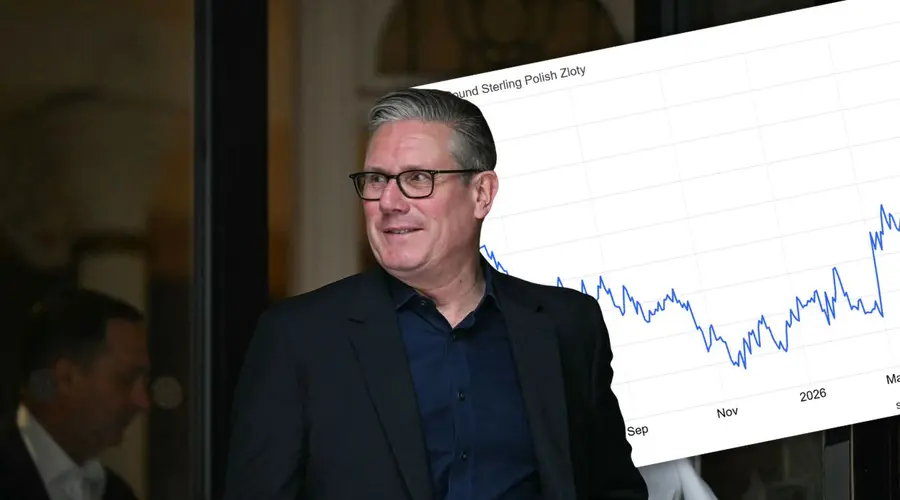
The pound to the zloty on Monday, May 11 fell to 4,89 PLN.
Chart. Pound to zloty rate (GBP/PLN)

Source: Trading Economics.
The pound to the dollar increases to around 1,36 USD.
Chart. Pound to dollar (GBP/USD)

Source: Trading Economics.
The pound to euro falls to 1,15 EUR.
Chart. Pound to euro (GBP/EUR)

Source: Trading Economics.
Read also: Dollar rate before a breakout chance? Expert: “Capital will flow back to USD”
See also: Will the dollar surprise again? The expert issued a forecast for USD/PLN and EUR/USD. “It’s hard for me to believe there will be no more fires.”
Sources: BBC, ING Think.