The Monday session brought a deterioration of global sentiment after media reports that the Iranian negotiating team had halted the exchange of messages with the USA via mediators due to the escalation of Israeli military operations in Lebanon. This led to a clear rise in oil prices and a moderate increase in risk aversion in global markets.
As a result, the zloty came under pressure, especially against the dollar, which has safe‑haven status. The scale of dollar strengthening and oil price rise was somewhat limited by US diplomatic actions that led to a partial ceasefire between Israel and Hezbollah in Lebanon in the evening.
In this unfavorable external environment, the upwardly revised final reading of Poland’s GDP for 1Q26, fundamentally supporting the national currency’s strength, failed to curb the zloty’s depreciation.
On Tuesday, the attention of domestic market participants will be drawn by the RPP decision, while the almost certain maintenance of interest rates at the unchanged level and the expected lack of significant changes in the Council’s statement should be neutral for the zloty’s valuation. However, we fear that the increasingly tense geopolitical situation may harm the Polish currency.
Euro rate – forecast for the coming days
The development of events in recent days pushes back the prospect of a quick agreement between the USA and Iran, creating a risk that the Strait of Hormuz will remain blocked longer than the market has recently priced in.
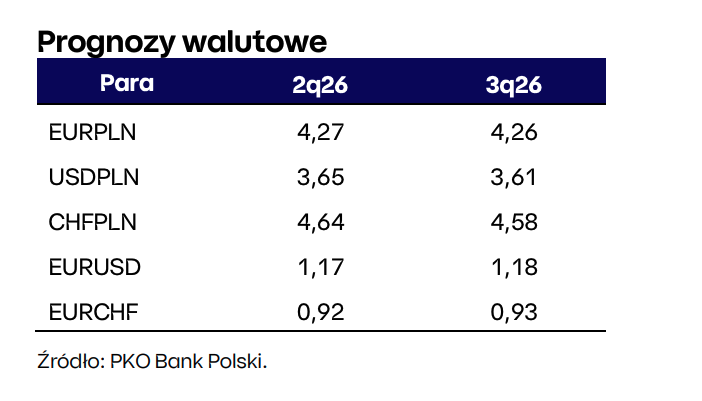
Hence, in the horizon of the upcoming sessions we see an asymmetric probability of EURPLN rising to about 4.25 and USDPLN moving towards 3.68, especially if EURUSD breaks clearly through support at 1.1580.
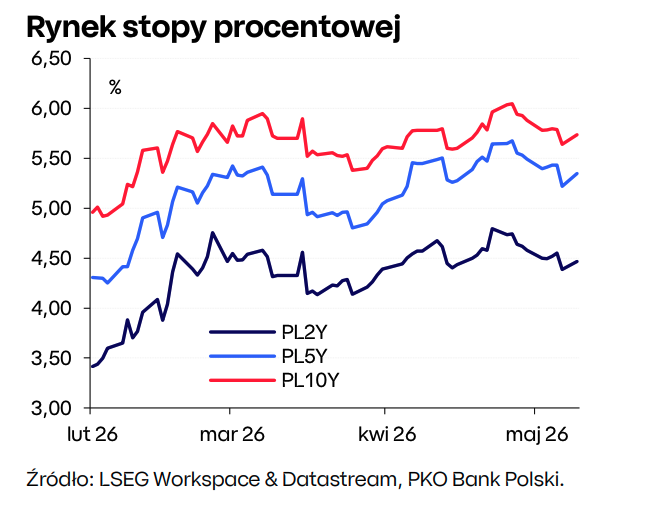
On the domestic interest rate market, the beginning of the week saw a rise in yields on Polish government bonds by 8‑13 basis points, in line with global trends. Negative reaction was triggered by media reports suggesting an increase in the risk of a freeze in talks between the USA and Iran (talks of a halt in information exchange between the parties). However, we assume that later in the week pressure on yield increases will weaken.
In our base scenario, 2‑year bond yields have room to fall below 4.40%, and 10‑year yields below 5.65% by the end of the week.
RPP will decide what to do next with interest rates in Poland
The argument for such a scenario is the Tuesday RPP meeting. The Council’s comment on the decision, and even more so the press conference of the NBP president, A. Glapiński, should reinforce the market’s conviction that there will be no room for rate hikes in 2026.
Meanwhile, market valuations fully account for a 25 basis point rate hike in October and about half of the next move of this scale by the end of the year. The cooling of expectations for hikes by the central bank is supported by, among other things, a drop in inflation in May to 3.1% year‑on‑year.

As a result, forecasts for the entire inflation path in the coming quarters were significantly lowered. We assume that by the end of the year inflation should remain below the upper bound of the NBP target band. Given the RPP’s past communication, this means no need to change monetary policy. Additionally, on Tuesday the preliminary reading of May HICP inflation in the euro area will be published.
The consensus assumes it will rise to 3.2% year‑on‑year versus 3.0% in April, and for core inflation it will rise to 3.4% year‑on‑year versus 3.2% a month earlier. In investors’ view, after lower‑than‑expected inflation readings in Germany and France, the probability of a lower‑than‑consensus result for the entire euro area has increased.