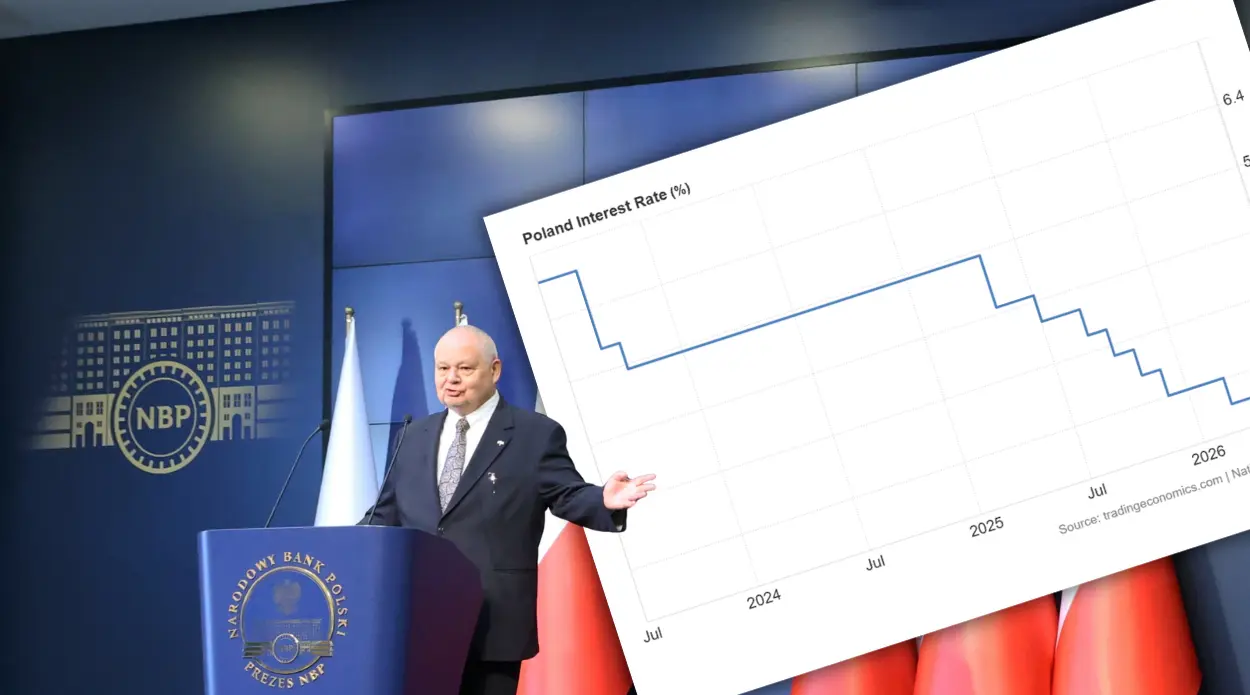
After the earlier higher March inflation reading and the higher-than-forecast preliminary April reading, despite the fuel price cap program, the room for any easing of monetary policy was practically very limited.
>> Also read: Orlen shares attacked by bears, Mostostal shares make up for losses
The today's decision confirms that the central bank does not intend to react hastily and remains focused on stabilizing inflation expectations, which remain sensitive to a range of domestic and global factors.
RPP waits and observes. Inflation and the Middle East situation remain key
In practice this means entering a clear waiting mode. RPP will closely monitor not only subsequent inflation readings but also the real economy’s condition and the behavior of key price components. The key point is that the current inflation profile does not yet provide comfort for continuing a cycle of rate cuts.
Price pressure, although partially eased by administrative actions, still shows signs of persistence, limiting the flexibility of monetary policy. In such an environment keeping rates unchanged is a defensive approach, but it also increases the central bank’s credibility and helps better anchor inflation expectations over the long term.
External factors are increasingly important, which may in the coming months determine the inflation path. The situation in the Middle East remains particularly significant, where tensions between Iran and the United States are still seen as a potential source of a strong supply shock in the oil market. Currently, however, more signals point to the possibility of de-escalation and reaching an agreement. The market is gradually pricing in a scenario in which the Strait of Hormuz is unlocked, which could clearly improve the global energy commodity trade situation.
Wall Street hits records, markets play for de-escalation
This development would have significant consequences for inflation worldwide, as stabilizing oil supplies reduces the risk of energy price increases and transport costs. At the same time it is worth exercising caution in assessing potential effects. Even if an agreement is formally reached, the process of restoring full throughput of transport routes and rebuilding trade liquidity will not happen immediately.
In practice this could mean several months of higher volatility in the oil market and gradual, not abrupt, easing of price pressure. For central banks, including RPP, this means the need for further action under uncertainty and limited predictability.
Against this backdrop the situation in the United States clearly contrasts, where equity markets remain in a strong uptrend. Major indices almost every day reach new historical highs, and investors increasingly boldly increase exposure to risky assets. The market’s behavior is supported by a combination of several factors. First, growing hopes for a calming of the geopolitical situation, which reduces the risk of sudden commodity price spikes.
Second, a very solid earnings season is ongoing, in which technology companies and semiconductor sector firms perform especially well. These market segments once again serve as the growth engine, strengthening the narrative of the strength of the U.S. economy and its ability to generate profits even in a more demanding macroeconomic environment.
Poland waits for inflation to fall while Wall Street drives a tech rally
In a broader view the current situation clearly shows the divergence between markets. Poland remains in a phase of cautious waiting, where the key role is played by fighting inflation and maintaining macroeconomic stability. Meanwhile, in the United States the growth narrative dominates, supported by company results, the technology sector and improving global sentiment.
This differentiation may persist in the coming weeks, especially if the Middle East situation gradually stabilizes.
For investors this means an environment where selectivity and careful monitoring of incoming information are crucial. Every new inflation reading, every statement by the Monetary Policy Council and every report on Iran-U.S. relations can quickly affect asset valuations. Today’s market picture therefore suggests the coexistence of two distinct phases of the cycle.
Poland remains in a patient waiting mode for a more definitive fall in inflation, while U.S. markets benefit from improved sentiment and the strength of company results, which continue to drive indices toward new record levels.