President NBP’s dovish remark weakened the zloty
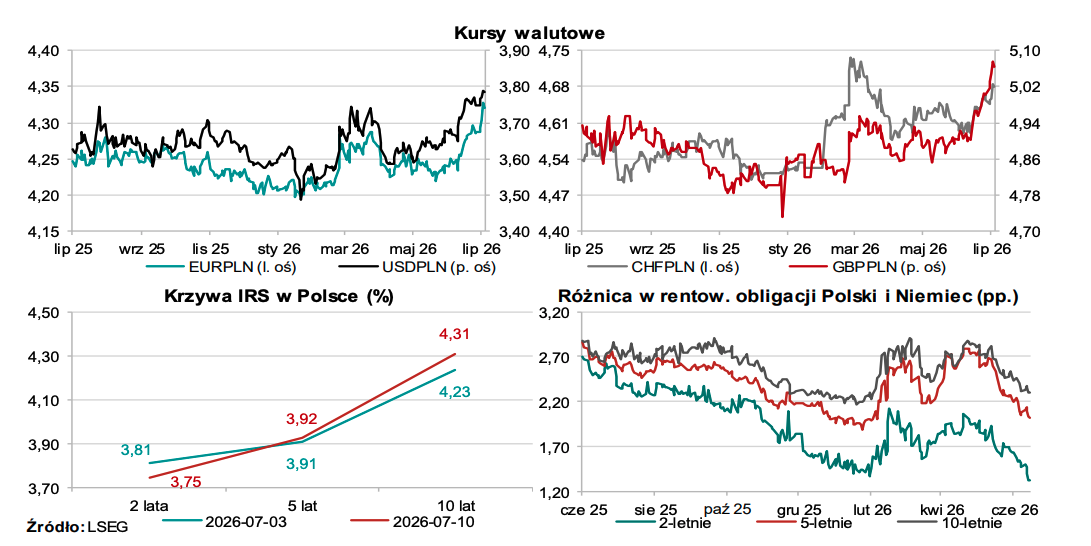
The start of the week was calm, and EURPLN hovered near 4.29, but on Tuesday and Wednesday the rise in oil prices and the decline in global risk appetite led to a weakening of the zloty to around 4.31 per euro and an increase in bond yields and IRS rates.
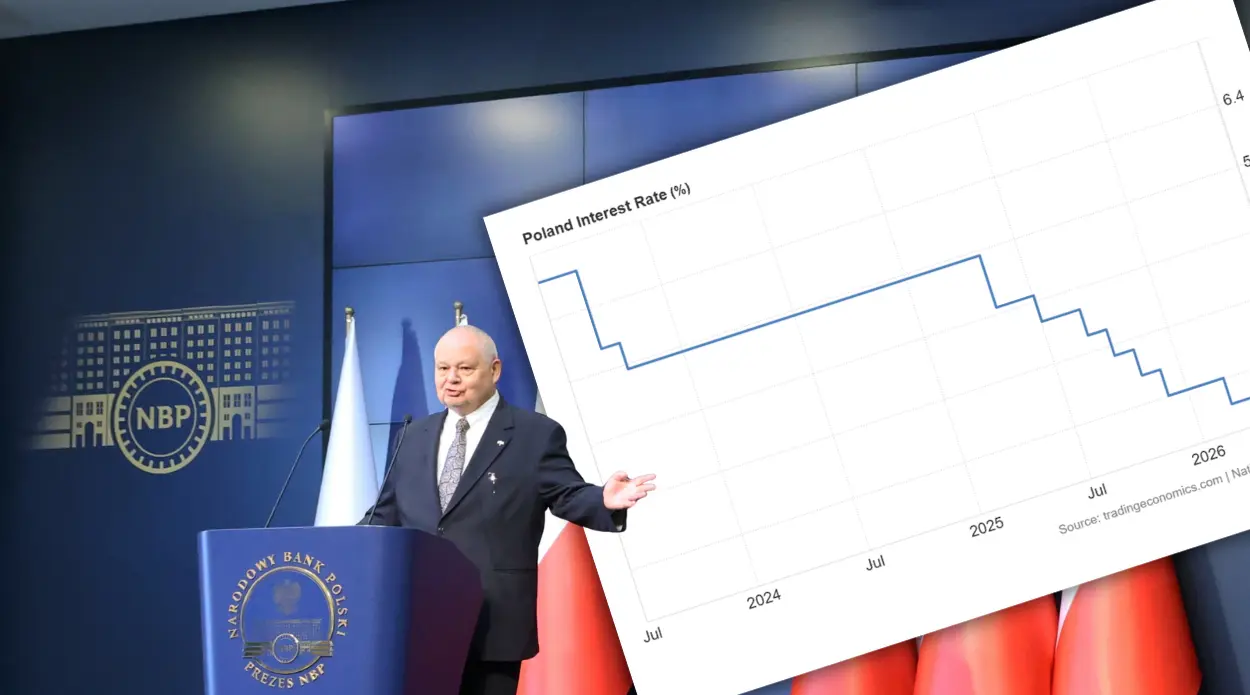
The RPP decision to keep interest rates at 3.75% did not trigger a lasting reaction, and an additional factor supporting the rise in yields on primary markets was the hawkish tone of the FOMC Minutes. After the dovish conference of A. Glapiński on Thursday, who allowed the possibility of rate cuts after the holidays – EURPLN rose to around 4.33, while domestic bond yields and IRS rates fell noticeably, especially on the short end of the curve. On Friday the market picture did not change significantly: the zloty remained weak, Brent oil stabilized near 76 USD per barrel, and the domestic debt market did not see a clear reversal of the earlier yield decline.
This week the main factor shaping financial markets will be the Tuesday CPI inflation data in the US and the semi‑annual appearances of K. Warsh before Congress. China’s data will also be important, as we believe they will confirm a slowdown in economic growth and weak domestic demand, while the final CPI inflation reading in Poland should be neutral for the market.
Searching for reserves of growth efficiency in Poland
In the last few decades, the Polish economy still made up for the productivity gap with developed countries, although the mechanism of catching up has become more complex than in the early decades of transformation. Back then the basic mechanism was relatively simple: industrial modernization, inflow of direct foreign investment, integration with European supply chains and relatively low labour costs enabled rapid growth in output per worker. Today this mechanism still works, but other factors are increasingly important: scale of operations, process organisation, digitisation, logistics, quality of human capital and the ability of firms to use data and new technologies, including artificial intelligence. In the following analysis we look at changes in productivity in specific sectors of the Polish economy to assess which of them have most supported the catch‑up process with developed countries and where the reserves of further growth lie, including those related to the spread of AI.
The starting point of our analysis is the quarterly, seasonally adjusted labour productivity indices (i.e. the ratio of added value to employment by BAEL) in selected PKD sections from Q1 2008 to Q1 2026. We begin the analysis in 2008 because earlier years lack comparable and methodologically consistent BAEL employment data. However, caution is needed when interpreting this data. The productivity indicator analysed depends on the method and precision of measuring real added value. This is especially important in public services, education and health, where measuring real production volume is particularly difficult. In the real estate market, productivity is strongly linked to the housing market cycle, rising housing prices and relatively low employment.
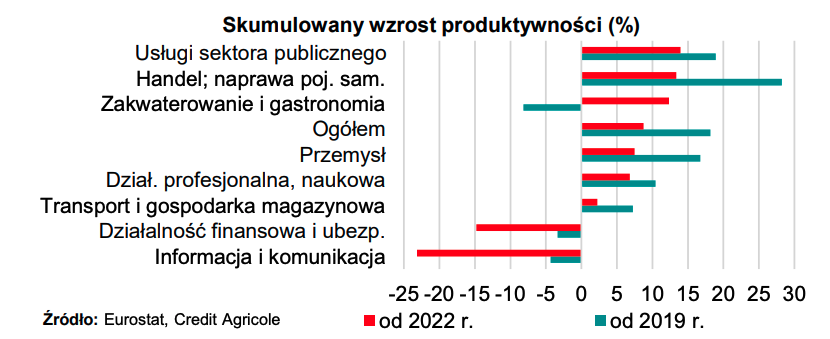
From the 2008 average to Q1 2026, productivity in the entire economy increased by about 64%. A similar result was noted in trade, where productivity also rose by about 64%. Even stronger growth was seen in industry, where productivity increased by about 68%. Relatively good results were also achieved by professional and administrative services and transport, where productivity increased by about 46% and 43% respectively. Public services, education and health, finance, accommodation and gastronomy, and information and communication performed noticeably weaker.
This structure of productivity growth indicates that in the analysed period the traditional convergence model of the Polish economy was not exhausted, although its sources gradually changed. Industry remained one of the main engines of efficiency improvement, with the simple cost advantage becoming less important and automation, process digitisation, energy efficiency, production quality and moving firms towards higher value‑chain stages becoming more important. Thus, productivity growth in industry supported the catch‑up process with developed countries, relying more on technological and organisational modernisation than before.
Digitisation boosted the economy’s productivity by 18%
The picture for the post‑pandemic period is more varied than for the long period. From the 2019 average, i.e. the last full year before the pandemic, to Q1 2026, productivity in the entire economy increased by about 18%. The strongest growth was noted in trade, where productivity rose by about 28%, confirming the importance of scale, digitisation, e‑commerce and organisational changes in this sector. Public administration, education, health protection and social assistance, and industry also achieved relatively good results, with productivity increasing by about 19% and 17% respectively, although the first group should be interpreted with great caution due to difficulties in measuring real added value in non‑market sectors.
Transport and warehousing, as well as professional, scientific and technical activities and administrative and support services performed weaker, with productivity growth noticeably lower than the overall economy. Accommodation and gastronomy remained below 2019 levels, indicating that despite the recovery after the pandemic slump the sector has not yet recovered its productivity losses.
Costs and weak demand from Europe are hampering transport
In transport and warehousing, long‑term productivity growth was solid, consistent with Poland’s growing role in European logistics, the development of warehouses and international transport. After 2022, productivity in this sector remained essentially stable. Rising fuel, energy and labour costs and labour shortages increased pressure to improve efficiency, but its growth was limited by weaker demand from European industry and high financing costs, which hindered investment in modernisation and automation. Accommodation and gastronomy remain examples of highly labour‑intensive and local activities. The recent rebound in productivity was mainly post‑pandemic.
Special caution is required when interpreting financial and insurance activities and information and communication. 2022, which serves as a reference point for assessing recent changes, fell during a period of high interest rates and very good banking sector results. Because added value in this industry largely reflects gross profit, its later decline should be seen primarily as a high‑base effect rather than evidence of deteriorating operational efficiency of financial institutions.
Information and communication remains a sector with high potential, where scaling activity without proportional employment growth is possible, and is strongly linked to digitisation and AI. However, data do not yet show a clear positive impact of these technologies on productivity. It is more likely that after the post‑pandemic digital boom demand normalised, while the continued rapid employment growth and difficulties in measuring the quality of digital services lowered measured productivity.
Why services in Poland rise faster than goods?
Relatively rapid productivity growth in industry, trade and parts of services subject to international competition, with clearly weaker results in local and labour‑intensive services, is consistent with the operation of the Balassa‑Samuelson mechanism in Poland, although its interpretation requires caution. In the classic view the economy is divided into the sector of goods subject to international exchange and the sector of goods not subject to such exchange, mainly local services. In a catching‑up country, productivity usually rises faster in the first sector because it is more exposed to foreign competition, technology transfer, investment and integration with international value chains.
For goods subject to international exchange, largely priced on global markets, productivity growth allows wage growth without reducing competitiveness. Because the labour market is shared across the economy, wage pressure also transfers to local services, where productivity growth is usually slower. Consequently, higher wages in these sectors translate more into price increases than real output growth. The result is a relative rise in local service prices compared to internationally traded goods, and thus a real appreciation of the exchange rate in the catching‑up country. Data show that the intuition behind the Balassa‑Samuelson effect remains valid, although the classic division into industry and services is now too simplistic.
The sectors subject to international exchange and foreign competition still include industry, but increasingly also parts of trade, logistics, professional services, information and communication and finance. These are the industries where production can grow without proportionally increasing employment. On the other side are local and labour‑intensive services such as gastronomy, hospitality, part of personal services, education, health and public services.
From the perspective of further catching up with developed countries, it is crucial not only to ask which sectors grew fastest in the past, but also where the largest productivity reserves remain. In industry some simple reserves have already been used, but there is still potential related to automation, robotics, energy efficiency, digital production management and moving up the value chain. In trade, transport and warehousing further catching up may come from digitising smaller firms, automating back‑office, data analytics and consolidation. In professional, scientific and technical activities and in administrative and support services the potential is especially large due to the possibility of scaling activity without proportionally increasing employment, exporting parts of services and the susceptibility of many tasks to support by digital tools and AI.
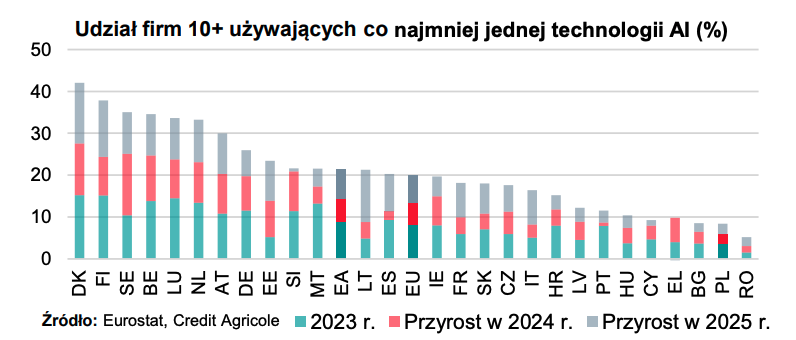
Only 8.4% of Polish firms use AI. Eurostat exposes Poland’s technological gap
Further productivity growth will likely occur not only by shifting resources between sectors, but also within individual industries. Poland still has significant reserves in small and medium firms, which are often less productive, use digital technologies less effectively and have fewer opportunities to invest in data, automation and intangible capital than large enterprises.
This means that the potential for productivity growth in industry, trade, business services or transport will largely depend on the spread of solutions already used by more advanced firms. In this sense future convergence may become increasingly micro‑economic: it will be less about moving workers and capital to more productive sectors and more about raising the efficiency of weaker firms within the same sectors. Artificial intelligence could play a special role, although its potential remains largely untapped in Poland.
According to Eurostat data, in 2025 only 8.4% of Polish enterprises used at least one AI technology, one of the worst results in the EU (see chart). A similar gap is visible in industrial robotics. In 2022, 10.8% of Polish industrial firms used robots, compared to 16.3% in the EU and 17.3% in the eurozone. Poland ranked sixth from the bottom in the EU in this regard. The low level of AI and robot utilisation indicates significant modernisation reserves. Bringing Polish firms closer to the technological level of more advanced European economies could therefore provide a significant boost to productivity growth in the medium term.
The importance of modernising enterprises, spreading automation, robotics and AI and reducing productivity gaps between firms will grow as the demographic situation worsens. According to our long‑term forecasts, the pace of Polish GDP growth will fall to about 2.7% p.a. With a gradually shrinking labour supply, achieving such a result will require a productivity increase of about 3% p.a. This means that in the coming years the main source of economic growth will no longer be employment growth but improving the efficiency of labour and capital utilisation.
Whether Poland maintains a relatively fast growth rate and continues to reduce the income gap with developed countries will depend on the pace of enterprise modernisation, the spread of new technologies and the reduction of productivity differences between firms.