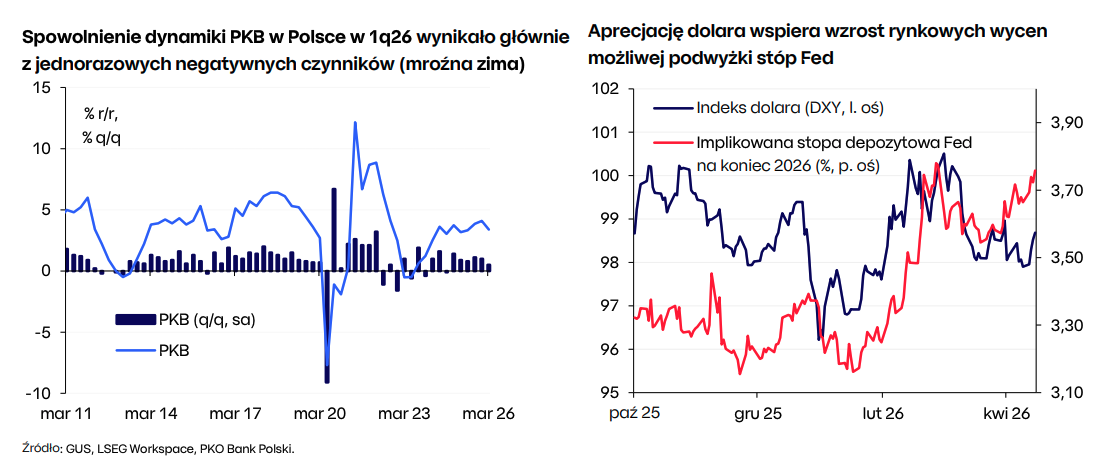
This, in turn, slightly lowered inflation expectations, which in FI markets translated into a decline in Treasury yields, and globally — an improvement in risk appetite. Stock indices rose, but in the U.S. portion of the market, the złoty and other EM currencies began to feel the global dollar appreciation, supported by the recent rise in market expectations of a Fed rate hike.
Today from the morning weaker sentiment
On Friday morning, market sentiment is weaker, mainly due to the rise in U.S. Treasury yields.
In the domestic FI market we expect yield stabilization near current, elevated levels.
Euro rate - forecast for the next hours
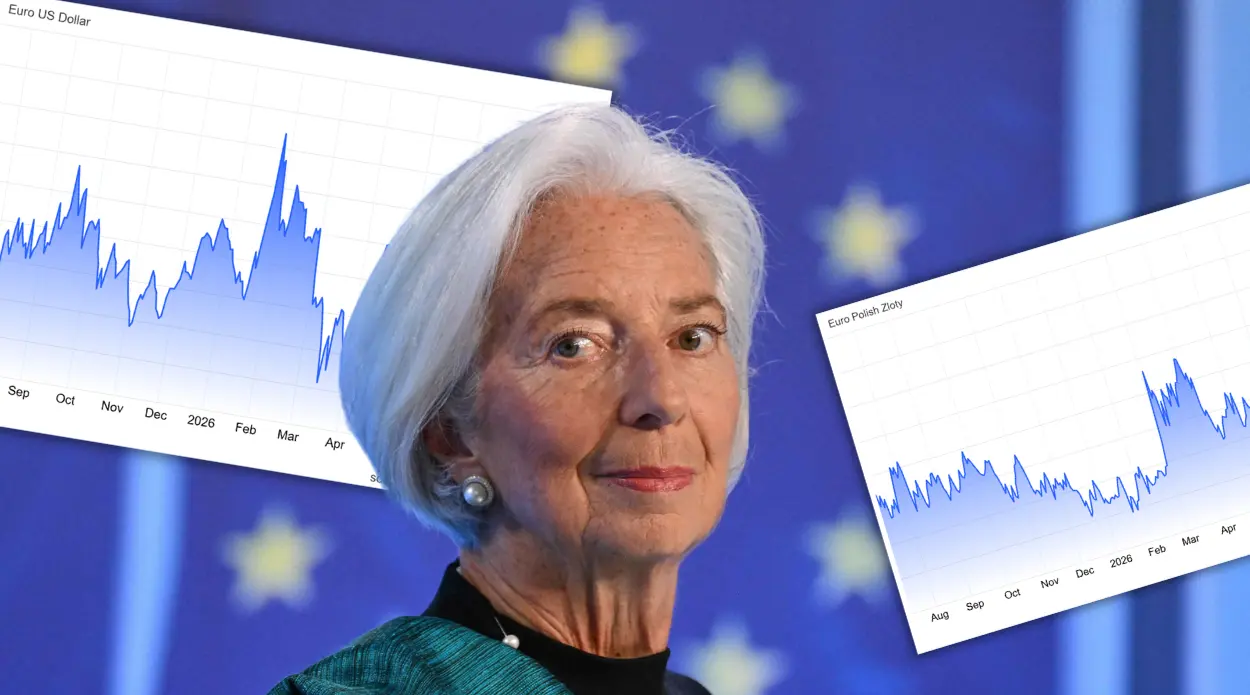
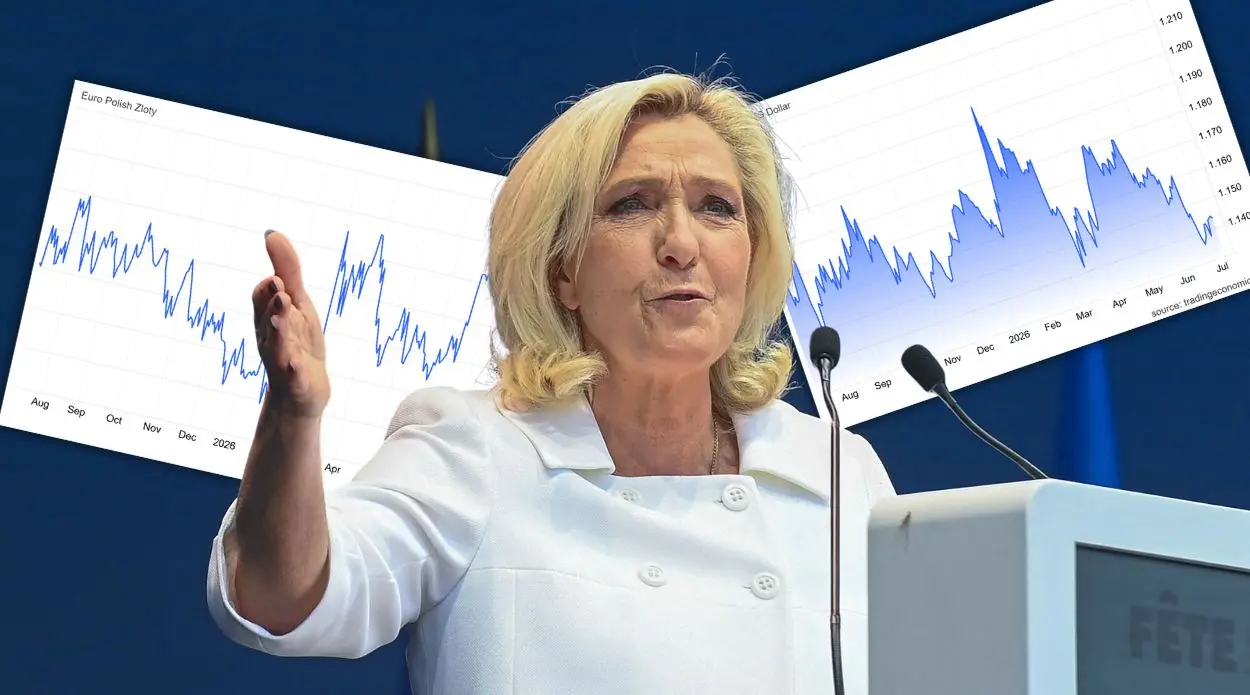
For the złoty we assume the EURPLN rate will stay in the 4.23–4.26 range, while there is a risk of USDPLN moving toward the 3.66–3.68 zone.
Friday is unlikely to bring breakthrough macro data from the world. In the U.S. we will see April industrial production – expected to rise 0.3% m/m after a 0.5% m/m decline in March. In the CEE region, the National Bank of Romania will keep the interest rate unchanged (6.50%), but comments on the recent RON weakening could be interesting.
In Poland, two releases will be key – inflation and the balance of payments. Revised and detailed April inflation data (initially 3.2% y/y vs 3.0% y/y in March) will allow us to assess how the oil shock spreads to core categories.
After preliminary data we estimate core inflation rose to about 2.9% y/y from 2.7% y/y. The March balance of payments may indicate a deepening current account deficit. Both export and import dynamics should be high (8.9% y/y and 8.3% y/y).
Another day of the US-China meeting without breakthrough
The second day of the US and China leaders' meeting did not bring breakthrough information. Presidents D. Trump and Xi Jinping agreed that the Strait of Hormuz must remain open for free transport of commodities. The meeting also discussed, among other things, deepening progress in fighting the diversion of fentanyl to the U.S. and increasing Chinese purchases of U.S. agricultural commodities.
Xi Jinping pointed out that US-China relations are the most important bilateral relations in the world and repeated that for China and US-China relations the issue of Taiwan remains crucial, which could be a source of conflict. D. Trump invited Xi Jinping to Washington on September 24.
Retail sales growth in the US
Nominal retail sales in April rose as expected, 0.5% m/m after a 1.6% m/m increase in March. Sales excluding cars and fuels increased 0.5% m/m versus 0.7% m/m in March. Fuel station sales rose 2.8% m/m versus 20.9% m/m in March, mainly due to higher fuel prices.
In the sales mix electronics and household appliances, as well as “sports, hobby, books” stood out positively with a 1.4% m/m increase. At the same time, car sales fell slightly (-0.4% m/m) and furniture (-2% m/m), which may be the first signal that consumers are limiting “major expenditures”.

On an annual basis, overall sales and sales excluding vehicles and fuels grew 4.9% y/y, accelerating compared to previous months. Despite some negative signals, the data indicate relative resilience of U.S. consumption, despite the oil shock raising fuel prices and record weak consumer sentiment (according to the University of Michigan).
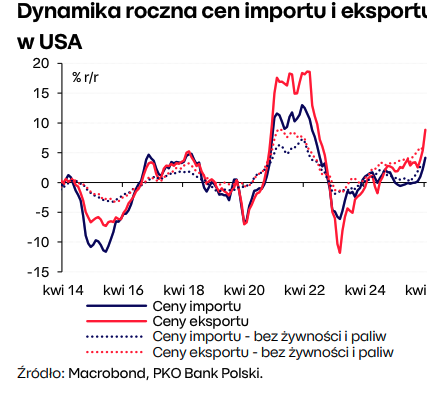
Annual dynamics of import and export prices in the US
Import prices in April rose 1.9% m/m and 4.2% y/y – stronger than expected and the strongest since 2022. Import prices excluding food and fuels rose less – 0.7% m/m and 3.3% m/m. It is worth remembering that import prices do not include tariffs – hence last year the data did not show a jump due to Trump’s tariff policy.
Even more than imports, export prices rose (as in earlier months) – overall 3.3% m/m and 8.8% y/y, partly due to the U.S. status as a net exporter of energy commodities benefiting from higher commodity prices.
J. Williams (New York Fed, voting member of the FOMC) said he sees no reason now to raise or lower rates, and monetary policy is in a good place. He added that maintaining stable inflation expectations is important, and while short‑term inflation expectations are not surprising, long‑term expectations remain stable, which is positive.
The number of unemployment benefit claims rose slightly to 211k from 199k the previous week. The data do not indicate changes to existing labor market trends.