Data: CPI, industrial production data
Today we will see the full CPI inflation data for April, as well as the March balance of payments. We expect it to show a deepening of the current account deficit to about 1.8 billion euros from about 1 billion euros in February.
The worsening of the current account is mainly attributed to a deepening of the trade deficit, with import growth of 10.2% YoY and export growth of 9.2% YoY. In addition, the US will release industrial production data for April.
GDP growth in Poland
Poland’s GDP grew 3.4% YoY in Q1, compared with 4.1% YoY in Q4 2025. The preliminary reading turned out to be a negative surprise: market consensus was 3.7%, and our forecast was 3.8%. In the quarter‑on‑quarter view, after seasonal adjustment, GDP rose 0.5%, while last year it recorded quarterly growth of 0.8‑1.1%. The weak Q1 GDP reading makes a rapid shift to a tightening monetary policy stance by the RPP in July seem unlikely.
Third driest April since 1951
April 2026 was the third driest April since 1951, according to the Institute of Meteorology and Water Management. It was added that in the vast majority of synoptic stations, total rainfall in April did not exceed 30% of the long‑term norm.
Any continuation of adverse weather conditions would add pressure on domestic food prices (in addition to the global rise in food prices reflected in the FAO index, higher fuel and fertilizer costs), thereby creating inflation forecast risk. This would reverse the 2025 situation, when unexpectedly high domestic supply of fruits and vegetables contributed to a faster-than‑expected fall in inflation in the second half of the year.
Trump does not need to unblock the Strait of Hormuz
Brent crude rose overnight above $107 per barrel, although it stayed near $105 during the entire Thursday European session. In reports of the Trump‑Xi talks, markets heard the US president say that his country does not need to unblock the Strait of Hormuz.
The market stance also reflected a series of US releases on April price movements: CPI, PPI, and foreign trade price data, showing higher-than-expected increases. As a result, market sentiment is negative today, and EURUSD fell to its lowest since April 8 (the start of the ceasefire in the Middle East).
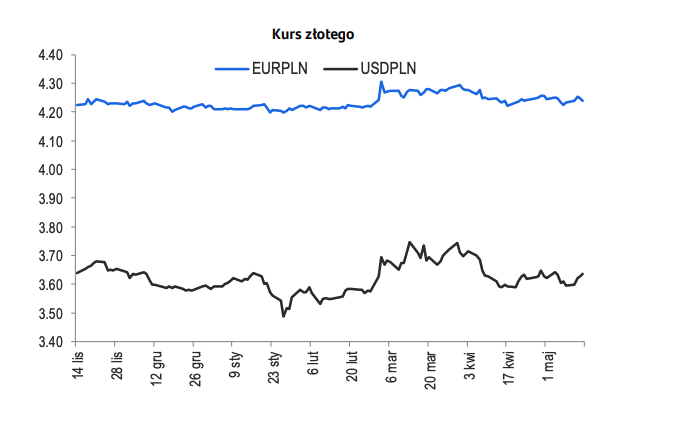
Despite weaker-than-expected GDP data, the zloty slightly strengthened against the euro yesterday –the EURPLN rate fell about 0.2%, below 4.24.
Due to the worsening sentiment after the European session, EURPLN is back near 4.25 this morning.

The recent weakening of domestic bonds was slightly corrected on Thursday, with yields falling 4‑6 bp and the curve flattening by about 2 bp. IRS and FRA rates also fell, by 4‑5 bp and 2‑8 bp respectively.
We see a risk that rising US yields, for 2‑ and 10‑year securities at their highest in over a year, will work against Polish bonds.