PL-INTEREST RATES: As expected, the Monetary Policy Council did not change interest rates. The reference rate therefore remains 3.75%. The post‑meeting statement was not significantly altered, except for adjustments to data that emerged in the last month. The MPC maintains that future decisions will depend on incoming information about inflation prospects and factors such as fiscal policy, fuel price regulations, the level of economic activity in the Polish economy, and wage dynamics. In our view, the MPC will not change interest rates this year.
DE-DATA: The Federal Statistical Office reported that German industrial orders rose 5% month‑over‑month in March, far above the consensus of 1% month‑over‑month. The data should be judged as good – no single sector, sales direction, or large orders drove it. The March German industrial results likely reflect a lot of inventory production due to fears of component and raw material shortages following the Gulf War. It is also worth noting that we saw a similar surprise in earlier published Polish industrial data.
EU-DATA: Final S&P Global data confirmed a significant deterioration in business service sentiment in the euro zone. The services PMI fell from 50.2 points in March to 47.6 points in April. It was initially estimated to have fallen to 47.4 points. Yesterday, PPI inflation data for March were also released – producer prices rose 3.4% month‑over‑month and 2.1% year‑over‑year. The price increase was mainly due to an energy price spike (+11.1% month‑over‑month). Intermediate goods and durable consumer goods also rose (0.7 and 0.3% month‑over‑month).
US-DATA: According to ADP, the U.S. labor market continued to perform well in April – the private sector was expected to add 109 k new jobs, versus +61 k a month earlier. However, ADP data were not very useful for forecasting official U.S. employment statistics.
How will the oil shock affect inflation in Poland?
For the past two months we treated tensions around the Persian Gulf as a serious but temporary supply shock with limited implications for inflation forecasts. Today it is increasingly difficult to maintain that narrative.
The conflict is extending, the prospects for a settlement remain fragile, crude flows through the Strait of Hormuz remain restricted, and oil prices have clearly stabilized well above pre‑escalation levels.
In practice this means one thing: the “fuel crisis” scenario is no longer a short‑term risk but becomes a baseline scenario. If fuel shortages persist longer, the negative economic consequences will gradually build up, leaving the world with noticeably higher inflation and lower economic growth.
Since the end of February, the market price of Brent crude rose quickly from about 68 USD to an average of 100 USD per barrel, staying – with very high volatility – near that level for a second month.
This is a 45–50% move, admittedly about twice smaller than the biggest crises in modern history, but still clearly stands out from the crowd. Such oil price changes have practically always translated into a clear inflationary impulse. The question is therefore not “whether” but “how strong” and “how spread out over time” the current effect will be.
US CPI Inflation vs. Market Oil Price Growth (% year‑over‑year)

Source: Macrobond, Pekao Analyses
First fuel‑sensitive categories, then the rest
How does the transmission mechanism of such an oil shock to inflation work?
- strongest impact 1–2 months after the shock: fuels
The fastest and strongest reactions come from categories directly linked to oil prices – first, unsurprisingly, fuel station prices. The effect is almost immediate and very strong.
We saw this already in March inflation data, when GUS reported a fuel price increase of over 15% compared to the previous month. With fuels accounting for 5.5% of the inflation basket, this translated into a direct contribution to inflation of 0.8 percentage points.
Yes, the CPN program partially reduced pressure on retail fuel prices, but – first – due to calendar effects it was not fully reflected in GUS data (as we noted after March and April inflation data), and – second – the relief visible to consumers does not mean similar savings for businesses.
Fuel expenses counted as cost of revenue and the possibility of partial VAT deduction mean that companies benefit from the cut only to a limited extent.
- 2–4 months: transport and energy
Next are sectors also heavily dependent on fuel costs, such as transport services or organized tourism. Fuel is a significant part of operating costs, margins are relatively low, and competition limits the ability to absorb the shock long‑term.
The next stage involves household energy carriers (electricity, gas, heat). Here the transmission mechanism is more complex because prices remain regulated, and there are smoothing mechanisms (e.g., long‑term contracts).
The Gulf conflict also affected gas prices, for which a new household tariff will take effect from July – we are waiting for the URE decision. In the meantime, price increases for gas cylinders or fuel (including coal) are already visible.
- 4–7 months: food and consumer goods
Only in the next stage does the shock begin to permeate food and other consumer goods prices. The impact is clearly smaller but more spread out over time. Companies gradually shift higher energy, logistics, transport, and more expensive derived raw material costs onto consumers – the so‑called second‑round effects. At the same time, some firms try to amortize cost increases by lowering margins, which limits the scale of immediate price transmission.
In the case of food, the main channel of potential impact remains fertilizer prices, which – due to strong dependence on gas and oil prices – can raise agricultural production costs with a delay.
Most services react the slowest and weakest. In their case, the oil shock impact remains limited because labor costs are a far more significant part of expenses. The exception in this group is the hospitality and tourism sector, where higher food and transport prices relatively quickly translate into final prices. Still, even in these categories, the scale of reaction remains clearly lower than for goods.
According to our analysis, the peak impact of the current fuel shock on inflation will appear about 5–6 months after its onset. Assuming March as the start of the current shock and assuming its current structure and scale remain (oil price about $100/barrel, natural gas 50 EUR/MWh), the greatest impact on consumer inflation is expected at the turn of Q3 and Q4.
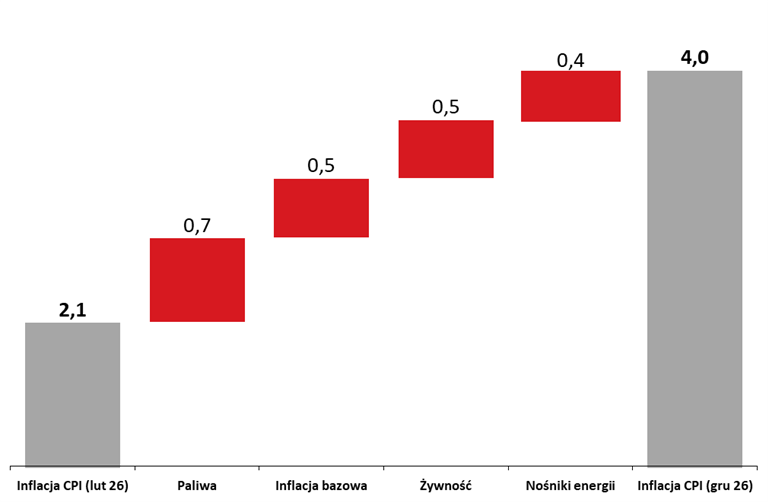
By the end of 2026 the current fuel crisis could raise inflation by about 2 percentage points. Importantly, core inflation will react mainly through the goods channel, not services – which, with the current weakening of labor market conditions, further limits the risk of entrenched high inflation.
Estimated contribution of inflation categories to inflation growth in response to the current fuel crisis (percentage points)

Source: GUS, Pekao Analyses
The CPI impact decomposition shows that by the end of 2026 about 60% of the total effect (about 1.2 percentage points) will come from the direct channel of higher fuel, transport, and energy carrier prices.
Remaining 40% (about 0.8 percentage points) are second‑round effects, which we will see in higher food prices, other consumer goods, and to a lesser extent in services.
Estimated contribution to inflation growth in response to the current fuel crisis – direct effect vs. second‑round effects (percentage points)

Source: GUS, Pekao Analyses
Implications for forecasts and monetary policy
In light of the above results we see a need to revise our inflation path upward. The fuel shock will gradually raise CPI inflation over the coming quarters, culminating at the turn of Q3 and Q4. We assume that by the end of 2026 inflation will approach 4% year‑over‑year, reaching a local peak.
Of course, this scenario assumes the current fuel crisis remains roughly as observed today. A 4% inflation level seems today to be the threshold separating two scenarios: below it forecasts assume a rapid conflict resolution and no significant second‑round effects.
From a monetary policy perspective this means the classic dilemma: whether to react to a clear inflation rise or treat it as largely a temporary cost impulse. At the same time the character of the current shock remains relatively “narrow” – focused on energy‑intensive sectors and only partially permeating broad inflation.
Key to the further development will be whether high oil prices persist long enough for the inflationary impulse to become entrenched, raise consumer inflation expectations, and spread to other economy segments. In such an environment the MPC will remain cautious in a “wait‑and‑see” mode, keeping rates unchanged throughout 2026.
Projected contribution of inflation categories to inflation growth by the end of 2026 (% year‑over‑year, percentage points)
Source: GUS, Pekao Analyses
Yesterday financial markets again believed in a quick opening of the Strait of Hormuz. Optimistic assumptions were buoyed by Axios reports that both Americans and Iran are close to signing a one‑sided memorandum, under which the strait will reopen.
These news temporarily pushed Brent crude below 100 USD per barrel, EUR/USD approached 1.18, and yields on major market bonds fell noticeably, about 8 basis points across the yield curve. Stock indices, as expected, recorded strong gains (1.5% for the S&P 500).
This is not the first optimism eruption in recent weeks, and history has always ended the same way – positive information had no lasting effect and optimism evaporated. It will likely be the same in the coming days.
Relations between Iran and the U.S. have already deteriorated: Americans fired at an Iranian ship while Iranian authorities said the memorandum Axios mentioned was an attempt to force capitulation.
In such a situation we cannot split market optimism. We believe crude prices will rise in the coming days, as will Treasury yields. We also expect a renewed strengthening of the dollar.
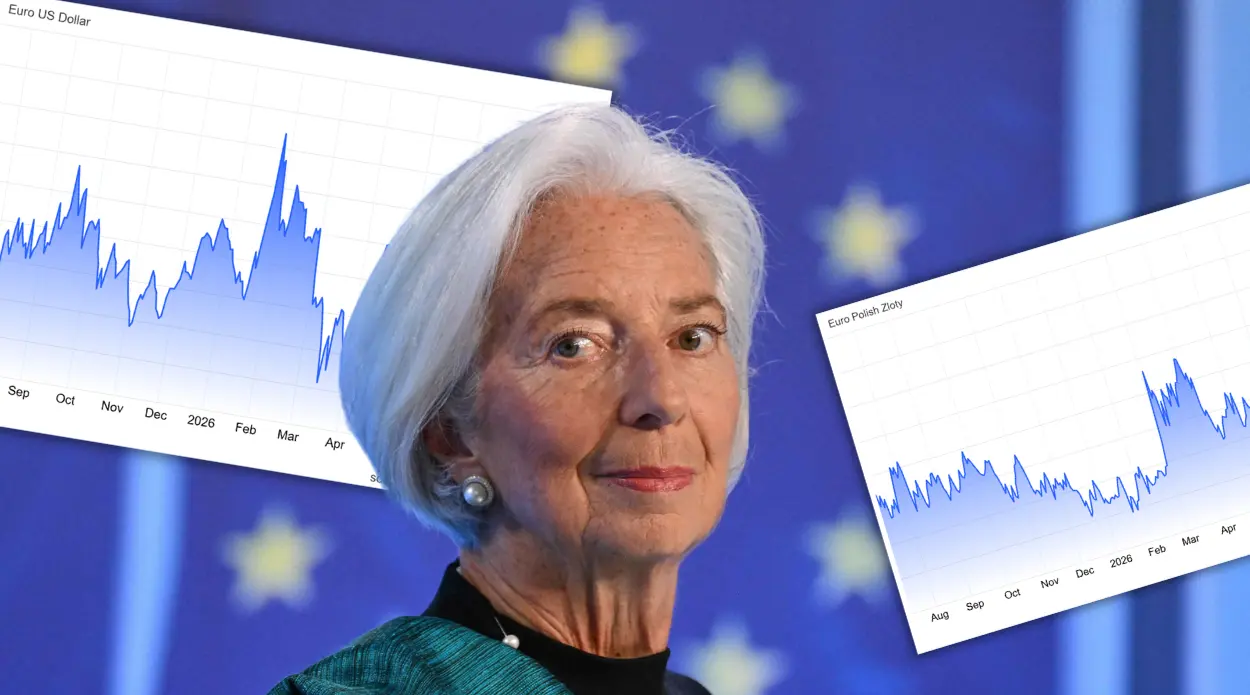
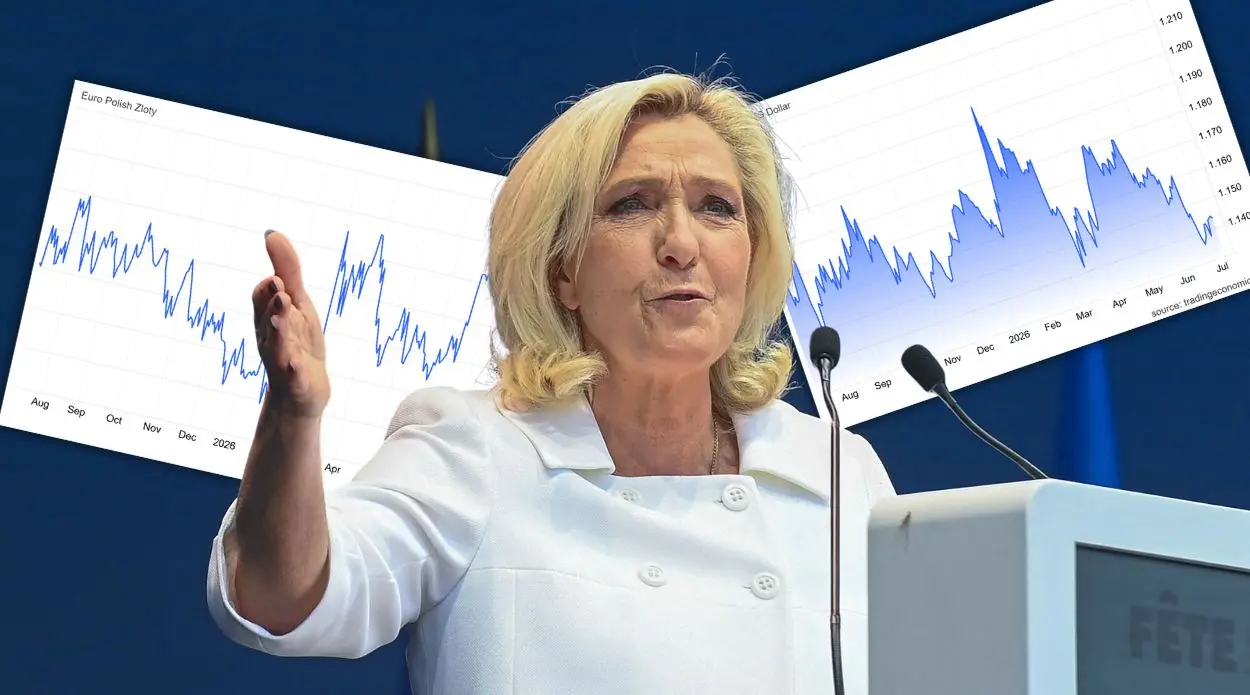
EUR/PLN fell to 4.23 and USD/PLN to 3.60
Positive sentiment in global markets translated into a good investor mood in Poland.
The zloty clearly strengthened and POLGB yields fell – almost as much as similar securities on major markets.
EUR/PLN fell from 4.245 to just over 4.23 and USD/PLN from 3.63 to 3.60.
The MPC meeting proceeded as expected and was ignored by the domestic market.
We do not expect market optimism to persist.
We believe the zloty will again weaken in the coming days and bond yields will rise.
Not enough, however, to break out of the current volatility bands.