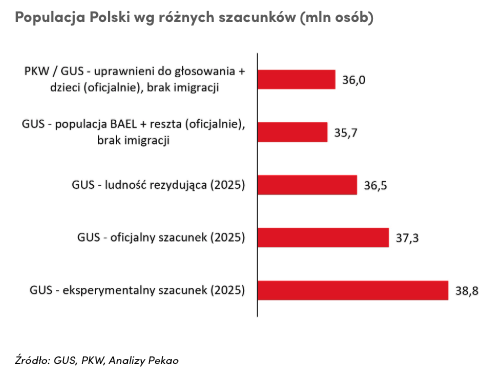
Asked about this, a passerby will probably answer “38 million”, because that number was learned in school, read in an encyclopedia, or seen in one of the thousands of articles. However, it is most likely wrong. The answer to the question posed in the title is, however, harder than it seems, and the GUS routinely provides two different, inconsistent numbers. Yesterday it presented a third one, which inspired us to briefly discuss it. Here they are (as of the end of 2025):
- Population by national definition – 37.3 million. According to this methodology, Poles were 38 million for years, but demographic processes (natural increase has been negative for years) and universal censuses ultimately raised this anchor. This is also the “capita” in GDP per capita reported by Eurostat.
- Population residing or residing – 36.5 million. This methodology is often used by international organisations, recommended by the European Parliament, etc.
- Population present in Poland based on so‑called life‑track – 38.8 million at the end of 2025. This is a new element of the compilation.
You can also try to combine these estimates, consider other sources, etc., but at least it does not reduce the confusion.
What causes the confusion and discrepancies?
The national definition is based on the concept of registration – a person living in Poland must be registered for permanent residence and can temporarily stay abroad (temporarily = any length). This means that this definition includes practically all modern emigration and excludes a large part of immigration. Conversely, being counted among the residing population generally requires staying in Poland continuously for at least 12 months. This definition is more realistic regarding Poles staying in Poland, but it also fails with immigration, because determining the duration of stay or the intention regarding stay is difficult.
Public Polish statistics are, after all, not very precise when it comes to immigration. In practice there are many incomplete and incomplete data sources on immigrants, as well as many estimates of the migrant stock (including GUS, NBP and private firms), but the nature of immigration means that most immigrants pass through the sieve of the second definition.
The inability to determine Poland’s population has serious consequences (and some of them explain why it is so difficult to reform public statistics):
- It disturbs statistics that convert economic sizes per capita (e.g., GDP per capita) and those based on population (voting power in the EU).
- It disturbs their changes, especially in the short term, which affects, for example, the assessment of convergence speed.
- It disturbs the geographic distribution of the population, affecting, for example, transfers between regions, the size of electoral districts, the assessment of the need for public services, spatial planning, etc.
GUS has been criticized for the national definition for years by experts, and the new experimental population estimate is an attempt to meet this criticism.
What was done? GUS subtracted emigrants and added immigrants, concluding that at the end of last year 38.8 million people were in Poland, 1.5 million more than the official population estimate.
Of these almost 39 million foreigners, 2.3 million people, 6% of the population (more in urban agglomerations). Their geographic distribution is shown in the map below, and we note that the increase in the number of foreigners in 2025 (215 thousand) is, according to GUS, more than twice the number of foreigners insured in ZUS.

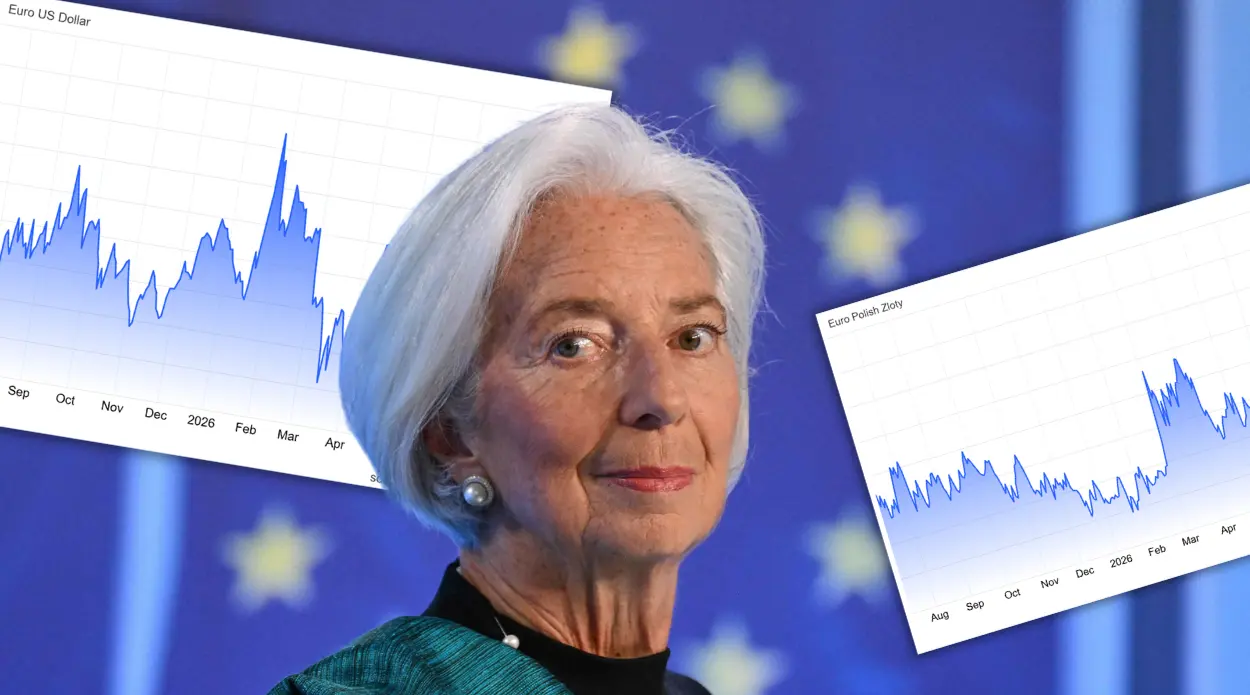
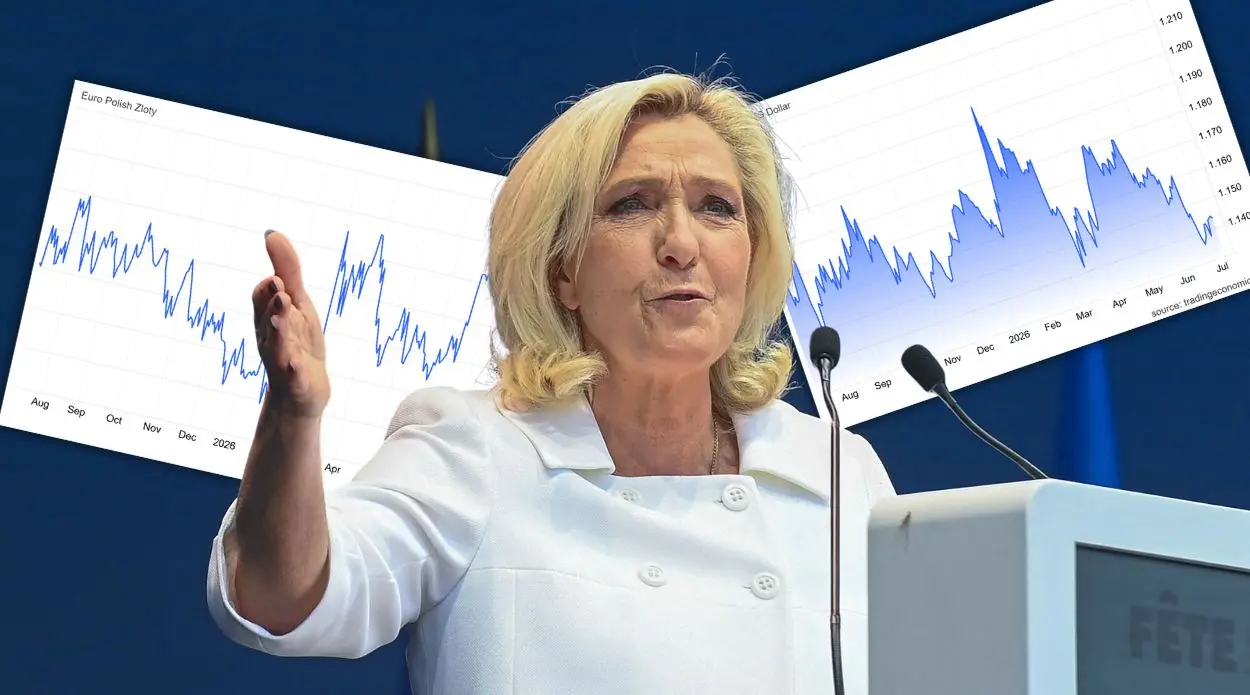
Euro‑dollar in the corridor, and the zloty stable at 4.29
Volatility in the euro‑dollar was yesterday similar to previous days; EURUSD basically stayed in the 1.1375‑1.1425 corridor, which it has moved in since Friday. More interesting movements were observed in the FI market, where the U.S. yield curve flattened.
In particular, the yield on 2‑year bonds is today around yesterday’s opening, but yields on the long end rose by about 2 bp.
Stability on the short end of the curve is interpreted as a signal that the market does not expect surprises in light of the Challenger and ADP reports, and the market does not expect surprises in today’s Payrolls data.
The European FI market, however, listened carefully to the central banking forum in Sintra, whose tone had to be optimistic enough to halt the yield increases on Bunds that had been rising since the beginning of the week.
In the end it seems that the market is well prepared for upcoming data, and the information set is reflected in valuations – suggesting that today asset valuations will follow a sideways trend.
Tuesday’s surprise on national inflation pushed EURPLN higher – and yesterday’s surprise on European HICP inflation brought it back down. As a result, after the turbulence of recent days, we see the euro rate slightly above 4.29 today.
The lack of significant domestic economic news generated a fluke in the valuation of other assets. The yield on 10‑year POLGBs remains below 5.30, 2‑year IRS 8 bp below the WIBOR rate, and the WIG20 rose yesterday to 3,620 points, continuing its gains.