US lifts sanctions on Iranian oil, but Tehran denies the nuclear deal
At the same time, the decision unlocks banking transactions, insurance, and transport, eliminating the need for Tehran to operate through a network of intermediaries to trade commodities. In theory, crude oil could even be exported directly to the US. Treasury Secretary Scott Bessent said that in exchange for the 60‑day suspension, the Islamic Republic committed to keeping the Strait of Hormuz open and to allowing International Atomic Energy Agency (IAEA) inspectors back into the country. Earlier, during a brief conference in Switzerland, JD Vance also announced that Iran agreed to invite IAEA representatives again.
However, the spokesperson for Iran’s Ministry of Foreign Affairs, Esmaeil Baghaei, said – according to state broadcaster IRIB – that Tehran “has not made any new commitments to any party” regarding cooperation with the UN agency overseeing nuclear matters. The head of Iran’s MFA praised mediators for helping bring an end to fighting in Lebanon during US‑Iran peace talks (Sky News). The UN reported that Sunday was the first day since March 2 that UN peacekeeping forces recorded no air attacks in Lebanon.
We assess that despite contradictory signals, the memorandum provisions are slowly being fulfilled by the conflicting parties. This helped the oil price declines yesterday. Brent crude finished Monday’s session near $77.5 – just under 4% below Friday’s level.
That is only about 10% higher than the days preceding the start of the Iran‑US war. In contrast, the situation for fuel is still far from February‑end levels – diesel is about $118/b (≈20% higher than four months ago), and gasoline ($109/b) is about 30% higher than at the end of February.
Oil from Iran could flow to the US. Behind it a ceasefire in Lebanon and conflicting nuclear messages
Data published yesterday by the Central Statistical Office (GUS) for the enterprise sector (SP) shows that annual nominal wage growth jumped from 5.4% to 5.8%. That is close to our forecast (6.0%). After seasonally adjusting, monthly momentum was +0.5% m/m, near recent levels. Again, it is impossible to fully assess the structure across industries because GUS omitted data for recreation and culture (PKD: R) and other services (PKD: S).
However, the fastest wage growth remains in IT (PKD: J) and professional services (PKD: M), at 7.1% and 7.9% respectively. The weakest growth is in manufacturing sectors (agriculture, mining, processing), matching the largest job cuts in those industries.
Overall employment is falling for the sixth consecutive month, this time by 9,000 jobs, unchanged from last year at -0.9% y/y. The implied real wage fund rose from +1.2% y/y to +1.8% y/y, slightly ahead of consumer spending.

We believe annual nominal wage growth is slowly finding its minimum. We expect it to stay ahead of the five‑year mark by year‑end, supported by still‑unabated service‑price inflation momentum and solid economic conditions.
Polish consumer remains in good shape after holiday volatility
Annual retail sales growth corrected April’s spike from 8.7% to 1.3%. In May it was already 3.0% y/y. The previous month’s reading was affected by holiday swings, which we commented on here. In May, after seasonally adjusting, monthly momentum was slightly positive, ranging from +0.1% m/m to +0.4% m/m depending on the method.
Across categories we see fuels correcting their holiday surge, while apparel and footwear recovered April’s spike. These two categories accounted for most volatility in recent months. Other categories show a slight decline in food spending and consolidation of furniture purchases, while health and automotive spending rise again.

Thus, the publication supports a scenario of continued consumer revival in Poland in the next quarter.
Special construction work at record highs, building stagnation
Annual construction and assembly production growth in May was 3.9% y/y, comfortably close to our forecast (4.0% y/y). That is similar to last month’s 4.5% y/y. After seasonally adjusting, GUS momentum was +0.8% m/m, we estimate +1.9% m/m.
By both methods this is the third consecutive month of positive volume growth in constant prices across all three highlighted categories: building construction (+0.9% m/m), water and inland engineering (+0.6% m/m), and special construction work (+1.6% m/m).
In the last sector we see production at historic highs, while engineering and building construction report a cyclical trough from which they are slowly emerging.
Simultaneously, GUS provided data on residential construction. It shows that the number of started projects again lags behind the number of issued building permits. Annually, the former is 212.2 k, the latter 282.9 k.
The difference is almost the largest in history, excluding the 2022 episode. This indicates developer downtime and pushes expected industry activity into future quarters.

Overall we rate the publication positively. It indicates entrenched momentum in the sector, which, thanks to the slowly concluding KPO, should also be stimulated in the second half of the year.
Treasuries weaker, Bund stronger
Despite oil market declines, US debt remained under pressure throughout yesterday’s session. The market clearly assumes that after the hawkish FOMC turn, current price processes are advanced enough that lowering energy‑commodity valuations (with good conditions) is not a sufficient argument to reduce tightening risk.
Regarding the committee’s stance, yesterday’s speech by Ch. Walter (which did not reference current economic processes) added little. A. Goolsbee focuses on “too high” inflation.
The Fed Chair from Chicago assessed that the labor market is stable, but it is unclear whether price pressure will persist after the Middle East conflict ends or will ease. Ultimately, compared to Thursday’s close, the US curve moved up 5 bp to 4.24% (2Y), 4.51% (10Y) and 4.95% (30Y). The Bund ignored negative signals from across the Atlantic and instead sought support from falling energy‑commodity valuations. Yield changes on key German debt nodes were -4, -4 and -3 bp to 2.60% (2Y), 2.95% (10Y) and 3.51% (30Y).
We see potential to maintain positive sentiment on German securities during Tuesday’s trading. This should be aided by oil price declines. At some point this trend should also help lower UST yields, but the initiation of this move will occur today.
SPW returns to strengthening. Region less optimistic
Domestic bonds benefited yesterday from both Bund yield declines and lower oil valuations. However, the region’s debt did not shape as optimistically – Hungary and Czech 10‑year benchmarks ended the session flat. Ultimately, the national curve on key nodes moved down 2, 4 and 3 bp to 4.27% (2Y), 4.92% (5Y) and 5.41% (10Y).
We assume SPW yields will continue to fall. This should be aided by further reductions in energy‑commodity prices under a scenario of gradual fulfillment of the US‑Iran memorandum. Potentially we see a chance for the 10‑year tenor to drop to the 5.30‑5.35% range this week.
EURUSD lower
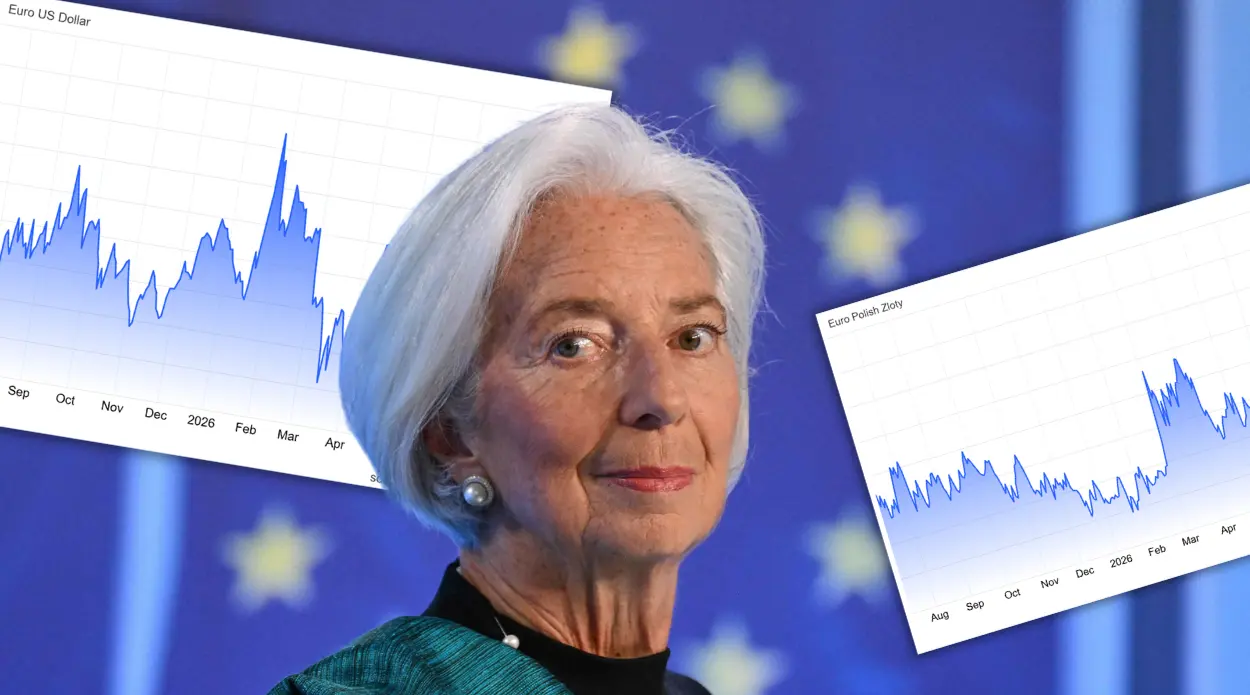
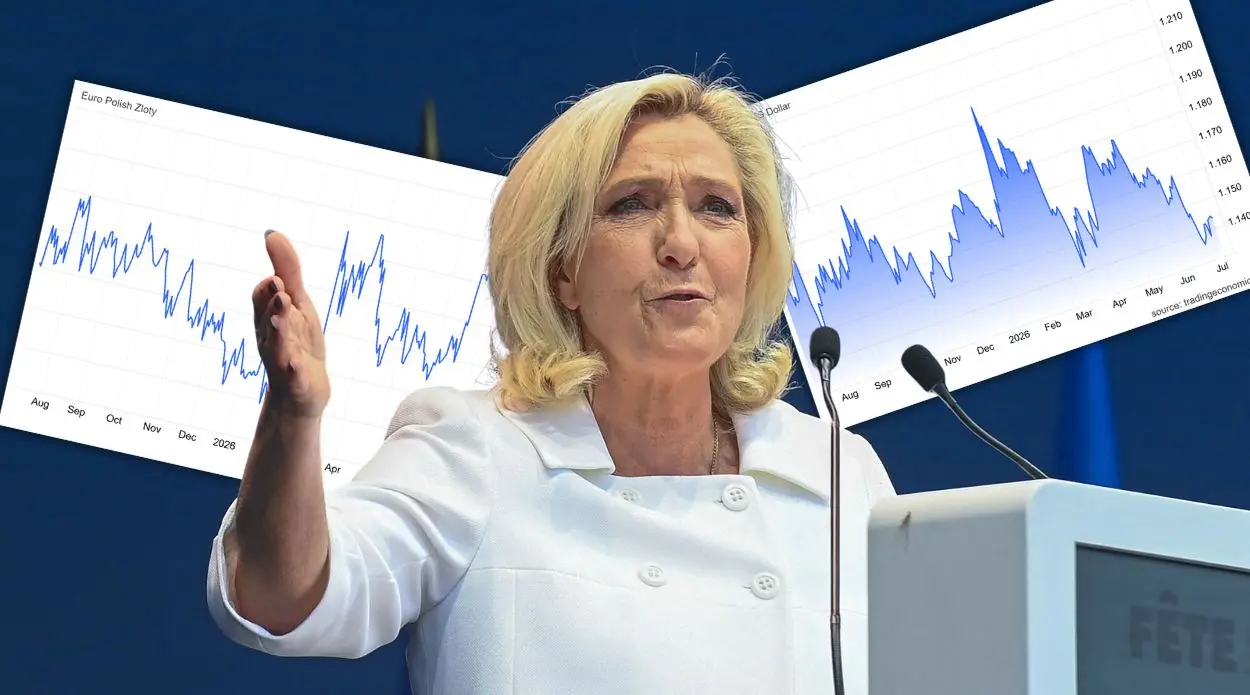
Monday’s trading ended with a weakening of the euro. EURUSD fell from around 1.1460 to 1.1430. The euro was under pressure not only against the dollar – it also fell against GBP (-0.5%), JPY (-0.25%) and CHF (-0.2%).
However, note that aside from Bund yield declines, euro pressure also came from the relative strength of the pound (reduced political uncertainty in the Isles) and the yen (speculation of intervention). This does not change the fact that EURUSD is approaching the lower volatility bound of the last year.
With adverse signals for the euro (weaker conditions, sudden risk aversion), current conditions suggest a higher probability of EURUSD falling below 1.1400.
Gold weakens
On Friday and Monday we noted that FX fundamentals and the PLN IRS situation increase risk factors for the zloty. Before noon they materialized. EURPLN moved toward 4.2700, and during the US session the pair even reached 4.2770. By the end of yesterday’s trading the zloty recovered some losses, but the euro loss remained significant (0.35%) and larger than for the pound (0.15%). Today’s open brings further pressure on the domestic currency, and EURPLN broke 4.2800.
In our view this stems both from narrowing spreads between expected interest rates in Poland and abroad, and from worsening global sentiment. This is also confirmed by the weakening pound, which remains one of the region’s most sentiment‑sensitive currencies. We maintain our Friday expectations and assume trading on EURPLN in the 4.26–4.29 range, with increased risk of testing today’s upper bound.