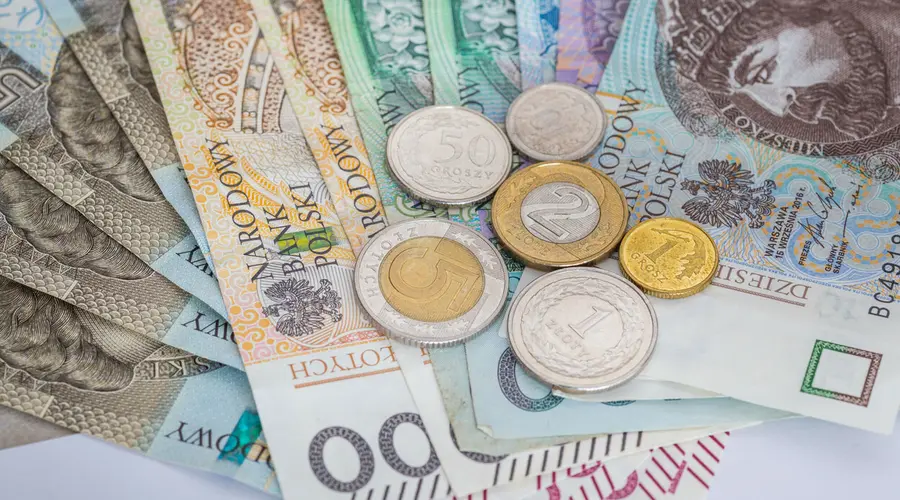
Both ministries present different positions on the minimum wage increase, driven by entirely different premises. The Ministry of Family, Labour and Social Policy, headed by Agnieszka Dziemianowicz‑Bąk, wants Poles to earn more and more. The proposal for a 3.7% increase is not accidental. It would raise the minimum wage from the current 4,806 PLN gross to 4,986 PLN. That would mean the minimum wage would represent 50% of the projected average salary, which in 2027 is expected to be 9,971 PLN. As the ministry emphasizes, 50% of the average salary is the minimum Poles should earn. In fact, this was achieved in 2026. The Ministry of Finance, led by Andrzej Domański, proposes only a 2.5% increase, the minimum. This decision is driven by the fact that with higher wages, the costs of running a business in Poland also rise, and this ministry often cites it as a key argument in wage negotiations.
Would a 3% increase satisfy both sides?
Alongside the rise in the minimum wage, there is also a battle for public sector wage increases, even though not all public employees earn the national minimum. A compromise might be reached where both ministries make concessions. According to “Fakt” on Monday, an increase that could be acceptable to Agnieszka Dziemianowicz‑Bąk and Andrzej Domański might be a 3% rise. Public sector wages would also rise by the same amount. Regarding the national minimum, “Fakt” calculates that a 3% increase from January 1, 2027 would raise wages by 144 PLN gross, bringing it to 4,950 PLN gross.
Nations must discuss the proposals for raising the lowest national wage and public sector wages on Tuesday (June 9, 2026). This will not end the entire battle. The final decision will be made only in September. Until then, the proposal must go through consultations, including with the Social Dialogue Council, which includes representatives of entrepreneurs and trade unions.
Politicians from the New Left are announcing a fight for wage increases higher than 3%, aiming to convince coalition partners that higher wages will benefit the economy and Poles.
Poland among the lowest earners in the European Union
Finance and Economy Minister Andrzej Domański still emphasizes that the Polish economy is 20th in the world and one of the fastest‑growing economies in the European Union. Unfortunately, the “green bars” in the tables that the finance minister often cites do not translate into reality for the lowest‑earning Poles. Minimum wages in Poland are roughly half of those earned by EU workers. They are almost half lower than in Luxembourg, Ireland, Germany, the Netherlands, and Belgium. The minimum wage that Poles receive is, however, considerably higher than that in Romania, Hungary, or Estonia.
Minimum wage in EU countries converted to euros (Eurostat data):
- Luxembourg (2,704 EUR)
- Ireland (2,391 EUR)
- Germany (2,343 EUR)
- Netherlands (2,295 EUR)
- Belgium (2,112 EUR)
- France (1,823 EUR)
- Spain (1,381 EUR)
- Slovenia (1,278 EUR)
- Lithuania (1,153 EUR)
- Poland (1,139 EUR)
- Cyprus (1,088 EUR)
- Portugal (1,073 EUR)
- Croatia (1,050 EUR)
- Greece (1,027 EUR)
- Malta (994 EUR)
- Czech Republic (924 EUR)
- Slovakia (915 EUR)
- Estonia (886 EUR)
- Hungary (838 EUR)
- Romania (795 EUR)
- Latvia (780 EUR)
- Bulgaria (620 EUR)