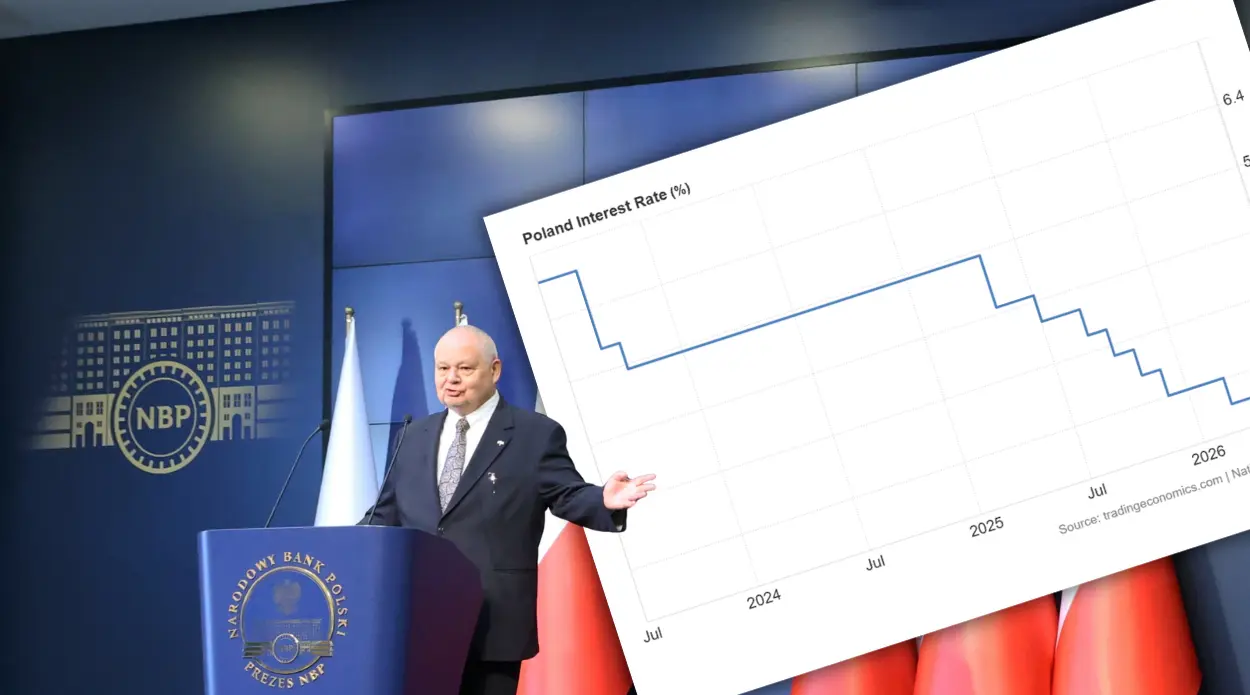
At the same time, on the domestic debt market we observed a clear rise in yields on treasury bonds and IRS rates, driven not only by global factors and rising inflation expectations linked to higher oil prices, but also by very strong domestic economic data for March.
Thus, although very good domestic data limited the scale of the zloty’s weakening, they were not enough to prevent further bond discounting and rising IRS rates during the week.
This week the markets will focus on Fed and ECB decisions, with the baseline scenario in both cases being to keep interest rates unchanged.
Inflation data for the euro area, the US and Poland will also be important. For the zloty and the domestic debt market, information from the Middle East will remain key.
On the brink of a construction revival
A key element of the moderate‑strong economic growth we expect in 2026 will be the projected revival in construction. Production data for construction and assembly in January‑February, however, did not inspire optimism. Due to a harsh winter, production fell by 9.8% month‑over‑month in January and another 3.8% in February on an annualised basis.
Only last week’s March data signalled a partial rebound in this area (see MAKROpuls 21.04.2026) – production rose by 6.2% month‑over‑month. Below we present our scenario for construction in the coming months, broken down into its three most important segments.

One of the main determinants of construction‑assembly production dynamics is the pace of EU fund absorption. These funds constitute a large share of public investment financing.
Because of the nature of the projects (largely infrastructure investments), the dynamics of European budget revenues under the Cohesion Fund have shown high correlation with construction‑assembly production in the civil engineering and water infrastructure segment and overall construction‑assembly production over the last decade. (see chart).
In 2025 EU fund utilisation increased due to overlapping financial streams under the Multi‑Year Financial Frameworks and the National Recovery Plan.
Based on the Ministry of Finance’s plans presented in the 2026 budget law, we can forecast how EU funds will flow in the coming months.
We expect about 117 billion PLN (≈3.0% of GDP) in EU funds to flow into Poland, twice as much as in 2025. Note that these amounts refer only to the EU part of project financing (i.e. excluding the domestic share).
Thus, the inflow of EU funds will be a significant impulse for public investment implementation and growth in construction‑assembly production in the industry. We described our forecast for EU fund inflows in detail in the MAKROmap 19.01.2026.

Housing units delivered in Poland
Besides the trend in infrastructure investment, an important issue from the construction perspective is the evolution of the number of housing units delivered in subsequent quarters. To forecast new housing supply we used the econometric model presented in the MAKROmap 23.09.2024, which explains the annualised dynamics of delivered units (smoothed by a 9‑month moving average).
The key variable in the model is the 24‑month lagged dynamics of construction starts, representing the basic time‑lag relationship between start and completion, historically the main determinant of delivered units.
We believe this relationship may temporarily shorten or lengthen due to other factors, which we incorporate using two additional explanatory variables.

One of these is the 12‑month lagged dynamics of construction‑assembly production prices for building construction, whose rise in 2022‑2023 slowed project implementation and was correlated with expected interest rates, affecting construction time. The third factor is the 4‑quarter lagged GDP growth rate, reflecting the overall economic situation in Poland during project implementation, influencing developers’ decisions and construction sector activity.
Based on econometric modelling results, we expect a 6.4% increase in delivered units in the industry compared to 2025 and another 2.3% year‑over‑year in 2027. Thus, residential construction will be the second biggest driver of construction‑assembly production in the industry after infrastructure investment.

We see the best prospects in the warehouse‑logistics segment
Forecasting trends for 2026 in corporate building and construction investment is particularly difficult because this category covers many segments with different prospects: production buildings, warehouses and logistics, offices, retail‑service facilities, hotels, data centres, energy facilities and other specialised buildings. We expect aggregated activity in this area to grow gradually, but the rebound will be less uniform than in public infrastructure and residential construction. The best prospects are in the warehouse‑logistics segment.
After a strong earlier increase in new warehouse supply, developers are now more cautious and less likely to start construction without signed lease agreements, but demand is supported by e‑commerce, nearshoring and Poland’s resilience as a logistics hub. Shopping malls and data centres will also perform well. Conversely, the office segment will remain weak, where new supply is constrained by the entrenched hybrid work model, high construction costs and competition from more profitable residential projects.

We expect, as in March, construction‑assembly production to continue its upward trend in the coming months. This scenario is supported by high values of indicators for expected production and expected order book observed in construction enterprise business‑cycle surveys by GUS. Thus, in the second half of the year we will see a clear construction revival.
Significant uncertainty remains from the Middle East, which could raise risk premiums and disrupt supply chains. We also see downside risk for this scenario due to supply‑side constraints. In conditions of high utilisation of production capacity and strong demand, project delays and cost increases may occur.
Monthly macroeconomic indicator forecasts