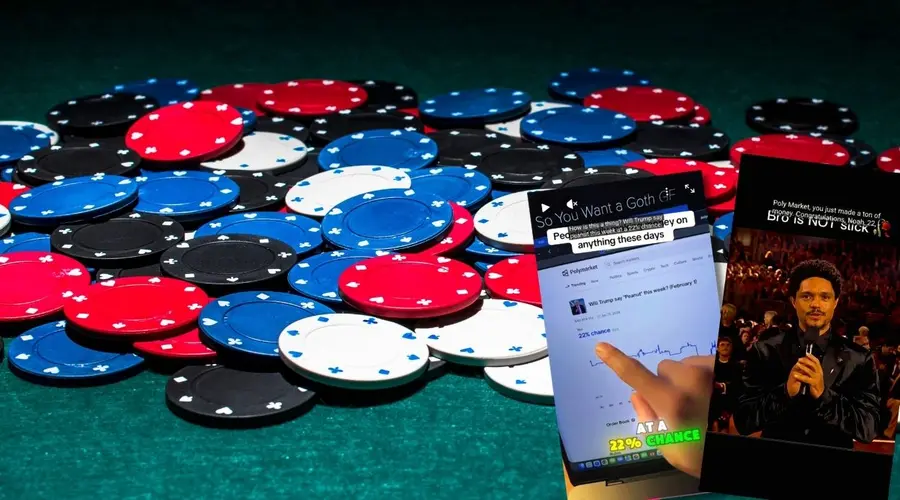
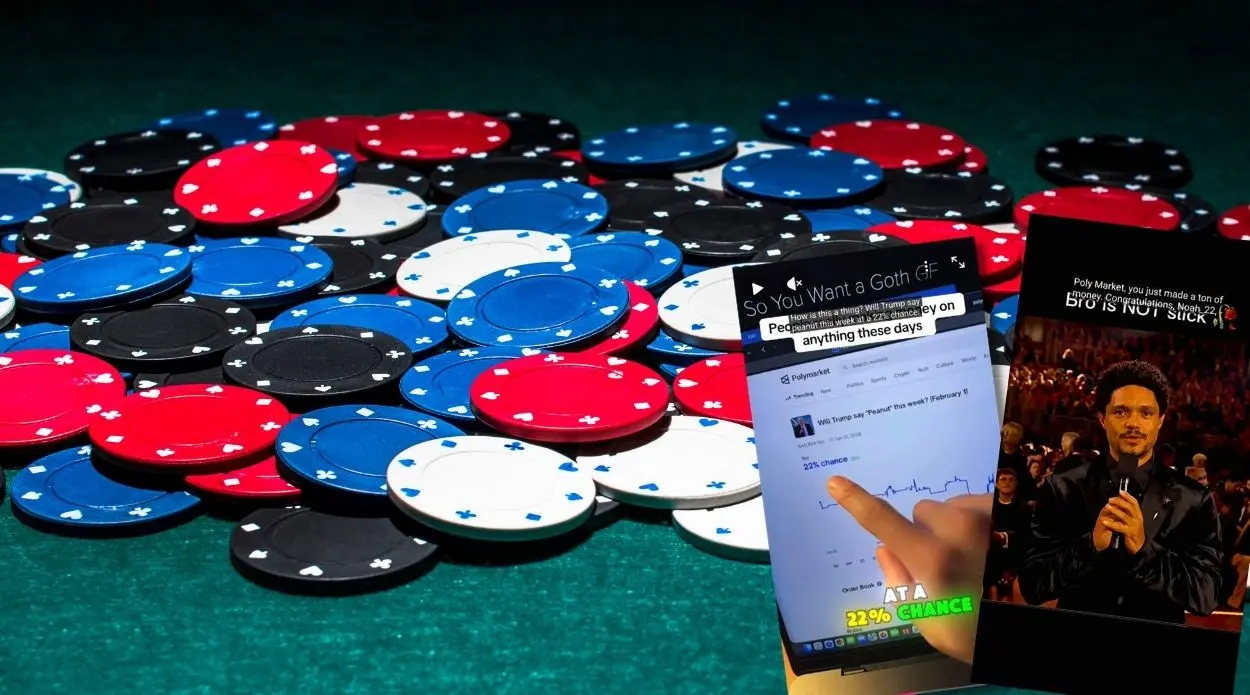
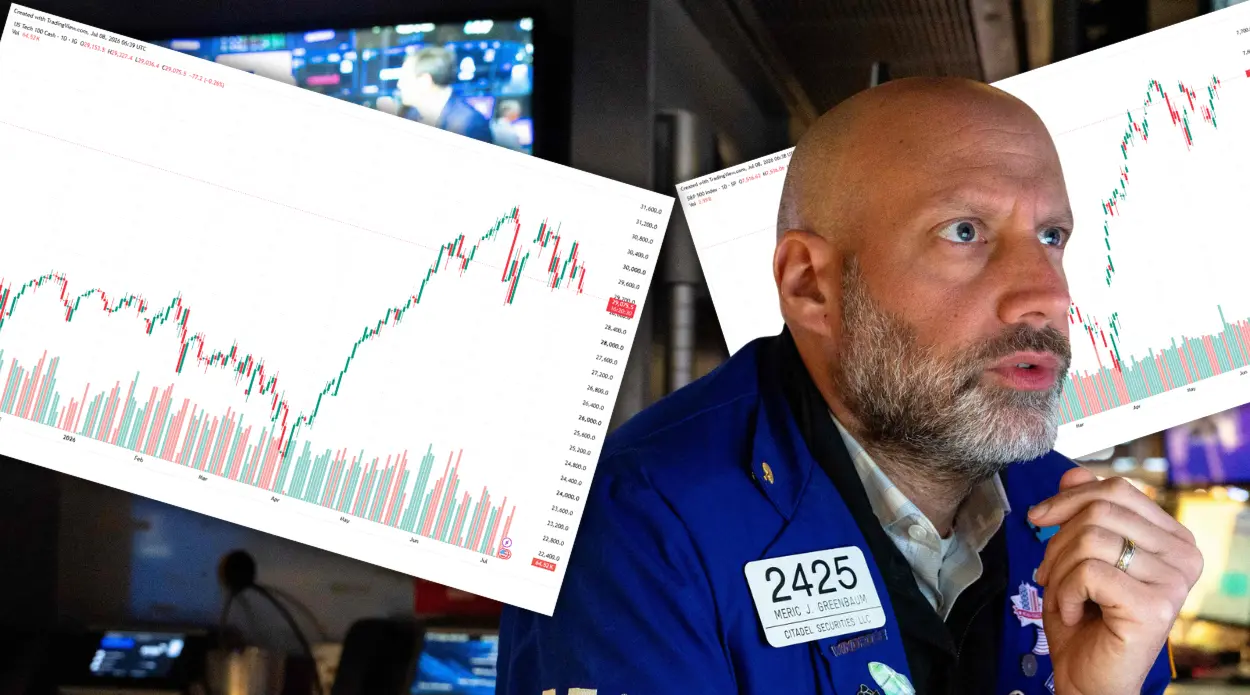
The market priced the probability of a nuclear bomb detonation before the end of 2026 at a flat 22 percent. Someone just bet their own money on it, pumping the absurd wager’s pool to 850 thousand dollars. Predictive markets are growing at a terrifying pace, devouring traditional bookmakers and opening the door wide to the biggest insider‑trading scandals of our decade.
original material FXMAG based on freepik and youtube
Traditional bookmakers have a huge problem. Clients are simply bored. Instead of betting whether three yellow cards will be shown in a match, they prefer to guess whether the president will say the word "walnuts" in his next speech.
The scale of this phenomenon is staggering. Bernstein analysts calculated last year’s volume of predictive markets at 51 billion dollars. This year that amount will jump almost fivefold, reaching a peak of 240 billion. What comes next? Forecasts scream an astronomical trillion dollars by 2030. Bank of America sees a "ceiling" in that figure, and Citizens Financial Group experts predict revenue growth for the platforms themselves from just under 2 to 10 billion dollars.
Why is traditional betting losing ground?
Numbers rise because the center of gravity shifts dramatically. Sports lose their monopoly. Bernstein estimates that the share of sports betting, which today accounts for about 60 percent of turnover, will shrink by half by the end of the decade. Predictive platforms can monetize every politician’s statement and every pop‑culture scandal.
This phenomenon brutally verifies life. Look at the legendary Grammy Awards gala. Host Trevor Noah suddenly weaves the absolutely abstract word "potato" into his monologue. A moment later he announces that users of the Polymarket platform who bet on that exact word just won a fortune.
He smiles and congratulates even the winner with a pseudonym identical to his own name. It was supposed to be an innocent sketch mocking the crazed trend. The joke sparked powerful controversy and serious accusations of deliberately influencing the bet outcome. Such a mechanism in logic is no different from a footballer deliberately getting a yellow card to enrich his own family. Regulators are, however, powerless, like cities fighting a decade‑old scourge of scooters on sidewalks.
Meanwhile, sports still generate gigantic cash injections if offered in a new model. The ending World Cup proved to be real harvests for predictive markets – especially for sport‑focused giant Kalshi – with weekly turnover consistently and proportionally rising since mid‑last year. The start of the World Cup triggered an absolute frenzy. Market participants pushed turnover volume to just over 8 billion dollars in a single week. Fourteen days earlier they were trading half that amount.
Advertising
This capital does not come from nowhere. Someone loses to let someone else gain. Classic bookmakers record that loss. Just look at the stock market listings of major U.S. companies – DraftKings and Flutter. Since January both firms lag far behind the market leader and the S&P 500 index. Predictive markets simply suck the blood from them.
The legal gap worth billions (and Michael Burry’s bet)
Capital always flows where the system offers the least resistance. Predictive markets built their current power on a gigantic regulatory gap. U.S. law treats them entirely differently from traditional betting. Although these platforms have an evident gambling element, in light of regulations they operate as derivatives, i.e., as futures contracts (similar to futures). This bureaucratic loophole gives them a colossal advantage. They bypass strict and problematic state gambling laws. They don’t need expensive licenses. They also don’t pay the taxes that burden traditional operators.
Not everyone believes in this eternal eldorado, however. Michael Burry just entered the game and bet on the exact opposite scenario. He is the famous contrarian investor who flawlessly predicted the global financial crash in 2008. On July 8 he publicized his new, widely discussed move. He took a long position, buying shares of the market giants hit by the market: Flutter and DraftKings in a 60 to 40 percent split. He also announced a possible increase in both stakes.
This man rarely acts in the dark. His decision is backed by iron logic. Burry simply plays for an inevitable legal blow. His thesis is clear: the current free American market will not last long. Over time regulators will close the regulatory gap and predictive markets will receive exactly the same tax burdens that bookmakers face. The magical advantage will disappear. When the playing conditions level out, massive capital will flow back to old market predators.
Advertising
Bookmakers do not wait with hands folded. They change the offer to stop the cash outflow. Flutter, which owns brands like Paddy Power and FanDuel, pumps money into gamification of interfaces. Betting should resemble an engaging game, visually encouraging users to stay in the app. Simultaneously the companies add new, highly current markets. The client does not wait for the meeting to end. They indicate in real time exactly which part of the goal the player will hit during a penalty kick. The battle to regain user attention has only just begun.
The golden age of insider trading
Confidential information is no longer just a Wall Street domain. Predictive markets created the perfect ecosystem for monetizing state and corporate secrets. Jokes ended when national security became the stake. A Harvard research team dissected the practice and issued a crushing verdict. Only insider trading cases could generate even 143 million dollars of profit from a single platform – Polymarket. The prospect of such rapid enrichment attracts people with access to the biggest secrets.
In April the authorities arrested an American army soldier, Gannon Ken Van Dyke. He bet 34 thousand dollars that Nicolas Maduro would lose power in Venezuela before the end of January this year. On January 3 the U.S. armed forces carried out a swift operation to seize the Venezuelan dictator. The world froze. No one expected such a drastic step right after New Year. Van Dyke, however, knew. He threw the majority of his capital onto the market less than a day before the operation, when odds were priced at a modest 8 percent. The American collected 400 thousand dollars, which he promptly withdrew. Despite crushing evidence of guilt he does not admit. The trial is still ongoing.
Likewise an Israeli reserve hiding under the pseudonym ricosuave666 played. With terrifying effectiveness he picked the exact date of Israeli bombing raids on Iran. He didn’t guess. He had hard first‑hand data. He was arrested in February for deliberately using intelligence information for gambling.
Civilians and big tech business also succumb to temptation. Michele Spagnoulo, an engineer working at Google’s Italian Swiss office, used special internal privileges. He had access to secret tools that studied the most popular search terms long before the company released its official annual search ranking. Without hesitation he bet that in 2025 the number one on the web would be singer D4vd. The artist "rose to fame" by being accused of brutally murdering a fourteen‑year‑old. Users on Polymarket massively bet on other stars. The probability of D4vd winning was almost zero. Spagnoulo went against everything and took 1.2 million dollars from the market. The online community immediately sensed fraud, conducted its own amateur investigation, and the FBI efficiently closed the case. The man was charged with money laundering and commercial fraud, and Google closely cooperated with authorities, saving its tarnished image. Suspicious millions also flowed during Taylor Swift’s engagement to Travis Kelce or Maria Corina Machado’s sudden Nobel Peace Prize race.
Advertising
Private banks do not wait for weary politicians. They impose a chokehold on their people. Bloomberg reported that Goldman Sachs tightened its internal policy. Employees can still bet on sports results, but they received a complete ban on political and economic markets – such as predicting Fed decisions on interest rates. Morgan Stanley, Bank of America and JP Morgan Chase followed suit, blocking similar operations. Interestingly, the U.S. Senate introduced identical moral rules for its members. But that is still only an internal regulation. The law remains silent.
The war for control and the hidden interests of the Trump family
The U.S. bureaucratic machine is bogged down by its own rules. The federal CFTC, the Commodity Futures Trading Commission, regards predictive markets as its direct domain, regulating them at the federal level. Strict federal law clashes with state powers that have a monopoly on dictating gambling conditions. The absurdity of the situation is obvious. Platforms like Polymarket and Kalshi attract a mass of customers in states that live off taxes from traditional bookmakers. They add not a single cent to that pot.
State frustration boils over, resulting in powerful court battles. Arizona struck in March. It filed criminal charges against Kalshi, accusing the platform of unlicensed gambling and offering illegal election bets. A judge in Massachusetts reacted even faster. In February it cut Kalshi from offering sports markets to state residents, citing a brutal threat to public health and safety. Kalshi mounts a fierce defense in appellate courts. It firmly asserts its subordination to the federal CFTC.
Growing pressure ultimately moved to the corridors of Congress. There a draft of a powerful law, the End Prediction Market Corruption Act, awaits. The idea is clear. The law must sharply define event contracts, completely cut federal politicians (from Congress members, through the president, to the vice‑president) from trading such papers and stifle the use of confidential information from the outset. Politicians also debate including platforms in the framework of the current STOCK Act and demand radical blocking of betting on the development of armed conflicts and terrorist attacks.
But there is no agreement. Democrats want a tighter belt. They aim to push predictive markets under the definition of traditional betting, which would immediately hand full power to strict state regulators. Donald Trump categorically disagrees with such a turn of events. The former president directly demands the creation of greenhouse conditions for further pumping of this business. On social media he used strong words: "It is critically important that the Commission maintains exclusive oversight of predictive markets and that they prosper." In the same post the politician did not hesitate to strike much lower.
✕
Figure 1. Donald Trump’s tweet from May 26, 2026
Advertising
State regulators were called "noise makers", refusing them the right to interfere in the promising new sector of the economy.
Why does the president fiercely defend these platforms? The answer comes from the capital summary. The Trump family has a gigantic interest here. Donald Jr.’s venture capital fund pumped massive money into Polymarket. If that wasn’t enough, the firstborn son of the former president sits in advisory boards of both market giants – he controls not only Polymarket investments but also the Kalshi giant.
The golden rain will continue, and predictive markets will likely hide behind the favorable CFTC jurisdiction. The agency itself tries to salvage credibility, proposing rules that block the dirtiest bets – those that prey on coups or player injuries. However, as the Wall Street Journal reports, the list of allowed trading options will still heavily dominate the ban side. The main goal is ultimately smooth market development. Donald Jr. must earn.
European wall and blocked access
Europe plays in a completely different league. American chaos and political posturing sharply contrast with the hard wall that EU states have put in front of predictive platforms. Poles will not play in this digital casino. Our Ministry of Finance cuts all speculation and unequivocally classifies Polymarket and Kalshi as strictly gambling entities. The rule is simple: if you want to offer bets, you must have a state license. Predictive markets do not have such a document in our country, so their activity instantly falls into the illegal zone.
The same rigor stifles platforms in the west and south of the continent. Hard blocks, preventing the use of predictive market services, were imposed by the governments of France, Spain, Portugal, the Netherlands and Hungary. Across the entire European community we find today not a single state that has fully legalized this practice for retail users. Gambling law in the EU is set at the national level, not the community level, so there is no single universal directive. European regulators, however, hold a firm, united front. They shut the doors with a bang.
We are left with a powerful dissonance. On one side we have a European ban, on the other – a free American market driven by the political connections of the Trump clan. The mechanism of predictive markets is a fascinating financial tool. The situation becomes dark when we look at the subject of these bets. Someone is now risking huge capital by betting on the date of a terrorist attack, the outcome of a secret military operation or, finally, the real probability of an atomic bomb. Where do you think the ultimate moral line of profiting from global misfortunes and armed conflicts lies? Let us know in the comments, because this market, backed by billions of dollars, is just getting started.
Advertising
The entire material on the above topic can be found in our video at this link:
FXMAG’s editorial team creates high-quality content on financial markets, investing, and the global economy. We provide timely analysis and clear insights to help our audience navigate complex market dynamics.