In 2025, general high schools graduated 161,200 students, which represented exactly 35,5% of all upper‑secondary school graduates in Poland.
Hype for general high schools versus hard market pragmatism
Although the total number of high school graduates increased by almost 15,000 compared to 2020, their overall share in the educational structure fell by 2,3%.
It may sound like dry facts, but this change perfectly fits deeper structural trends described by experts at the Polish Economic Institute.
Why are young people changing their strategies? The answer is the growing popularity of vocational schools and technical colleges, which today act as a great business hybrid, providing a concrete job right away and not closing the academic path.
This is a decisive reversal of a trend that even the millennial generation remembers, which strongly favored and did not want to go to technical schools, considering them inferior and less elite.
Interestingly, school infrastructure itself is also growing, as in 2015 there were 2,163 general high schools in Poland, and by 2024 there were already 2,351 such institutions.
This jump of almost 9% is thanks to private and social entities, not local government units, and here we reach the crux of the entire discussion—does a larger number of general high schools correspond to higher future wage value for employees?

Source: Polish Economic Institute.
See also: Demographic crisis will overturn the labor market. “It’s a ticking bomb” – warns the European Bank for Reconstruction and Development
Feminized humanism and technological revolution
The analysis of the general high school student structure shows a powerful demographic split that strongly affects future earnings in the modern economy.
General high school students are heavily feminized; among 2023 graduates, women made up as much as 64%, while in the entire upper‑secondary school population their share was a modest 55%.
In this regard, general high schools are only surpassed by post‑secondary schools, where as many as 77% of students are women.
Conversely, the male bastion turned out to be those places where hard engineering, IT, robotics, or automation is taught.
In technical colleges men now make up 60%, and in first‑level vocational schools as many as 67%. The boom in AI and modern technologies means that this career path offers better earnings, as it attracts global investment capital. Women less often choose purely technological paths, which immediately cuts their financial potential.
See also: U.S. labor market in focus: the key NFP report could move markets
Academic marathon and the gap year phenomenon
After finishing general high school, the vast majority of graduates choose a further demanding educational marathon at universities. In December 2023, immediately after finishing school, 76% of graduates were studying.
However, just a year later (December 2024) this indicator rose to 83%.
The remaining percentages in these statistics often result from well‑thought market strategies, i.e., the gap year phenomenon (a one‑year break before university) or re‑approaching difficult admissions to dream schools.
When young graduates reach universities, women most often choose social, medical, and humanities majors. Men, on the other hand, much more frequently attack advanced engineering‑technical majors, seeking well‑paid jobs in the technology sector or the rapidly growing game development field.
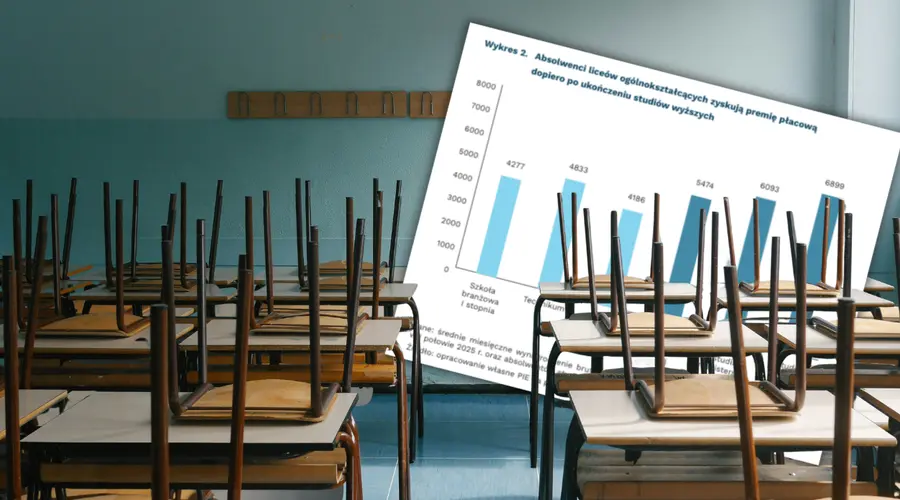
Today, the high school itself opens doors to university, but does not guarantee any wage advantage over vocational paths.
Moreover, without concrete skills and interests, a general high school graduate simply becomes a long detour without a guarantee of reaching the financial finish line.
“High school primarily opens the way to university, but does not yet provide a wage advantage over vocational path graduates,” was conveyed.
“Technical schools give a faster professional start while maintaining flexibility, and vocational schools are increasingly becoming a realistically chosen path preparing for quick entry into the labor market,” added.

Source: Polish Economic Institute.
See also: UK labor market is exploding! Wages are lowest since pre‑COVID times, slowdown signals enter a new phase
Source: Polish Economic Institute.