Geopolitical chaos breaks the rules of the game
Artificial intelligence fed on historical market data and quant algorithms face a big problem today. The situation on the charts breaks all rules, like in the plot of the book Three-Body Problem. A tweet (or rather X) from May 16, 2026 by user KobeissiLetter perfectly summarizes the current market anomaly. The 60‑day correlation between Brent oil prices and the Bloomberg Dollar Spot Index jumped to 0.55. That is the highest level since the index was launched in 2005. A value above 0.50 was recorded only once before – at the end of 2025.
This positive relationship emerged early March 2026, immediately after the outbreak of war in Iran. Since then, the specific trend has relentlessly persisted. The classic textbook dogma that both assets (USD and oil) move in opposite directions has ceased to apply. The armed conflict in a region key to global commodity production has completely changed the rules of the game.
See also: Oil above $150 per barrel. Experts paint bleak forecasts. Fuel prices enter a “radical scenario”
A brief lesson in history – it used to be… much simpler!
To understand the current market situation, you need to go back several decades. For most of the time after 2000 (greetings to all those worried about the millennial bug ;)), and especially after the 2008 financial crisis, the market relationship between USD and oil was delightfully simple and clear. A strong USD meant cheaper oil. The reasons for this were purely fundamental and logical for every trader, broker, and dealer. Since most oil in the world is priced in USD (the petro‑dollar mechanism), a stronger currency raised the real cost of purchasing the commodity for countries outside the US. The result was an instant drop in global demand and a collapse in barrel prices.
Moreover, in moments of intense panic, capital fled to the USD as a safe haven, which simultaneously boosted speculative commodity valuations. Studies published by the ECB and BIS repeatedly proved that negative commodity correlation was the market norm, only interrupted by extreme shocks. Today, old analytical matrices can be set aside, and market bears (not just those from the Bieszczady) must look for new reference points.
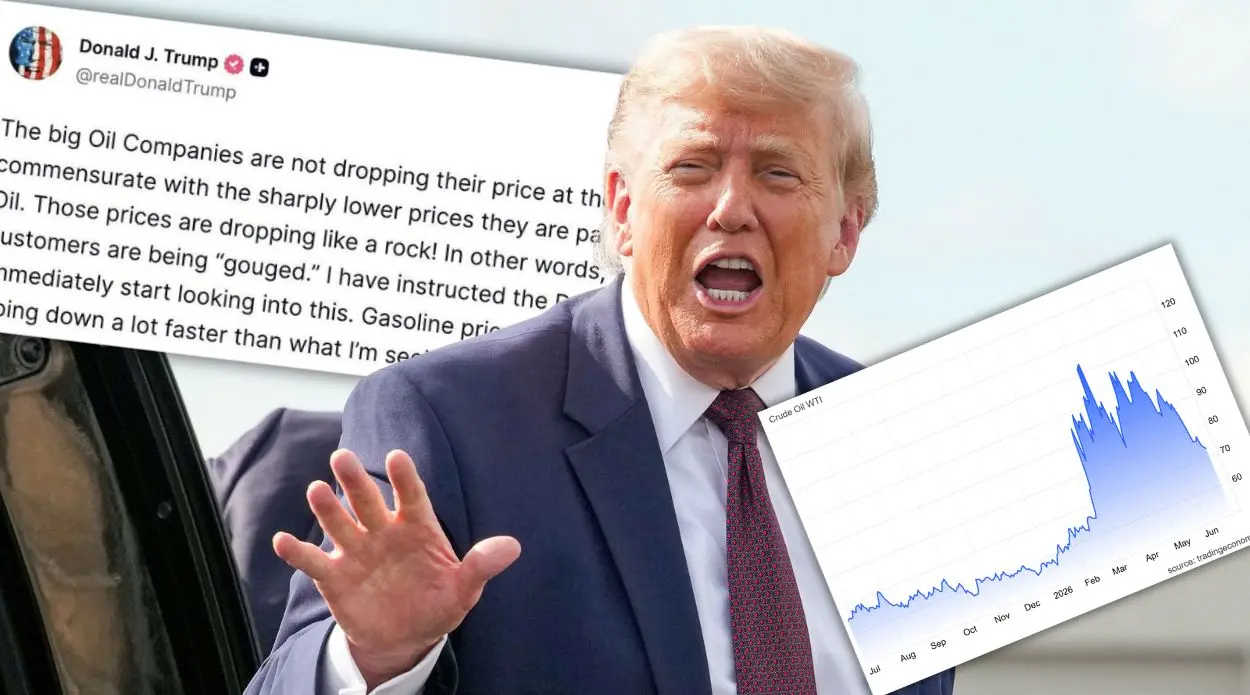
Chart. Futures contract prices for Brent oil.

Source: Trading Economics
See also: Dollar rate before the shock? Big changes coming in the Fed. Expert: “In the US we should not rule out any scenario”
Supply shocks and the American redefinition of strength
The current conflict along the USA‑Israel‑Iran line triggered a rare mechanism: a simultaneous supply shock and a huge demand for safe‑haven in the form of USD. The vision of paralysis in the strategic Ormuz Strait, through which nearly 20% of global oil trade flows, pushed Brent prices above $100 per barrel. At the same time, the USD gained the status of the first‑choice reserve currency, fueled by the fact that the US is now a net exporter of oil and refinery products. This is a fundamental shift, because before the shale era and the US transformation in 2015‑2020, negative correlation was much stronger.
History knows similar anomalies, though rarely on such a scale. In 1973, during the Yom Kippur war and the Arab embargo, oil exploded from about $3 to $12 per barrel, and the USD ultimately gained from the surge in settlement demand. In 1979 the Iranian Revolution brought a supply shock and strong pressure on the currency. In 1990‑1991, when Iraq invaded Kuwait, oil jumped from $15 to $42, and the USD rose as a shelter for capital, though prices fell after a quick intervention. Very similar in 2022, when Russia attacked Ukraine – oil crossed the psychological barrier of $120, and the USD rose driven by a hawkish Fed.
Today geopolitics has finally dominated the old petro‑dollar mechanics. Both the USD and black gold have become somewhat proxy instruments, reflecting essentially the same risk – war premium and fear of disrupted global supply routes. As long as the specter of escalation hangs over the Ormuz Strait, we will witness this fascinating, though dangerous dance of USD and oil.
See also: Dollar rate fell 20 cents. Worries returned, who is the new Fed chair?
Source: X