Since the debut of ChatGPT on 30 November 2022, the narrative of a technological apocalypse in the labour market has become part of public debate.
Fear has big eyes, and ChatGPT clean “hands”?
Prophets of the digital breakthrough warned of a sudden rise in unemployment among white‑collar workers, and frightened employees began loudly demanding a tax on artificial intelligence and government social safeguards.
Young people just entering the labour market were especially worried. In the UK, youth unemployment jumped to the highest level in a decade, which was eagerly attributed to the alleged dominance of artificial intelligence.
Many saw this as a sign of a catastrophic future in which society is eliminated from the labour market by more efficient and cheaper AI.
Wall Street and London City investors, pumping billions of dollars into tech companies, built their most optimistic forecasts on the foundation of rapid automation and mass labour cost reductions. It turns out, however, that market enthusiasm and media panic have largely diverged from reality.
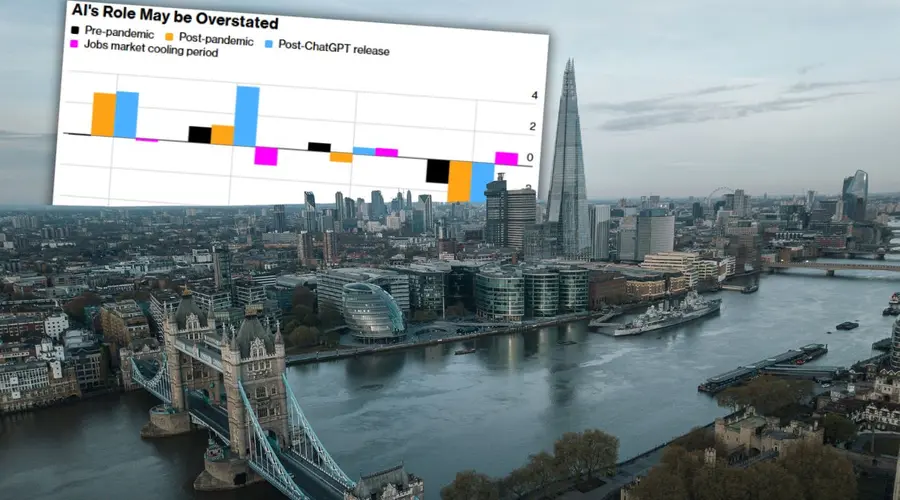
The latest Bloomberg Economics report, based on a detailed analysis of online job offers for 400 different professions, sheds entirely new light on the whole issue. Algorithms are not clearing corporate offices of people at the pace that the biggest tech optimists expected.
See also: AI was supposed to replace people. Now some firms are pulling back from transformation
What do the hard data from the UK labour market say?
The main conclusion of the study is clear: artificial intelligence has not yet had a significant negative impact on the UK labour market.
Interestingly, the decline in job offers for positions most exposed to AI began long before OpenAI released ChatGPT 3.5 to the world.
Although demand for these workers temporarily dipped right after the chatbot’s launch from San Francisco, the situation began to change dramatically.
Since 2024, demand for specialists in AI‑related sectors has even noticeably increased. Even in the face of a strong cooling of the local economy over the past two years, this particular segment began to show astonishing resilience.
UK tax data also present an equally interesting picture. Instead of an exodus of workers, payroll statistics in the private sector show a systematic increase in the number of employees in industries considered most vulnerable to automation. Instead of mass workforce clean‑ups, managers are adopting a more rational approach.
“Looking directly at these results, they contradict the theory of rapid, large‑scale displacement of people from work, as often shown in the media,” comments Ana Andrade, Bloomberg Economics economist.
She also adds that while AI may ultimately bring a re‑transformation of the economy that market players are counting on, the evidence indicates that macro‑economic changes will still take some time.
Even in the game‑dev industry, where generative tools were supposed to instantly replace human creators (asset generation and game production automation), the human element still plays a role.
If it’s not AI that is responsible for the cooling of the UK labour market and rising unemployment, where is the problem? The answer is far more prosaic and has a purely fiscal‑economic basis, not technological.
Business in the UK directly points to the culprits of the current state of affairs: a weakened economic outlook and political decisions.
Chancellor of the Exchequer Rachel Reeves decided to raise payroll taxes and jumpingly increase the minimum wage. These factors, combined with high hiring costs, forced companies to cut budgets and reduce staff.
See also: Will artificial intelligence replace the local entrepreneur? Private “human language models”
Source: Bloomberg.