Recent performance tests delivered a result that electrified the tech sector.
Algorithms on the payroll, or the digital promotion of Fable 5
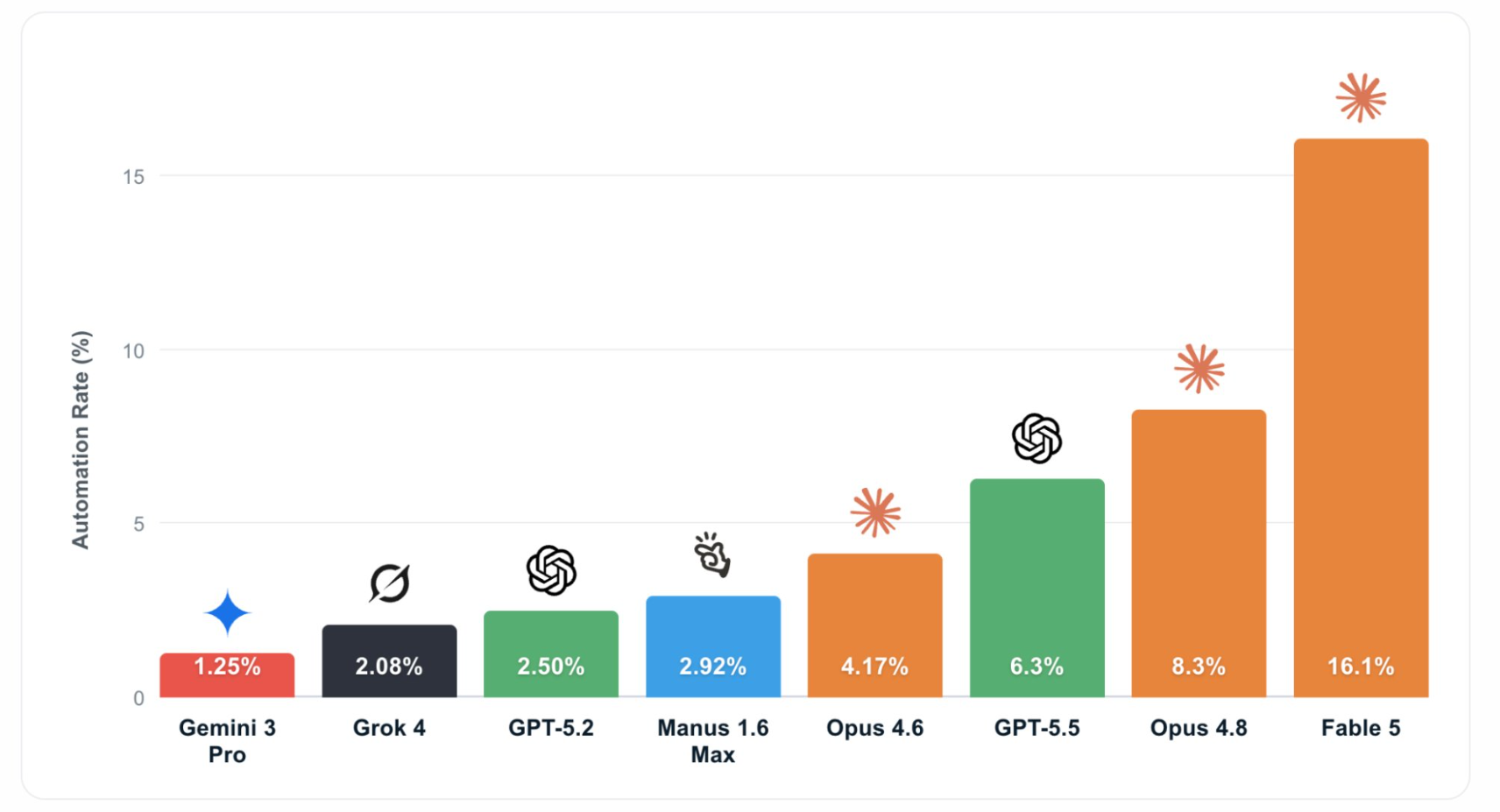
The Fable 5 model from Anthropic achieved an automation rate of as high as 16,1% in tasks previously performed remotely. To understand the significance of this success, it is worth examining the study’s methodology.
The RLI Index operates in an extremely transparent way: the same set of real, professional market tasks are assigned to both humans and advanced AI models. Independent experts then rigorously evaluate the results, checking whether the digital outcomes match exactly the level that a live professional would deliver.
Fable 5 not only passed this exam, but outright crushed the existing competition, including systems such as GPT-5.5 (6.3%) or Manus 1.6 Max (2.92%).
We are talking about a powerful, almost double increase in efficiency compared to Anthropic’s last hit from the stable, the Opus 4.8 model, which achieved a result of 8.3%. Such a jump in just a few months shows that technological barriers that had been holding machines for years are breaking one after another before our eyes.
Chart. Remote Labor Index (RLI)
Source: Center for AI Safety.
See also: Breakthrough at the giant. Will new news help Wall Street? Artificial intelligence takes over the market
Vision for 2028. Half of offices in the cloud?
If mathematics and analytical market trends do not lie, we stand on the brink of a fundamental upheaval in the labor market and the stock exchange. A simple extrapolation of the current pace of development leads to fascinating, yet terrifying conclusions.
If developers maintain such an aggressive release cycle and exponential growth in agent system capabilities, then in just 2 years over 50% of global remote work could be fully automated by artificial intelligence. That is at least what the theoretical approach to the topic claims.
For venture capital funds and tech companies, this is a signal for absolute portfolio rotation. Companies that base their structure on intelligent agents could theoretically enjoy a gigantic margin and operational advantage.
The vision of an army of digital assistants that do not need sleep, vacation or health insurance appears as the absolute Holy Grail for senior managers who will probably also be replaced by AI.
However, before corporations start mass‑terminating human employees, they must confront the hard, mathematical barrier hidden in data centers. Such optimization costs a lot.
See also: AI was supposed to replace humans. Now some companies are pulling back from the transformation
Token frenzy and financial handbrake
In this barrel of technological honey lies a powerful spoon of iron. Fable 5 is an outstanding model, but at the same time absurdly, even prohibitively expensive to maintain. The business quickly realizes that mindless AI deployment at scale is currently a playground only for the richest, because every single query, code analysis or report generation incurs real, thousands‑of‑USD infrastructure costs.
Processing gigantic context windows literally burns corporate budgets.
The best and most vivid confirmation of this thesis is the recent, loud decision by Microsoft. The tech giant officially banned its own developers from using the Claude Code tool. Why? Engineers generated such gigantic token‑usage costs that annual budgets for developer tools evaporated in an instant.
As part of the financial rescue, employees at the Redmond giant were immediately moved to the internal, more cost‑predictable Copilot.
Artificial intelligence can already replace a human in the sixth office task, but for now it is simply cheaper to… hire a human. Until energy and computational infrastructure costs drop by an order of magnitude, Fable 5 will remain a luxury sports car that only a few can afford to refuel daily.
See also: Will artificial intelligence replace the local entrepreneur? Private “human language models”