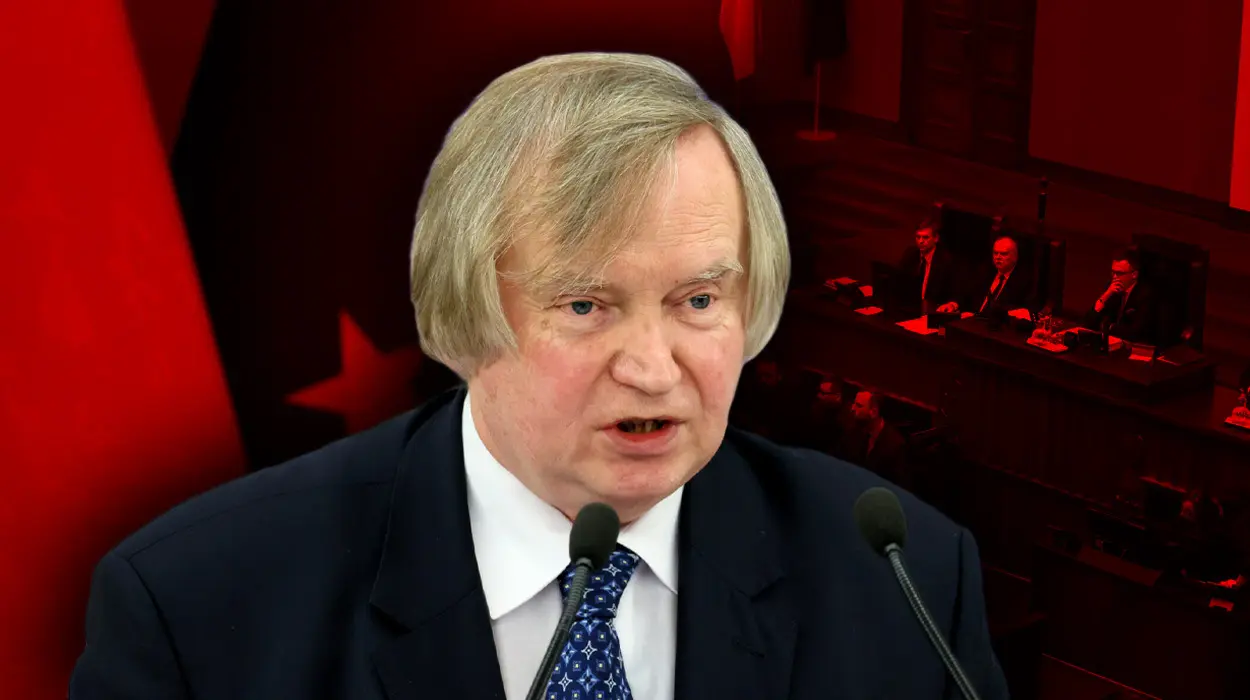


Kamil Markiewicz (FXMAG): How do you assess Poland’s legal order? After the change of power in our country, there were loud promises of restoring the rule of law. After two years of the current coalition’s government, can we say that the changes are moving in the right direction?
Prof. Ryszard Piotrowski (lawyer, constitutionalist, University of Warsaw): The rule of law can only be introduced by acting in accordance with the law. Yet we have witnessed actions related to breaking the law. Starting, for example, with the takeover of public media.
It is troubling that in public statements representatives of the authorities, especially the head of government, announced that such actions were necessary, inevitable, otherwise impossible.
Prime Minister Donald Tusk also said that he would respect the law “as he understands it.” Should we approach compliance with the law and constitutional provisions in the same way?
Anyone who applies the law interprets it. But from the interpretation of the law, from the binding determination of what it means, come the judges, especially the judges of the Constitutional Tribunal.
The Constitutional Tribunal has stirred extreme emotions in recent years. Is there a chance to change this situation? To make this institution associated with guarding the Constitution rather than politicians and their controversial decisions?
There is little chance, because one would have to accept that the Constitution applies, and we apply the law as it was formulated, not as we understand it. It does not seem that there is readiness for such an approach to the provisions concerning the Constitutional Tribunal. One can say that this state of non-respect of the Constitution, where some judges of the Tribunal are considered judges and others are not, is the source of the crisis we observe.
We see a similar crisis with judges. Some of them are called “neosędziami.”
Until there is a law that introduces the concept of “unauthorized person to adjudicate,” whether in the Constitutional Tribunal or ordinary courts, one cannot act as if that law were in force. One must follow the state of the law in force, under which concepts such as neosędzia or dubler judge do not exist.
In your opinion, can a country be governed based on parliamentary resolutions rather than laws? The current coalition does this in some provisions. It is a way to avoid the need for President Karol Nawrocki’s signature on the document.
If there is such a belief that the president will not sign the law, one must consider the basis of such assumptions. One should move towards accepting the role the president has in legislation, namely signing laws. Efforts should be made to reach an agreement. It is about agreeing on legal solutions so that they can be introduced in a way that does not provoke opposition from the president. Currently, the parliamentary majority sufficient to pass a law proceeds in a way that assumes any attempts to negotiate with the president are futile. As a result, since changes to the law cannot be regulated by law, substitute solutions are adopted, i.e., resorting to resolutions or regulations.
In your opinion, does the Constitution need improvement? More and more people say it should be changed. Voices even call for a constitutional reset.
One must start by explaining the very concept of “reset.” It would mean abolishing the current law and establishing some new law in its place, which would eliminate the crisis. There are no rational reasons to attribute the source of the crisis to legal provisions when the source is tied to people’s stance.
It is not the laws that are the source of the crisis, but those who do not want to apply them. The world will not change simply because some new legal solution is introduced. The Constitution is not perfect simply because it exists as a legal act. That does not mean we can reflexively introduce a state of legal system upheaval by constantly announcing that a new Constitution will appear soon, especially when there are no views for it due to the lack of a necessary majority in the Sejm.
However, corrections are possible, i.e., partial changes to the Constitution that would eliminate provisions that can be considered abused by politicians. Or, relatively, that would expand the Constitution’s text, making the legal act better than it is now. This requires recognizing that we cannot follow the principle of “politics over law.” The law should regulate politics, formulate standards that limit politicians. That is exactly what the Constitution and the Constitutional Tribunal serve for.
Politicians who do not want restrictions try to understand these restrictions in a way that deprives them of their proper meaning. To justify violating the law, they try to convince the public that this happens because the law is bad.
Every constitutional law, regardless of how excellently it was constructed, will be subject to politicians’ attempts to give it a completely different meaning than it actually has. And all this to strengthen the power of those who would like to exercise it as much as possible without limits.
Is it sensible to set up teams, like the one recently created by President Karol Nawrocki to draft changes to the Constitution? The ruling party criticizes the decision, saying it is not a constitutional body because it was not created in parliament.
The parliament can create such committees it deems appropriate. In the Sejm there are committees with specific tasks. The president can create teams or councils he considers useful for carrying out the tasks entrusted to these bodies. One does not exclude the other. There are no provisions that say how to enact a new Constitution. They would have to be created. The mentioned initiative by the president cannot replace solutions that do not yet exist. After all, there are no provisions saying how a new Constitution should be created. There is also no draft law concerning the amendment of the Constitution that would be submitted by the president in the proper manner. Then it would be subject to parliamentary work.
On this occasion, it is also said that when attempting to change constitutional provisions, the role of the president in the Polish legislative order may also change. In your opinion, is this possible?
It is, of course, possible. Everything depends on whether a majority will be found that would like a different shape of the presidency than the current one. In my opinion, the current model is appropriate under conditions of society divided between supporters of the presidential system and supporters of strengthening the prime minister’s power. If we wanted to introduce a solution that would somehow exclude part of society from identifying with the current system, such a solution would be dangerous.
Currently in Poland we have a system that can be described as a parliamentary system with some elements of a presidential system, but only with a slight shift towards the presidential system. This allows all those who were voters for President Nawrocki to find themselves in this system. Similarly, those who did not vote for President Nawrocki and consider him not their president can find themselves in this system in a way that they identify with the government, i.e., the Civic Coalition and its allies.
Thank you for the conversation.
Also see: Did the Poles want such a change? Another scandal involving Civic Coalition politicians