Entering the job market has never been a bed of roses, but current graduates are facing a steep uphill battle.
Generation Z on a side track, i.e., algorithms instead of interns
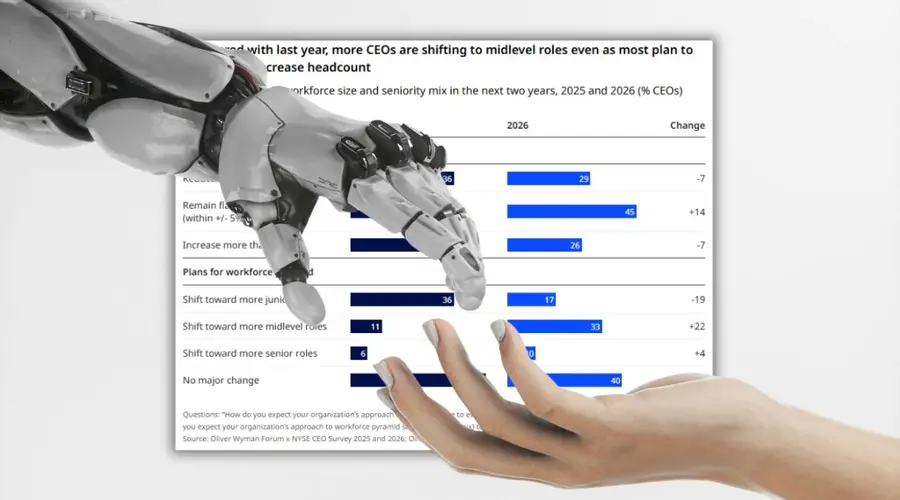
Instead of traditional competition with peers, they face soulless code. And, oh horror, they lose this battle right from the start. A report published by Oliver Wyman Forum in cooperation with New York Stock Exchange shows that up to 43% of CEOs of the largest companies worldwide plan to reduce the number of junior positions within the next two years.
This is a drastic jump, considering that in 2025 only 17% of leaders declared such an intention. It turns out that implementing AI is no longer a role of innocent tests in a technological sandbox, but becomes a harsh market execution.
Generative artificial intelligence handles basic tasks (from simple coding, through document analysis, to basic copywriting) much faster and cheaper than any novice employee.
Stock‑market giants, whose capitalization constitutes a significant part of the global market, seek efficiency and immediate cost reduction. As a result, the traditional employment pyramid is rapidly evolving into a structure resembling a rhombus or diamond. The position of “younger specialists” shrinks dramatically, while 33% of companies shift their resources toward mid‑level roles. For young people this simply means closed doors to a career.
See also: Will artificial intelligence replace the local entrepreneur? Private “human language models”
Supervisors of digital slaves – the triumph of experience over youth
Although CEOs recognize the usefulness of gen AI, they know that ultimately someone must approve AI actions. This is where industry veterans step onto the stage. Corporations prefer to pay more to experienced experts who know the internal processes, systems, and business specifics, so that they can supervise AI agents.
Artificial intelligence repeatedly makes mistakes, so catching such errors early in the creative stage is crucial. This requires experience that freshly minted graduates simply lack. This specific twist means that only senior employees benefit, becoming de facto guardians of digital order and AI supervisors.
From the perspective of an Excel table and quarterly financial results, often presented to shareholders on the exchange, everything looks almost perfect. Costs fall, efficiency rises, and savings in USD improve the operating margin. The scale of this phenomenon is well illustrated by the fact that up to 74% surveyed CEOs already now freeze or reduce total employment in their enterprises.
This strategy, however, is walking on thin ice. CEOs seek temporary savings but completely ignore the long‑term, destructive consequences for their organizations. Replacing juniors with artificial intelligence cuts companies off from fresh blood and the natural succession process.
In a few or a dozen years, when current veterans retire, companies will wake up in a new and brutal reality. Who will be able to objectively assess whether AI performs its tasks correctly when no one in the company has gone through traditional vocational education from scratch?
Chart. Plans for optimizing the human resources pyramid

Source: The CEO Agenda 2026.
See also: Sudden double‑digit return on shares of a well‑known company. Olive oil poured into fire by artificial intelligence and politics
Source: Olivier Wyman Forum.