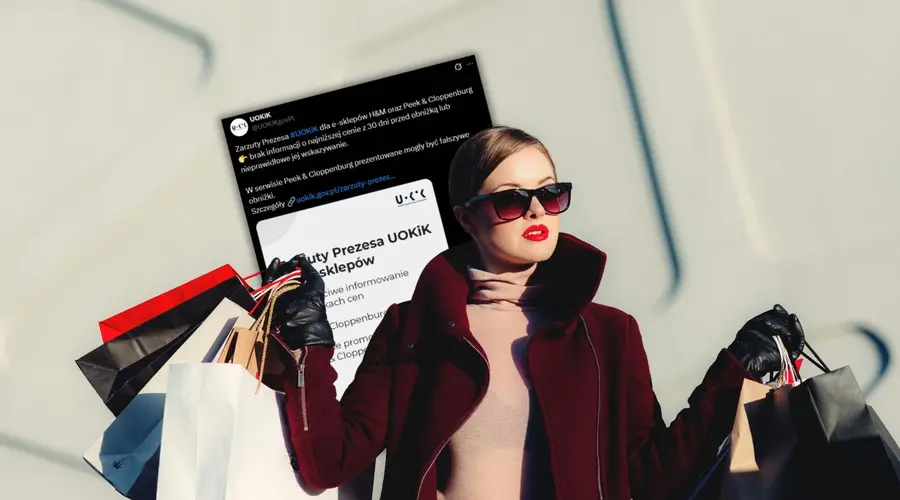
The Swedish giant, whose valuation depends on consumer loyalty, has fallen into considerable trouble.
H&M, or automated exclusivity for every consumer
The office carefully analyzed the promotional actions organized in H&M’s online stores. The scheme was simple – the platform displayed lower prices for so‑called club members and higher prices for other users. Sounds like an elite loyalty program? Nothing could be further from the truth, because in reality anyone could benefit from this offer. The only technical requirement to obtain club member status was a quick registration by providing an e‑mail address.
According to EU and Polish law, when a trader advertises a discount, at every stage of presenting the product offer – including its detailed description – the current price and the lowest price that applied in the 30 days before the discount must appear. This mechanism is meant to protect consumers from false discounts.
Importantly, the same requirements apply to offers made through clubs and loyalty programs if discount notices are directed to specific products or groups. The UOKiK analysis showed that H&M’s online store did not always provide this data correctly. As a result, consumers were deprived of a reference point and could not verify the attractiveness of the promotion.
See also: UOKiK searched Lidl offices! Another conspiracy. Entrepreneurs could have made it difficult for drivers to change employers.
Peek & Cloppenburg – when a discount code generates logical errors
The UOKiK took an even harsher stance against Peek & Cloppenburg’s platform, examining how price reductions are presented in online stores and the mobile app. The office accuses the clothing chain of not always informing about the lowest price of a product in the last 30 days before the discount, and when it does, it can be extremely unclear to the consumer.
Seeing on the product card the message “30‑day best price: xx PLN” can make it impossible to understand what that value refers to. Regulations are clear – the price information must be unambiguous to avoid doubt and allow easy comparison.
The real blow comes from accusations of organizing false promotions. We encounter this when the prices presented as discounted are equal to or even higher than the lowest price from 30 days before the discount. A classic example from the office’s database: the store offered a skirt with a supposed –43% discount. The price after the discount was 199.99 PLN, the earlier “original” price was 349.99 PLN, and the “30‑day best price” also was 199.99 PLN. The math does not lie – the price advantage was exactly zero.
See also: UOKiK strikes a well‑known company! Over 2 million PLN fine. The company’s free products were not at all like that.
Price errors can cost fashion giants a lot
In business, mistakes are paid for in real cash. Incorrectly informing about price reductions threatens entrepreneurs with high financial penalties reaching up to 10% of annual turnover. For global conglomerates, this is a risk of losing hundreds of millions of PLN, and for shareholders it is a real signal to step down. Today’s accusations against e‑shops are another element of the wide‑scale offensive by the UOKiK Chairman related to the Omnibus Directive. As Tomasz Chróstny himself emphasizes:
We constantly monitor how shops present promotions. I remind you that online buyers must also be informed about the lowest price that applied in the 30 days before the introduction of a given discount. This information should be present wherever it is communicated. We also closely watch for false discounts. They occur when the supposedly promotional price is equal to or even higher than the lowest price in the 30 days before the discount.
It is worth noting that recently similar accusations were heard from the physical stores Żabki Nano and Black Red White. The digital Wild West in e‑commerce is slowly coming to an end, so algorithms (or rather the companies behind them) will eventually have to learn to be honest with consumers.
See also: UOKiK strikes a mass of companies in Poland! Harmful substances were found in their products.
Source: UOKiK