The decline of foreign investors’ share in the State Treasury debt financing structure below 30% increases Poland’s resilience to episodes of global risk aversion and strengthens the importance of domestic investors.
Non-residents today have a greater influence on short‑term pricing and market liquidity than on the State Treasury’s ability to finance obligations, while their activity is mainly focused on the medium and long end of the yield curve.
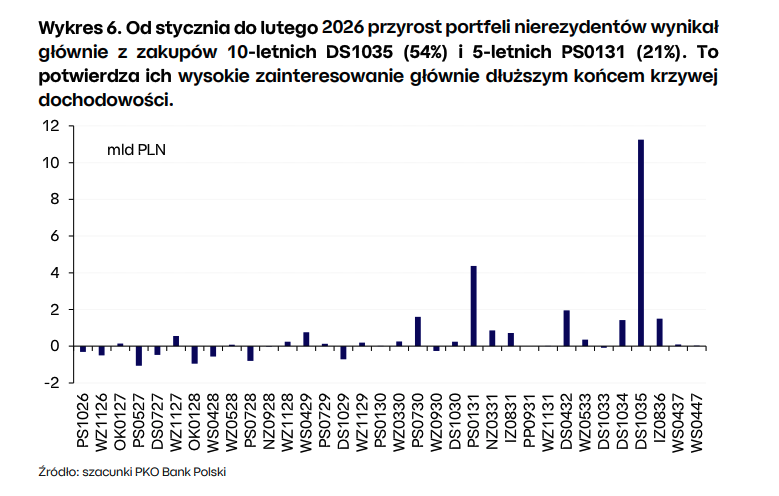
The structure of foreign investors’ purchases confirms a preference for longer tenors. From January to February 2026 demand was concentrated on 10‑year DS1035 and 5‑year PS0131 (non‑resident participation in purchases of these series was significant, despite their limited role in the overall broad market).
The market environment still favours the inflow of foreign capital into the debt market, supported by relatively attractive yields, our forecasted return of expectations for NBP rate cuts and the potential decline in currency‑risk hedging costs.
Further inflow of foreign capital into long‑term fixed‑coupon bonds should stabilise asset‑swap spreads in the 5Y and 10Y sectors respectively near 60–70bp and 90–100bp.
Over five years, 75 bn PLN of foreign capital has flowed into the Polish debt market
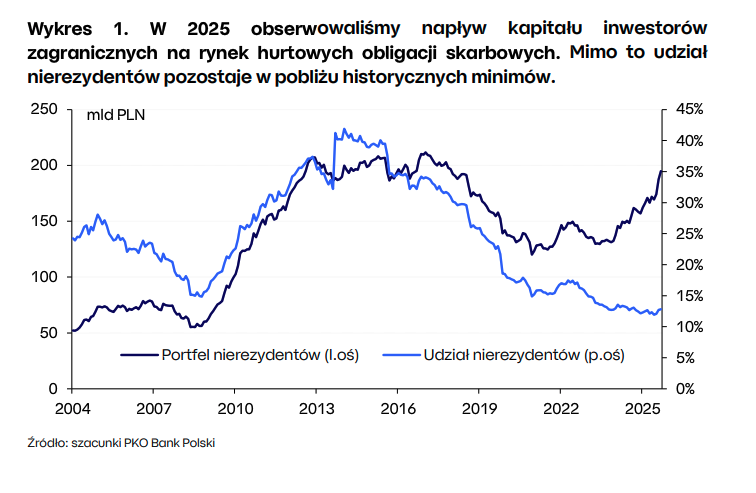
Since 2021 we have observed a clear inflow of foreign capital into the Polish wholesale treasury bond market. Since February 2021, when non‑resident engagement reached a local minimum of almost 120 bn PLN, the value of their portfolios has risen by 75 bn PLN.
Foreign investors return to Polish debt, but their role diminishes. Who really finances the budget?
Despite the visible increase in interest from foreign investors in the Polish debt market and solid capital inflows, they remain secondary market participants. Thanks to recent inflows they maintain only a historically low market share, stabilising since September 2023 in the 12‑14% range.
Such low engagement in the domestic debt market has not been observed since the start of the available time series, i.e. since June 2004. As a result, foreign investors’ share in financing the State Treasury’s total obligations fell below 30%.
It can also be assumed that part of this non‑resident engagement does not stem directly from fundamentals, but indirectly from the fact that Poland is included in global indices (e.g. FTSE World Government Bond Index – WGBI, as a developed country). Such changes in the buyer structure have significant implications from a market‑trend perspective.
The Ministry of Finance, ensuring the state’s borrowing needs are financed, must rely on domestic investors and increasingly on household savings (trends in the savings‑bond market were described more extensively in the special report “Retail bond sales could set a new record in 2026”).
This potentially improves Poland’s credit‑worthiness perception and reduces the risk associated with financing the state’s needs in situations of global risk aversion.
However, a negative consequence is the shrinking base of potential investors. In this situation non‑residents influence pricing and liquidity more in short horizons than the state’s ability to finance its obligations.

Non‑residents mainly strengthen demand for long‑term bonds
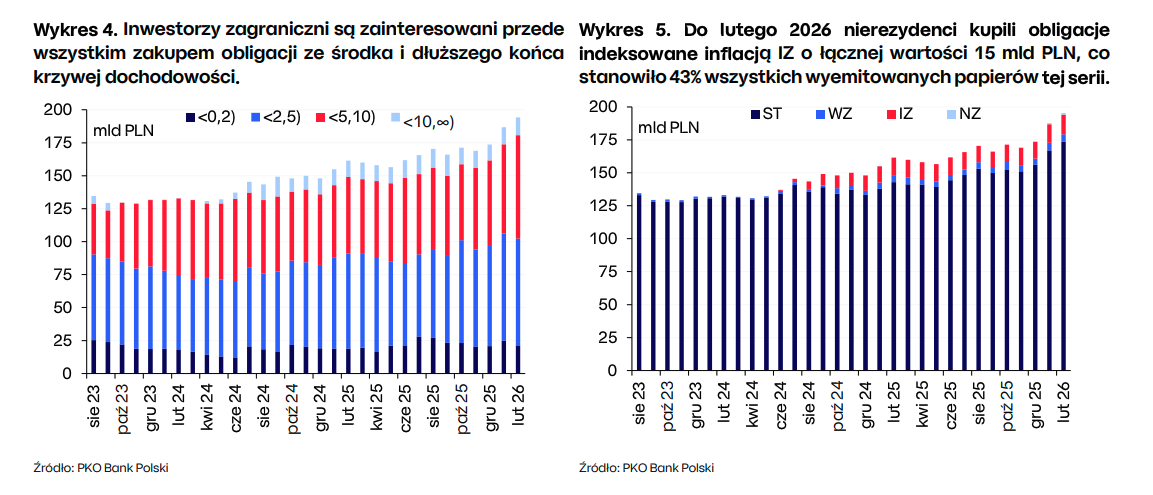
Foreign investors at the end of February 2026 held PLN‑denominated treasury bonds with a total value of 194 bn PLN. Analysis of buyer‑structure changes faces a significant barrier in the form of the growing “collective accounts” category, which already accounts for 46% of the entire non‑resident portfolio. It should also be noted that nearly 7% of securities are held by investors from Luxembourg.
This means that precisely determining the structure of half the portfolio is impossible. From the available entity data, covering about half the portfolio, it emerges that a significant group of stable, long‑term buyers consisted of pension funds, central banks (12 bn PLN from Asia) and public institutions. Together they accumulated 20% of the non‑resident portfolio. Despite difficulties in identifying the remaining categories, it is evident that this part of the portfolio is characterised by markedly greater state variability, suggesting a shorter investment horizon.
Regionally, investors from Europe (24%) and Asia (16%) dominate, while North America accounts for only 4%.
In recent quarters a clear trend of systematic growth in the importance of European investors is visible. Foreign investors mainly buy fixed‑coupon securities (almost 90% of the portfolio), but also express demand for IZ series bonds (3%). Papers in the 5‑10 year sector (82%) were also preferred. This characteristic of new purchases did not change over time.
From January to February 2026 the Ministry of Finance issued DS1035 bonds worth 24 bn PLN, while foreign investors could buy securities representing almost 47% of the entire pool. In the case of PS0131 this share was lower, though still significant at 21%. Although the role of non‑residents in the entire borrowing‑needs financing process is very limited, they constitute an important buyer group in certain market segments, e.g. the long‑term bond segment.
The market environment favours further inflow of foreign investors’ capital
It is difficult to define unequivocally and precisely the factors that in recent decades have determined changes in foreign investors’ portfolios in the Polish wholesale treasury bond market. Due to structural changes some relationships were periodically modified, and in the short term some specific factors periodically gained the greatest importance. Analyzing the data, however, one can identify a number of factors that over the last two decades had the greatest impact on non‑resident decisions, determining capital flows.
These include Polish bond yields, expectations of NBP monetary policy, changes in the main rates of central banks worldwide, global risk appetite and credit‑premium level, the strength of the zloty and the cost of hedging currency positions, and also the term premium.
When we built a cointegration model based on selected variables (5‑year German bond yields, 2Y10Y spread on the domestic debt market, EUR/PLN exchange rate, 1Y EUR/PLN CIRS quotes, and FRA9x12 contract) it turned out that it effectively described changes since the start of data collection by the Ministry of Finance, i.e. since 2004. For such a model the coefficient of determination R² was 66%.

Among the factors that hinder foreign capital inflow into the domestic debt market, and which for various reasons were difficult to incorporate into the model, are: the war in Ukraine, the introduction of a bank tax (increasing the attractiveness of Polish instruments for domestic financial institutions), and the significant rise in public‑sector financial imbalance. A factor favouring short‑term, monthly declines in foreign investors’ portfolio values were also the bond redemption terms. However, they should have less importance in the long run.
Looking through the lens of fundamentals, one can expect that the inflow of non‑resident capital visible since mid‑2024 will continue. This thesis would also be supported in the short term by information on a lasting de‑escalation of the conflict in the Middle East (although we do not yet have March data that would allow us to assess the scale of the war’s impact on foreign investors’ decisions). Interest in Polish bonds should be sustained by a favourable market‑environment.
Bonds in play: the market starts pricing rate cuts
We expect that on the domestic interest‑rate market expectations for rate cuts will return, which in our base scenario we anticipate in the second half of 2027. This could translate into a steeper yield curve, but at the same time would be an argument for buying fixed‑rate bonds.
These factors should favour greater interest from foreign investors in longer bonds. We also see moderate room for zloty appreciation, which in turn can translate into lower currency‑risk hedging costs, and even motivate the purchase of securities with an open currency position. Moderately positive information should also flow from base markets.
If a de‑escalation of the Middle‑East conflict occurs, the Polish debt market should benefit from a decline in German bond yields, which not only indirectly strengthens Polish instrument valuations but also encourages investors to seek higher returns. Further inflow of foreign capital should favour the stabilisation of asset‑swap spreads in the 5Y and 10Y sectors near 70pb and 100pb respectively. It can be assumed that at these levels at the 2025/2026 transition both foreign and domestic investors were activated.
Since March, the negative impact on the market has been exerted by the escalation of the Middle‑East conflict. Near current levels of 60pb and 90pb, quotes should stabilise, and this should be helped by medium‑term inflow of foreign capital.