Nvidia beats forecasts, yet the stock falls. The market starts to doubt the AI narrative
Equally impressive was the forecast for the next quarter, assuming about $91 billion in revenue, more than the market expected. Yet Nvidia shares fell in after‑hours trading, which clearly shows that for a highly valued company, even very good results are no longer enough.
>> Read also: Dollar rate may change direction? Sparks between the US and Israel. Trump: “We’ll see what happens”
The key element of Nvidia’s story remains dominance in AI infrastructure. The company is still a key supplier of chips used to train and run advanced AI models, and its Blackwell platform is presented by management as the fastest‑growing product in the company’s history. Jensen Huang is building around Nvidia a narrative of “AI factories”, a new generation of computing infrastructure that is meant to become the foundation of the digital economy. In this vision, demand for computing power is not a short‑term investment cycle but the beginning of a long‑term overhaul of global tech infrastructure.
At the same time Nvidia is trying to reduce its dependence on the largest data‑center operators, the hyperscalers. This is an important strategic direction because currently a large portion of the company’s revenue is tied to investments by the biggest tech groups. The company increasingly relies on demand from businesses, governments, and industrial customers who will implement AI in production, administration, robotics, automation, and autonomous systems. Such diversification could reduce revenue concentration risk and extend the growth cycle beyond the current data‑center boom.
Not only Nvidia benefits. “Physical AI” drives a rally in Asia
The market reacted positively, especially to Huang’s suggestion that AI is moving beyond data centers and beginning to permeate the physical world. The concept of “physical AI”, encompassing robots, humanoids, and autonomous vehicles, expands the potential addressable market not only for Nvidia but also for the broader supply chain. That’s why the CEO’s comments triggered strong gains among Asian memory, chip, electronics, and component makers. Shares of Samsung, SK Hynix, TSMC, Hon Hai Precision, SoftBank, and robotics companies such as LG Electronics and Hyundai Mobis rose. This shows that investors are starting to look at the AI boom more broadly than just through the lens of a single American company.
Asia plays a fundamental role in this story. It is where a significant part of Nvidia’s supply chain is located: from semiconductor production, through memory, to equipment assembly and electronic components. If AI demand continues to grow, benefits could accrue not only to the most advanced chip makers but also to companies supplying cheaper chips, memory, cooling systems, networking gear, and automation solutions. From a market perspective, this means investors are seeking additional beneficiaries of the AI trend, especially where valuations may be lower than Nvidia’s.
China and AMD are growing threats
However, this does not mean there are no risks. The biggest unknown remains China. Nvidia did not record revenue from the Chinese data‑center market in the quarter, even though potential AI demand there is huge. US export restrictions prevent the company from fully exploiting that market, and Nvidia itself indicates that China could potentially generate tens of billions of dollars in annual revenue. The lack of a significant Chinese contribution in the next‑quarter forecast shows that management remains cautious and does not assume a quick resolution of regulatory issues.
The second major risk is competition. AMD, Broadcom, and Google are developing their own solutions, and Nvidia’s biggest customers are working on proprietary chips to reduce dependence on an external supplier. For now, Nvidia’s advantage remains very large because the company offers not only GPUs but an entire ecosystem covering hardware, networks, software, AI models, and complete computing systems. In the long run, pressure from customers to lower costs and develop their own chips could, however, limit margin growth or change demand structure.
Nvidia under pressure from its own success. Even great results didn’t stop profit realization
Investors also note costs. Nvidia still maintains very high profitability, with a gross margin of about 75%, but the company is increasing spending on employees, infrastructure, and new product development. At this stage it is not yet a problem because revenue dynamics remain impressive. The market will, however, closely watch whether operating costs start to rise faster than sales, especially as data‑center investment pace normalizes.
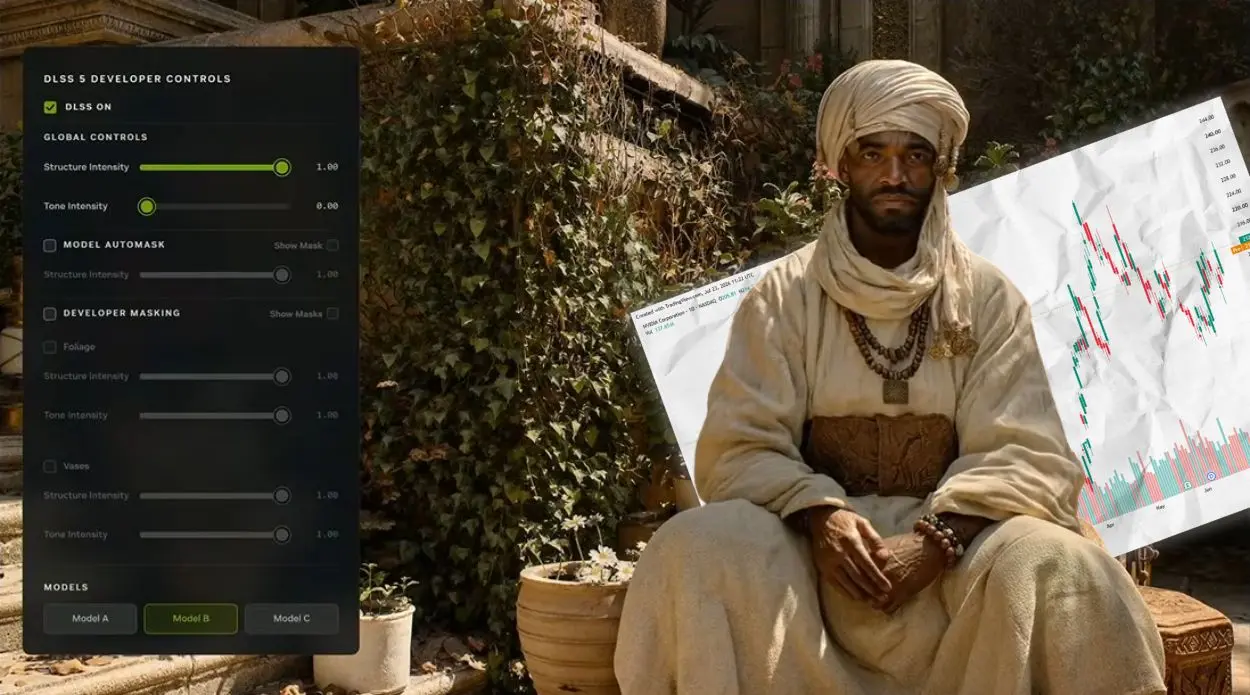
The company gained 1.3% at yesterday’s close compared to the previous day. After the earnings announcement, it lost 1.26% in the post‑market phase. This market reaction seems understandable. Nvidia did not disappoint operationally, but the target was set exceptionally high. The stock had been rising strongly, so some investors could realize gains after the data release. A drop in shares despite better‑than‑expected results does not indicate weak fundamentals but shows that the market is starting to demand from Nvidia not just growth but almost perfect execution of its expansion scenario.
The end of "easy growth"
In the long term, Nvidia’s story remains very strong. The company is a central player in the AI revolution, has a unique technological position, and benefits from huge demand for computing power. At the same time, its future valuation will depend on answers to several key questions: will AI demand maintain its current pace, will new areas such as robotics and physical AI truly become major revenue sources, will export restrictions on China permanently hamper growth, and will competitors and major customers erode the company’s advantage?
Nvidia remains a symbol of the current AI wave, but the market is increasingly moving from unconditional enthusiasm to a more selective assessment. The company’s fundamentals are strong, forecasts remain very ambitious, and long‑term potential is huge. At the same time, with such high expectations, even great results can be deemed insufficient if investors start fearing a slowdown, competitive pressure, or geopolitical issues. That’s why Nvidia remains a leader of the AI revolution, but also a company that the market no longer tolerates any sign of uncertainty.