Additional support for the USD came from the hawkish tone of the Fed’s decision. As a result, the main pairs with the gold broke local resistance levels. In the debt market, pressure on bonds was maintained by rising oil prices and inflation expectations, further reinforced by hawkish signals from the Fed. Yields in base markets approached March highs. Thursday’s session will be rich in macro events and central bank meetings.
Euro rate – forecast for the coming days
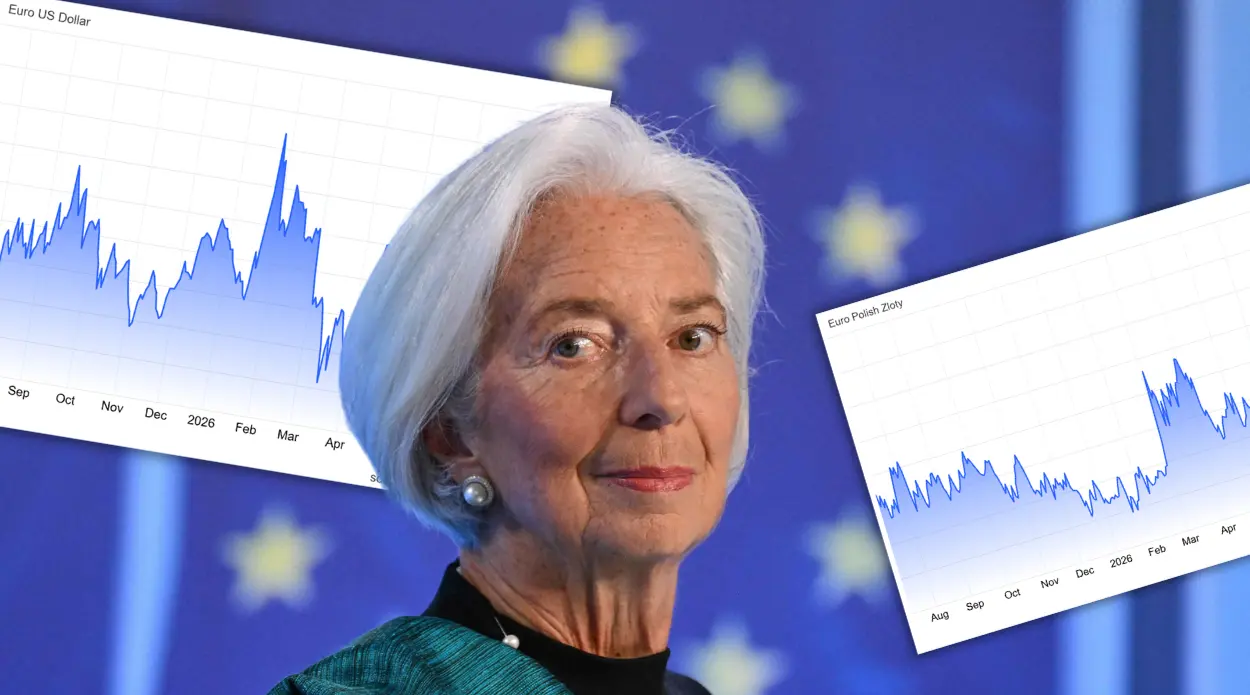
We expect continued high volatility in the FX market (EURPLN 4.2550–4.27; USDPLN 3.6450–3.68), while in the FI market the direction of changes will remain strongly dependent on the oil market, where there are currently no signals of a trend reversal.
Before the start of the May holidays we face an intensive day in terms of central bank decisions and data releases. The BoE and ECB will decide – in both cases rates will likely remain unchanged. In the face of rising inflation and a negative supply shock, choosing the right monetary policy direction is difficult, leading policymakers to adopt a "wait-and-see" strategy.
Among national releases, the NBP will publish a "Quick Monitoring" of enterprises, though the most important will be the preliminary CPI reading for April, which in our view fell to 2.9% YoY (consensus: 3.0% YoY) from 3.0% YoY in March, mainly thanks to the CPN program and favourable food price trends. Inflation data will also come from the eurozone – an increase to 3.0% YoY from 2.6% YoY is expected, although German data may signal a positive surprise – and from the USA (PCE deflator).
Today we will also learn a series of GDP readings for 1Q26. In the eurozone, a slowdown in growth is expected, especially in Germany. In the region, Hungary’s economy is likely to have accelerated, and Czech results should be similar to those in 4Q25. In the USA, according to consensus GDP will accelerate to 2.2% QoQ SAAR from 0.5% in 4Q25, although the Atlanta Fed nowcast indicates only a 1.2% rise.
Fed keeps rates unchanged (3.50-3.75%)
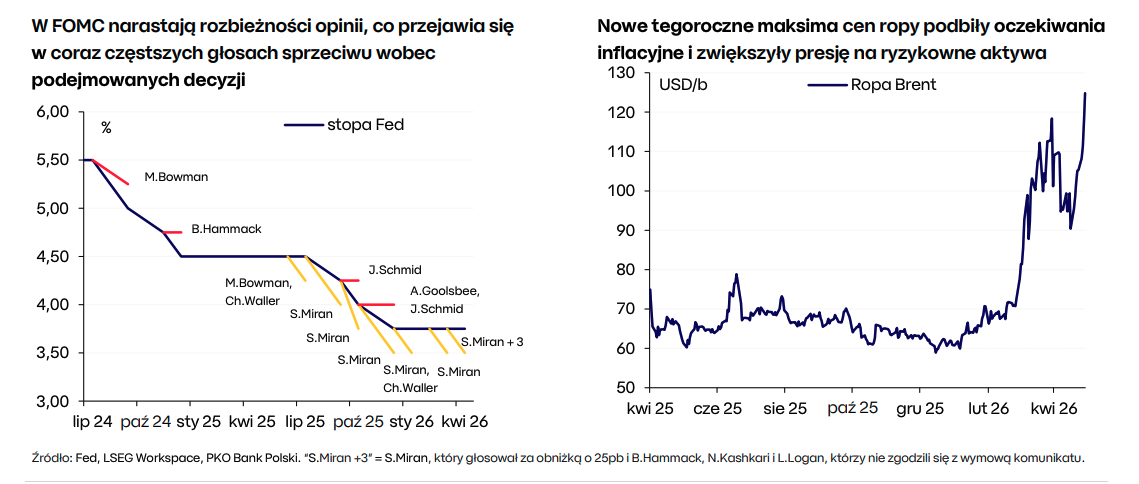
The Federal Reserve kept interest rates unchanged (3.50-3.75%), in line with widespread expectations. Chairman J. Powell noted that "textbook" the best response to a negative supply shock is to keep rates unchanged, but he emphasized the need for caution and readiness, as US inflation has long exceeded the target. The decision was made amid the widest split in the FOMC since October 1992 – 8 members voted to keep rates unchanged, 4 opposed the decision.
Board member S. Miran voted for a 25bp rate cut, and the other 3 dissenters (B. Hammack, N. Kashkari, L. Logan) agreed with the decision to keep rates unchanged but opposed a dovish tone in the communication (easing bias, no specific wording). Perhaps it refers to keeping unchanged the statement that the Committee will consider incoming data when deciding on further rate adjustments, which could suggest that the next Fed move would be a rate cut (as the latest projection showed). At the same time, as J. Powell stated, no one in the FOMC has yet expressed a desire to raise rates, although hawkish members would like the Fed to communicate that the next move could be tightening monetary policy.
More clarity on this issue may come from Fed minutes. The opposition of three members could also be a signal sent to the president‑nominee, K. Warsha, indicating a lack of agreement on rapid rate cuts and opposition to political pressure on the Fed. The communication emphasized that economic indicators suggest the economy is growing solidly, and the labor market condition is weak but stable.
President J. Powell also pointed to the economy’s resilience at the conference. A key change in the communication was the modification of the assessment that "inflation remains slightly elevated" to "inflation is elevated, partly due to rising global energy prices". This was the last meeting of J. Powell as Fed Chair, as his term ends on May 15.
The Chair noted, however, that he may remain on the Board until January 2028, explaining this by uncertainty that legal attacks on the institution will not occur. At the same time he emphasized that, by custom, he planned to fully step down to allow a smooth transition. He added that he would leave the Fed after the legal dispute ends. He spoke positively about K. Warsha, expressing confidence in his assurances of impartiality and apolitical stance and praising his competence. At the end of the conference he said: "I will not see you next time," which also suggests a smooth change in the Chair position.
K. Warsha received support from the Senate banking committee
K. Warsha received support from the Senate banking committee (vote 13-11), opening the way for his confirmation as Fed Chair. J. Powell’s term ends in mid‑May.
Inflation in Germany rises
April CPI inflation rose to 2.9% YoY from 2.8% YoY in March, below expectations (3.1% YoY). The increase was driven by energy prices (+10.1% YoY versus 7.2% YoY in February), while core inflation fell to 2.3% YoY from 2.5% YoY. The data structure indicates a cost shock (energy) with weakening demand pressure, especially visible in the services sector, where inflation fell to 2.8% YoY from 3.2% YoY a month earlier. This limits the risk of the energy price shock spreading and supports a cautious approach by the ECB.
HICP inflation (according to Eurostat methodology) rose to 2.9% YoY from 2.8% YoY in March, below expectations (3.1% YoY). The eurozone’s inflation reading today will also likely sit slightly below forecasts (3.0% YoY).

Chancellor F. Merz stated that he is dissatisfied with the atmosphere in the country and pointed out that Germany cannot continue the policy of the last 20 years, because "our illusion of prosperity will not survive." He also declared the need to continue difficult reforms, despite possible social opposition.