Nvidia, leader in the graphics‑chip segment, announced the deployment of innovative cooling technology using a fluid at 45°C.
Closed loop, i.e. effective statistics manipulation
Sounds hot? For a human it’s a high temperature, but for silicon servers it’s ideal operating conditions. The fluid flowing through the server racks absorbs heat, reaching 55°C, then is efficiently cooled by passive radiators using ordinary external air.
Josh Parker, Nvidia’s sustainability chief, proudly announced on Axios that “the water‑usage challenge in data centers has largely been solved.” In favorable climatic conditions the system allows a spectacular, 100% reduction in on‑site water use.
The fluid circulates in a completely closed loop, refilled only once over the entire life cycle of the facility. A server room without noisy fans or traditional cooling units becomes quieter, more energy‑efficient and (theoretically) eco‑friendly.
Wall Street reacted to these reports with enthusiasm, but inquisitive analysts quickly spotted a serious catch. Nvidia simply drew a thick line around the physical walls of its buildings.
Everything happening directly inside was optimized, but what happens outside was completely ignored. Typical behavior of giant corporations.
See also: Trump in Beijing. Nvidia shares won’t dodge the bull market? The giant’s CEO counts on a US‑China agreement
The hidden cost of energy hunger
The real problem with AI isn’t what happens in the rack cabinets, but the source of the electricity powering the chips. No data center operates in a vacuum, and the gigantic, avalanche‑like demand for electricity forces large corporations to increasingly rely on fossil fuels.
At this point Nvidia’s huge savings end spectacularly at the very threshold of the server room.
External water use, mainly generated by large power plants and advanced semiconductor manufacturers, can be two or even three times greater than the local water footprint of the facility. Nvidia’s innovation therefore solves only from 25% to 33% of the total water usage in the AI sector.
According to official U.S. Geological Survey data, fossil‑fuel‑powered plants are among the largest water consumers in the U.S., absorbing almost 10.2 billion liters per day, mainly for evaporative cooling. Gas plants consume on average 1.17 liters of water per kWh generated.
In the case of traditional coal this ratio rises sharply to 2.2 liters per kWh. Official IEA reports show that fossil fuels currently account for about half of all data‑center power worldwide.
See also: Nvidia, Intel and AMD shares on the brink? AI devours a familiar industry
Green alternatives with a spoon, not a drop of water
Even alternative renewable energy sources bring unexpected hydrological consequences. Hydroelectric plants, supplying about 10% of the global AI sector’s power, do not use water directly in the technological process, but natural evaporation from their large retention reservoirs generates a loss of up to 6.8 liters per kWh generated.
Meanwhile the modern geothermal being developed by tech giants is highly variable in performance depending on the chosen technology. Some startups, like Fervo, promise to use only degraded water unsuitable for municipal use, but it’s still a drop in the ocean of massive needs.
The cleanest in this regard remain wind and solar, using only 0.01 and 0.03 liters per kWh respectively, already accounting for production processes and regular panel cleaning.
If the trajectory of the global energy mix does not change radically, data centers will burn millions of liters of water indirectly, regardless of how ingenious and advanced Nvidia’s cooling systems are installed in their facilities.
Spectacular green reports did not satisfy investors, as Nvidia shares fell 25 June closing by 1.64%, settling at 195.74 USD.
Chart. Nvidia stock price
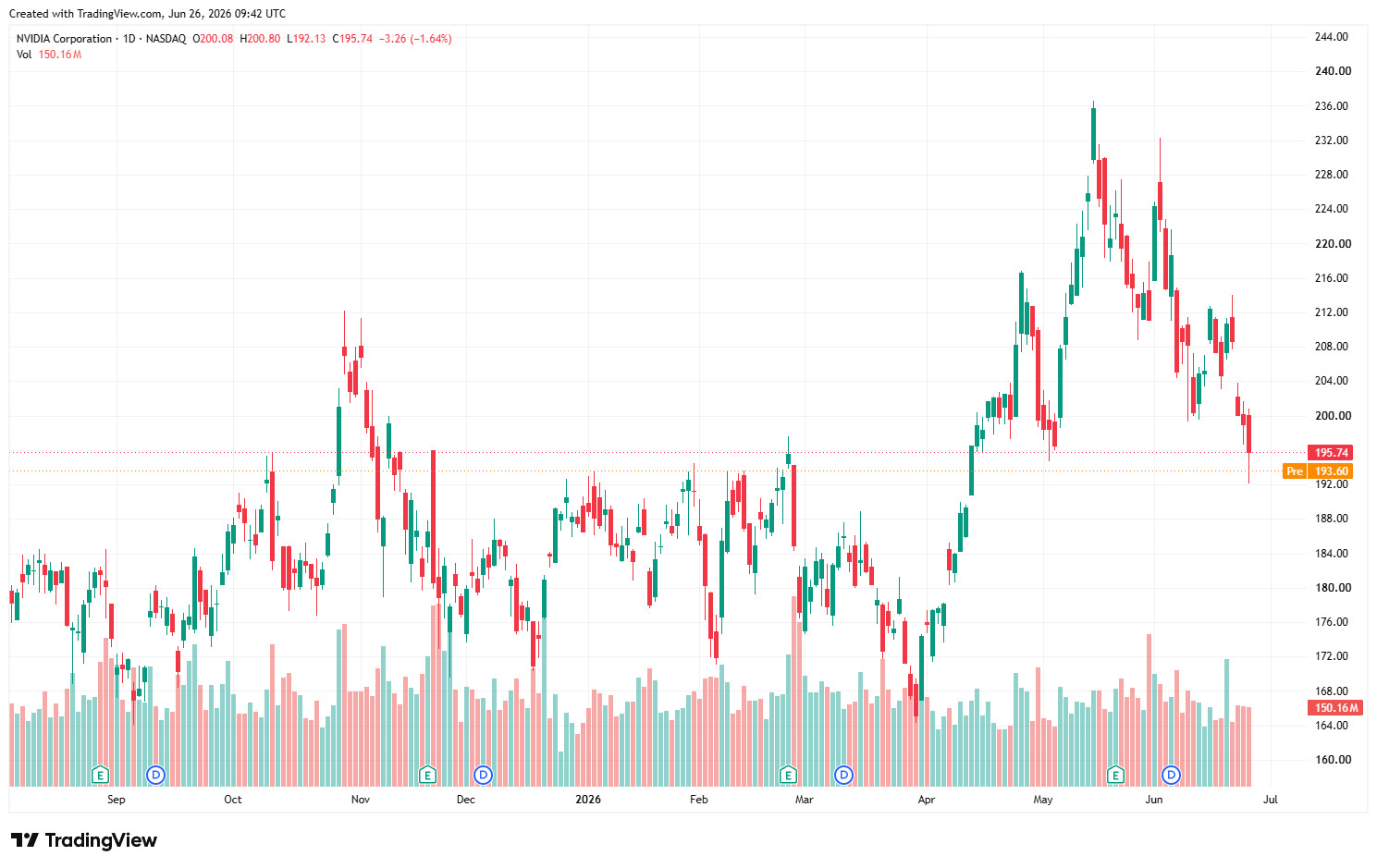
Source: TradingView.
See also: Nvidia shares crashed! Jensen Huang encourages buying. “Everyone should be very excited”
Source: TechCrunch.