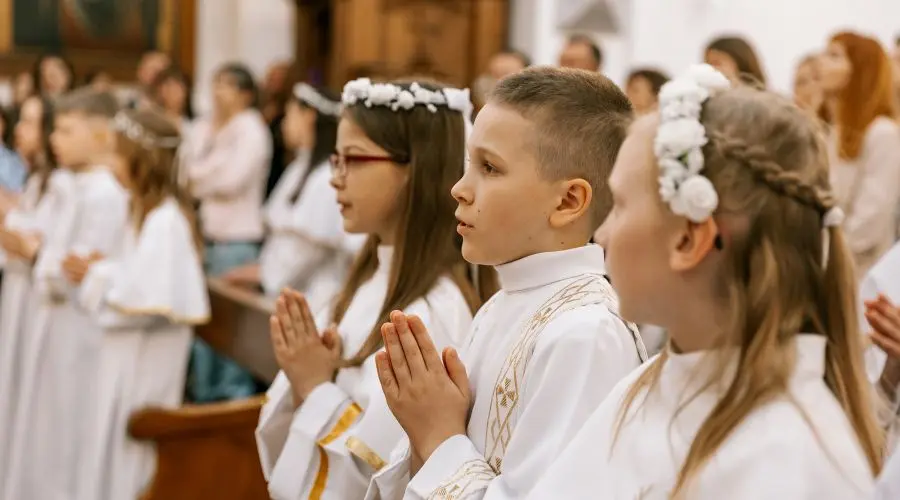
The problem is that after a few or a dozen years it is often hard to say what actually happened to that money. Some of it was spent on small expenses, some sat in an account, some slowly lost value due to inflation. After years it is more a memory of the money than the money itself. In my case part of the communion amount went to a keyboard, the first instrument I learned to play. In hindsight it was really an investment with a very high return rate.
And that is what it’s about. Money from a communion does not have to be just a gift to spend. Some can give the child joy, some can help with development, and some can start working for the future. This way the child gets not only money, but also the first lesson in managing it. And that lesson after years can be more important than the amount in the envelope.
Why should money work?
Many parents set aside a child’s money for later with good intentions. The problem is that simply “setting aside” is not enough. In Poland we still have a problem with investing for children. If money sits in an uninterest‑bearing account, a drawer, or an envelope, over time you can buy less and less with it.
That is how the silent thief of cash works – inflation. It doesn’t literally steal money from the account, but gradually takes away its value. A child can therefore have the same amount recorded on the account, but after a few years that amount will have less purchasing power.
Deposits are not enough. In April 2026 inflation was 3.2%. After accounting for the Belka tax, a deposit would need to yield about 4% per year to realistically protect savings from inflation. Such conditions are hard to find, especially for a period longer than a few months.
Keeping money in non‑interest‑bearing accounts erodes its purchasing power. Poles already have over a trillion zlotys in non‑interest‑bearing or low‑interest accounts. For adults this is often a result of caution or lack of financial education. For a child it can be the first lesson in passivity towards money.
And it could be the opposite. Money from a communion can show a child that capital does not have to just lie around and lose value. It can develop passions, help achieve goals, and work for the future.
Why time makes such a big difference?
Imagine that the already mentioned trillion zlotys that Poles keep in non‑interest‑bearing or low‑interest accounts were invested in May 2025 on the global equity market. In May 2026 the profit would be about 270 billion zlotys. That’s over 7 thousand zlotys per Polish person.
It sounds impressive, but of course it does not mean that every year on the equity market will be that good. The market can be volatile. That’s why a long perspective matters.
The global equity market grew in recent decades average annually at about 9% per year. Bank deposits, on the other hand, were around 3%. At first glance the difference does not look spectacular. But in investing, time can do a huge job.
It is clearly seen in the example of communion money. The same 2,000 zlotys invested in equities could grow to over 7 thousand zlotys after 15 years. In the case of a deposit it would be just a little over 3 thousand zlotys. It is the compound interest that does the main work here.

Regular investing for a child. How much can be built over the years
The numbers from the simulation look good, but life rarely follows a smooth line on a chart. The equity market can grow dynamically, but it can also fall sharply. It is affected by interest rates, inflation, central bank decisions, geopolitical events or company results. That is why time is so important in investing for a child.
Let’s take a simple example. A child turns 18 in May 2026. Parents invested the money received at communion on the equity market, and in addition invested 200 zlotys monthly for years. The total sum of contributions was 45,400 zlotys. That is obviously not small, but today such an amount is not even enough for a down payment on an apartment.
The situation looks different when that money actually worked. On the equity market the portfolio would have grown to 176,900 zlotys. That is already an amount that can realistically help a young person. For comparison, if the same money were deposited, the final amount would be about 59,800 zlotys. The difference is almost 120 thousand zlotys.

A child’s account can simplify formalities
If you are wondering how to invest for a child without later worrying about formalities when transferring funds, you can do it through Child Accounts on the Port. This solution allows you to invest for a child’s future, and the funds formally belong to them from the start.
This has an important practical advantage. If the funds formally belong to the child, when assets are sold the tax is paid only on the realized profit. The situation is different if a parent invests for years on their own account and later wants to transfer shares, ETFs or other instruments to the child. In that case the child would pay tax on the entire value of the transferred portfolio, not just on the earned profit.
Later you can set up a fixed transfer, so that investing is practically 100% automatic. That is a big convenience, because when investing money for a child the most important thing is regularity. Relatives can also contribute, for example grandparents, godparents or aunts, so that part of the gifts can really work for the child’s future.
Money is money, but knowledge is more important
Investing money for a child is only part of the success. Equally important, and even more so, is showing them how to manage that money later. Even a larger amount can disappear quickly if a young person does not know what a budget, saving or investing is.
If you have not yet talked to your child about money, communion money can be a good opportunity to start. Many of us did not receive such education at home and later learned finance only from our own mistakes, unfortunately often with varying results.
This is also reflected in broader data. The Polish Financial Health Report shows that with rising incomes consumption rises more than investing. As a result many people lack a financial cushion, live in debt and stress about finances.
How communion money can become a lesson in investing
A sensible solution can be a simple division of the communion money into several parts. For part of the money the child can fulfill their dream. It could be a bike, a trip to an amusement park, a trampoline or something else they have long wanted. This creates memories, and the child will not feel that their money simply disappeared after years.
Part can go to developing a passion. In my case it was music, the first instrument and lessons. For another child it could be sports, photography, tinkering, astronomy or something completely different. This is a good moment to see what the child really likes and feels comfortable with. Of course without forcing anything on them.
The child’s first contact with investing
It is worth investing part of the money. It does not have to be a large sum. The key is that it is the first lesson in money management. You can then calmly explain to the child what investing is and how it can be employed to work.
You can show it very simply. By buying shares you become a co‑owner of a company. ETFs can be compared to buying a basket that contains many companies, so you don’t have to pick them individually. Bonds work like a loan to a state or company in exchange for interest.
Checking together how the value of the investment changes, talking about inflation and explaining the world of money can give the child a big advantage. Thanks to this the child will understand faster that money is a servant, not a master.
A good example is Warren Buffett, regarded as the best investor in history. He started investing at 11 and over more than 80 years built a fortune exceeding 150 billion dollars. Yet he remained a normal person whose money did not hit him in the head.
That is why it is worth teaching children to be rich not only financially, but also in knowledge, patience and good habits.
Summary
A few thousand zlotys from communion will not make a child a retiree in adulthood. But it can give them something very important. The first lesson that money can be spent immediately, saved for later or invested with a view to the future.
That is why it is worth treating communion money not only as a gift, but also as an opportunity to talk about finances. Part can give the child joy now. Part can help develop a passion. And part can start working for the future, for example through Child Accounts on the Port.