A few hours earlier, Iranian paramilitary forces warned ships to use shipping routes approved by the regime – the WSJ recalled. Earlier on Tuesday, the International Maritime Organization (IMO) had informed shipowners that, in cooperation with Iran and Oman, it was coordinating an evacuation route for ships stranded in the Gulf.
After the attack, the IMO announced a suspension of the operation. So far, neither side of the conflict has officially commented on the incident. The information provided by the WSJ, and later repeated by other media, was largely based on anonymous statements from U.S. officials.
It can be assumed that the attack aimed to emphasize that the formal opening of the Strait of Hormuz and coordination of traffic by the IMO do not eliminate Iran’s influence on shipping in the area.
This action could signal that the functioning of transport routes still depends on taking into account Tehran’s interests, including transit fees and other disputed memorandum elements.
The U.S. economy continues to move forward
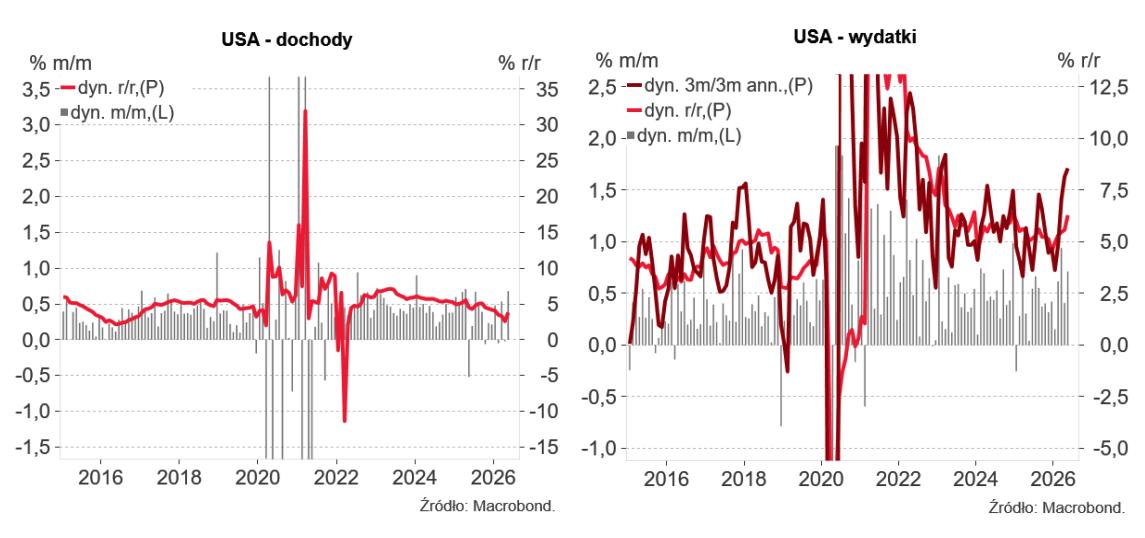
Yesterday’s overseas readings make it futile to search for weak points. U.S. May spending rose 0.7% month‑over‑month (consensus 0.6% m/m) after a symbolic downward revision of the April reading (to 0.4% m/m).
Solid data previously known, including retail sales, were confirmed. Surprisingly, income rose strongly (0.7% vs consensus 0.4%).
The main components of the reading were however close to expectations – 0.4% for private and public sector wages. The aggregate increase was partly due to higher benefits (mainly pension) and rental income.
Regarding PCE price dynamics, contrary to some market fears, there was no upward surprise. The Fed‑preferred inflation measure rose 0.4% month‑over‑month (consensus 0.5% m/m), and the core component was 0.3% m/m.
There are also no major concerns about inflation spreading. The Dallas Fed’s trimmed PCE average (excluding about 25% of the basket at the bottom and 30% at the top) came in at 2.4% annualized in May (2.3% in April; 2.4% in January).

We assess that the U.S. economy maintains decent momentum. At the same time, despite higher inflation, we still expect the FOMC to keep rates unchanged. Higher non‑core prices are not widely spilling over the inflation basket.
Additionally, sharp oil falls reduce the risk of a second‑round effect – such as rising wage expectations among workers.
Symbolic strengthening of core FI
U.S. securities reacted positively to yesterday’s macro readings. The yield on the 10‑year fell from about 4.42% to 4.38%. However, later oil price rises following Gulf events (details in the first paragraph) reduced the scale of UST appreciation. Ultimately, the change in Treasury yields at major nodes was symbolic, ranging from -2, -1 to 0 basis points to 4.09% (2Y), 4.40% (10Y) and 4.86% (30Y).
On a daily basis, little happened on the Bund either. German bond yields at major nodes closed the session at 2.53% (2Y), 2.85% (10Y) and 3.40% (30Y) after changes of -2, -2 and -1 basis points. The Asian session did not bring major changes to U.S. debt. We expect a calm session with a macro‑free calendar overseas today.
Domestic debt gains value
We had a good session on domestic bonds. POLGBs benefited from positive impulses – lower oil valuations observed in the afternoon and core FI strengthening. Support also came from better global sentiment. Ultimately, the 10‑year benchmark also fell within the range we mentioned earlier in the week (5.30‑5.35%).
The daily change at major SPW nodes was -3, -2 and -5 basis points to 4.15% (2Y), 4.82% (5Y) and 5.33% (10Y). Today we do not expect a continuation of domestic debt appreciation. External conditions are less favorable (Gulf incident, worse sentiment in Asia). As a result, we assume the 10‑year benchmark will stay near Thursday’s close.
Another defense on EURUSD
Before yesterday’s U.S. readings, the dollar attempted to appreciate but did not succeed. A calm reception of overseas FI readings (U.S. yield decline) caused the dollar to return to its morning level.
Ultimately, the change on EURUSD was symbolic, rising 0.1% to 1.1375. Today, like with base FI quotes, we expect a neutral session on base currencies. We assume EURUSD will stay near yesterday’s close.
Gold slightly stronger
A neutral market reception of Thursday’s overseas readings allowed gold to strengthen slightly. EURPLN moved down 0.1% ending yesterday’s quotes near 4.2850. In the region, we saw a slight divergence – the forint benefited from better global sentiment and appreciated to the euro by 0.3%, while the Czech koruna slightly lost value.
In the base scenario, we assume domestic currency quotes will be flat today.
EUR/PLN rate – forecast for today
EURPLN should stay in the 4.28‑4.29 range.
This will be aided by a macro‑free calendar and a relatively calm oil reaction to yesterday’s Gulf incident.