Israeli press writes in a similar tone. Reports from Pakistani negotiators point to a rather slow pace of talks and a strong reluctance on both sides to find any compromise – no one wants to cross their "red lines".
As a result, "inflation panic" continues to build on the markets, evident from the still rising bond yields – for 10‑year US Treasuries it is already 4.65%.
The market gives a 70% chance of a rate hike by the Fed in December, but indications for October have already exceeded 40%. Today agencies quote Anna Paulson from the Philadelphia Fed, who is increasingly leaning toward supporting a rate hike in the coming months.
Meanwhile, tonight at 20:00, minutes from the last Fed meeting will be released, revealing the biggest split since 1992 (three members opposed the president, arguing for more "hawkish" language in the statement). In the current situation, the pressure for "hawkish" language will only grow.
Strong arguments for further strengthening the dollar
These are, of course, strong arguments for further strengthening the dollar. On Wednesday it gains most strongly against the Scandinavian crowns and the franc (in the G‑10 space); the outsiders are the yen and the Australian dollar, although the moves are purely cosmetic.
In the case of USDJPY, concerns arise about how local policymakers will react to the recent weakening of the yen (also due to yesterday’s comment by Treasury Secretary Scott Bessey), but it seems the yen paradoxically benefited… from slightly cheaper oil this morning (or only temporarily?).
In theory, investors in this market focused on Donald Trump’s words, who reiterated that he expects a "quick end" to the war with Iran. This seems to suggest that the US president hopes that the next military operation will quickly force Iranians to concede.
In the macro calendar, aside from the already mentioned Fed meeting minutes, attention will naturally be drawn to NVIDIA’s evening financial data (the tech giant’s results will be known after the US session), as well as final Eurozone inflation data (ECB pressure is mounting to raise rates in the first half of June), and oil inventory data.
We have already seen CPI inflation data for the UK, which in April turned out surprisingly low (2.8% y/y and core 2.5% y/y). The market, however, has not changed its expectations much regarding a rate hike, which is now expected in the summer.
Eurodollar EUR/USD below 1.16
The EURUSD pair fell below 1.16 on Wednesday. The dollar, therefore, continues to gain value consistently in the context of inflation concerns and the Fed’s rate hike in the fall.
Interestingly, the euro basically ignores the fairly high probability of tightening by the European Central Bank at the June 11 meeting (over 80% chance of a 25 basis point hike).
This shows only that in a risk‑off situation (the question of renewed attacks on Iran is on the table) the dollar still leads. Key support is around 1.1570, where an additional uptrend line also runs.
Its break will signal a move toward 1.15, and later perhaps also to 1.1410 (March low).
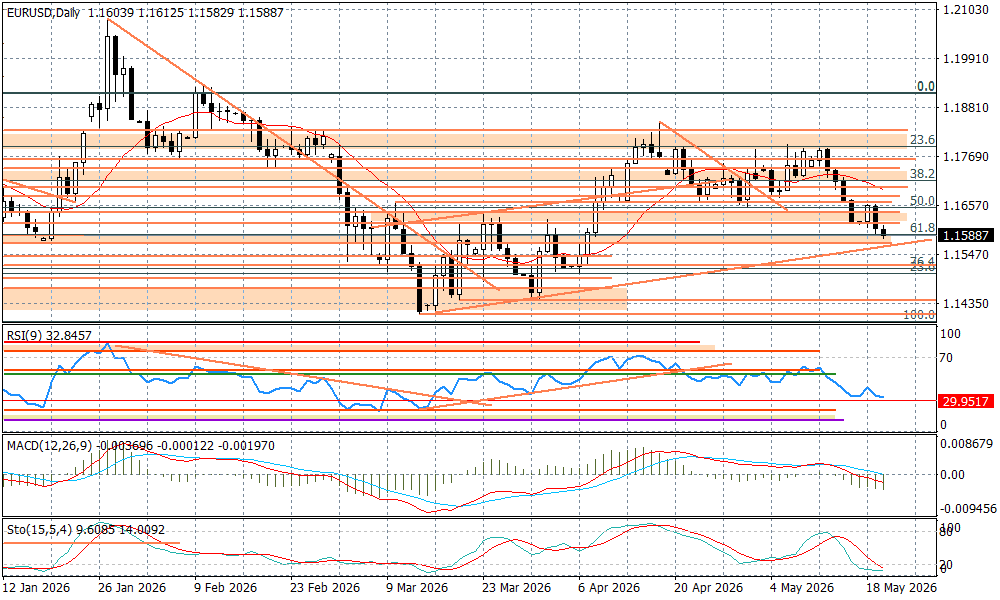
Daily EURUSD chart
Prepared by: Marek Rogalski – chief market analyst at DM BOŚ