Data far above forecasts
March macroeconomic data should already show the impact of the war in the Middle East. It must be admitted that in this context the national economy surprises strongly – and positively. Industrial production growth in March was 9.4% year‑over‑year, compared with forecasts of barely 4.2%. Earlier we also saw the release on consumer sentiment, which fell more sharply than analysts’ forecasts.
>> Read also: Nvidia and Alphabet stocks react to the giants’ launch. One of them may fall behind
And when it seemed that a pessimistically minded consumer would limit purchases, today we received a retail sales reading that completely shattered that line of thinking. The March result of 9.8% almost doubled the forecast, which only underscores that Poles are eager to reach for their wallets.
So we have a large gap between what consumers report in surveys and how they actually behave in shopping. This gives a very solid picture of the Polish economy, and at least for the moment fears of a large negative impact of the war in the Middle East seem exaggerated. For RPP it is also a clear signal that keeping interest rates at the current level has strong foundations.
Services disappoint
Today’s calendar was dominated by PMI readings from both the industrial and services sectors. The picture presented by euro‑zone data indicated a deterioration in consumer sentiment. This situation is not new. We have a simple chain of events: higher oil prices translate into higher fuel prices at stations almost immediately and cause sentiment in the services sector to deteriorate. Across the euro zone the reading fell below 50 points – to 47.4 points.
It thus fell into the range considered recessionary. The same situation occurs in individual countries. PMI for services fell even in Germany or France. Interestingly, there is no drama in industry, where PMI declines did occur (in Germany from 52.2 points in March to 51.2 points in April), but not only are they not large, they also managed to stay above the 50‑point threshold. Nevertheless, such readings today weakened the common currency, although the changes are not large.
“Edek” on support
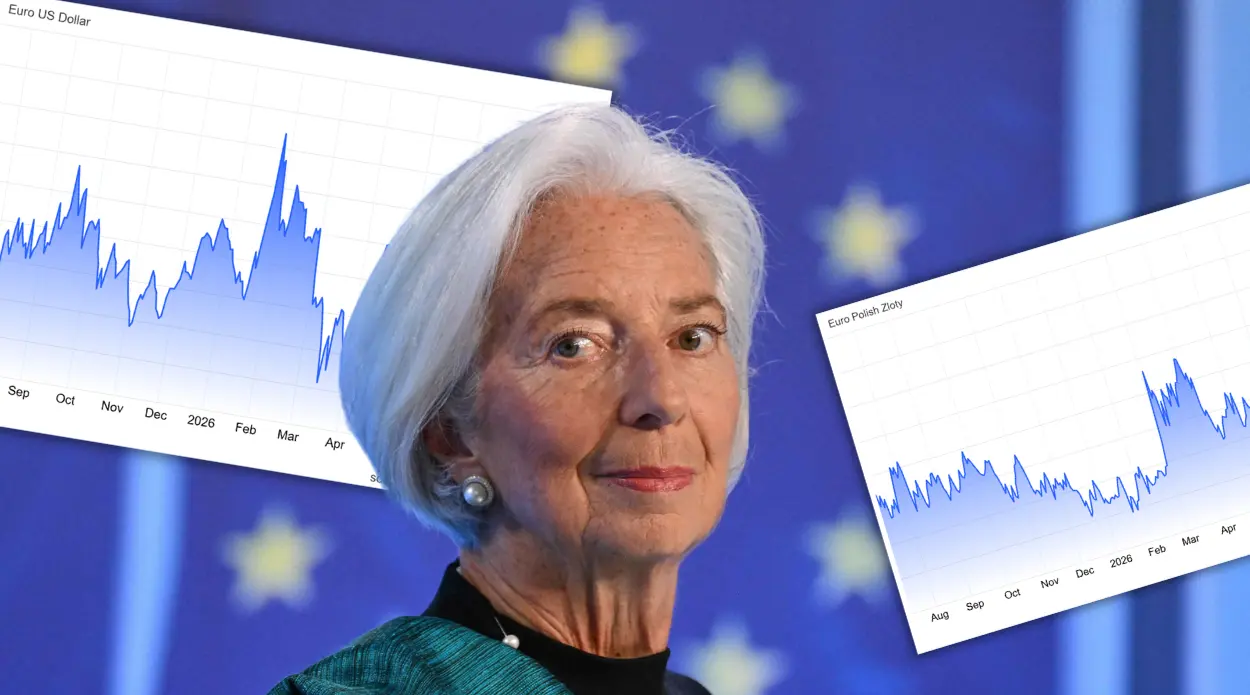
Looking at the broader picture in the currency market, we see a lack of decisiveness regarding the direction of movement in the world’s main currency pair. We still have many uncertainties in the context of the war in the Middle East, and the blockade of the Strait of Hormuz not only from the Iranian side but also from the American side only deepens the state of uncertainty. Today the popular “Edek” rate returns to the levels seen in the first half of April and falls to the support level at 1.17. The lack of escalation of the conflict should affect the rebound of the main currency pair, on the other hand the lack of prospects for a quick end to the war will not be an argument for the weakening of the USD.
The considerable uncertainty around the green also has to do with the new Fed chief, who is to become Kevin Warsh. As he himself says, he is for the independence of the central bank. He also wants to reduce the Fed balance sheet, but also finds arguments for possible rate cuts in the USA, which at least for the moment raises doubts (with rising inflation caused by rising oil prices). We therefore have arguments for the dollar to weaken, but also to strengthen, which may mean that the most likely scenario is consolidation in the near future with interspersed moves up and down.