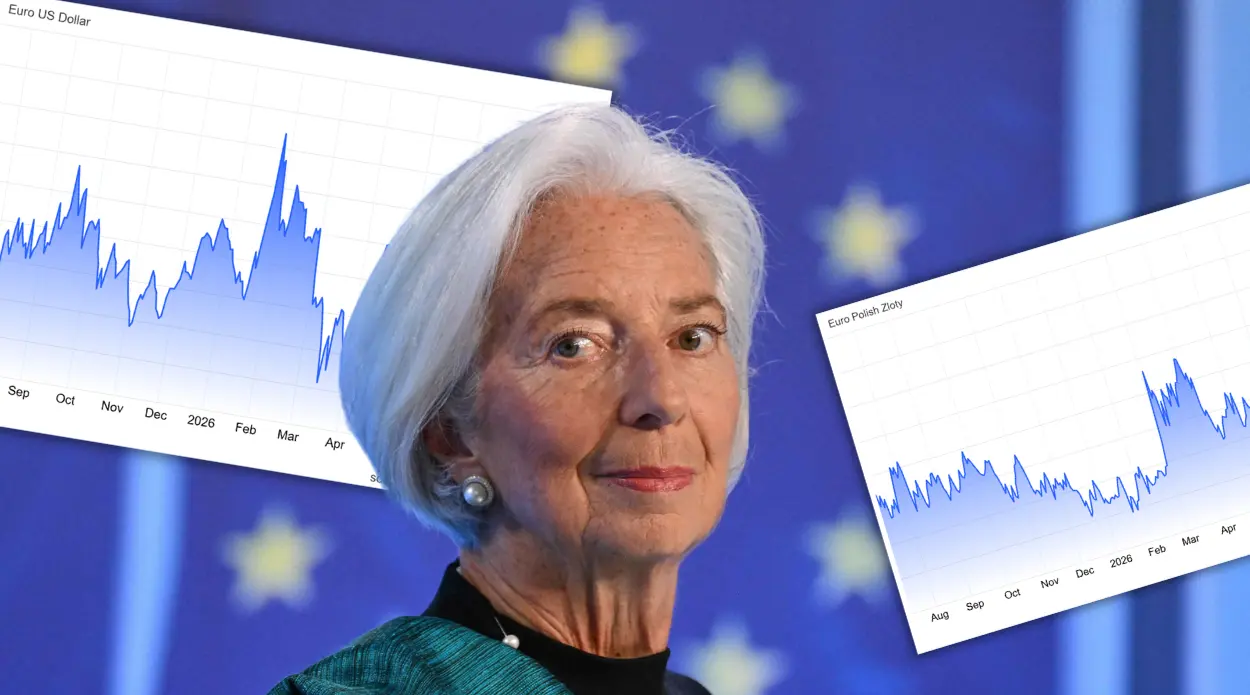
The main reasons for the zloty's weakening are the visible risk aversion in equity markets, driven by concerns about the pace of returns on AI investments, and the globally strengthening dollar, further supported by expectations of Fed rate hikes. Interestingly, the market did not react to significantly lower oil prices, which should support net importer currencies of this commodity, including EUR and PLN.
Oil price declines led to investors withdrawing from NBP rate hike valuations on the domestic FI market. With expectations of higher EBC and Fed rates than currently, this meant narrowing the implied rate differential, and thus lower attractiveness of the zloty for carry trade strategies.
As a result of the above factors, significant changes occurred in the trends of the instruments we analyze, where the dollar index (DXY) broke out above the medium‑term consolidation, EURUSD surpassed the support zone 1.1460–1.14, and USDPLN broke above the resistance zone 3.74–3.7550. On the last session of the week, mainly due to further pronounced oil price declines, the rates of these pairs tried to negate these breakouts, but they were not successful.
Euro rate – forecast for the coming days
We believe that in the coming days the global environment will still support a stronger dollar. The situation could change with weak data from the U.S. labor market, especially the NFP (Thursday), or a clearly higher preliminary HICP inflation reading from the euro zone (Wednesday), which could lead to an overestimation of market expectations for Fed and ECB rate paths.
In our view, the risks over at least a few days are tilted towards higher EURPLN and USDPLN rates, and the nearest technical resistances are around 4.30 and 3.80 respectively.
Interest Rate Market
In the interest rate market last week the yield curve of Polish bonds shifted down by about 20bp. One of the main factors favoring lower yields was the decline in oil prices and inflation expectations worldwide. It is worth noting that the annual inflation swap rates in the euro zone and the U.S. fell in line with commodity market changes to around 2.2%, close to central bank inflation targets.
It seems to us that after recent market changes the space for continuing the downward yield trend is running out. Nevertheless, on Tuesday the GUS will release data on June inflation, which should drop to 2.7% YoY from 3.1% in May. A further strong decline in inflation combined with falling inflation expectations will favor a moderation of rhetoric by the RPP. Derivative instrument pricing in Poland on Friday began to indicate a small probability of NBP rate cuts in 2027. In the base scenario we assume that the Council will ultimately decide to loosen monetary policy in 2027 by a total of 50bp. The upcoming inflation release in Poland, alongside sharply falling energy commodity prices, favors convergence of market pricing towards our forecasts.
In Europe, publications of inflation indicators scheduled for the end of June and July will also be important. For the euro zone, a decline in HICP inflation to 3.0% YoY from 3.2% in May is expected (with stable core inflation at 2.6% YoY). It is also worth noting the decline in May to 3.5% from 4.0% in April of the annual inflation expectations monitored by the ECB. All these signals create a positive environment for a potential decline in Polish bond yields, which could temporarily fall if 2‑year bonds drop below 4.15% and 10‑year bonds below 5.30%.