Fed Changed the Narrative
The June FOMC meeting led by new Fed Chair Kevin Warsh proved to be a turning point for global currency markets. The committee unanimously kept interest rates in the 3.50–3.75% range, but the accompanying Dot Plot showed that nine out of eighteen officials consider a rate hike before year‑end the most rational move.
This is a stark change from March projections, when no one in the committee anticipated such moves. Warsh was the only one who refrained from submitting his own forecast, and his rhetoric aimed at limiting forward guidance, as he admits, is intended to increase Fed flexibility, though it also raises the risk of higher volatility in the second half of the year. The median projection for the end of 2026 is now 3.8%, which the market interpreted clearly as a signal to buy the dollar.
The probability of a hike at the July meeting is already about 35–40%, and the PCE data scheduled for Thursday could further raise that probability.
Geopolitics Still Uncertain
The enthusiasm sparked by the U.S. and Iran signing a memorandum proved very short‑lived. Markets quickly recalled that talks in Switzerland are just a roadmap, not a final agreement. Iran has already again disrupted shipping in the Strait of Hormuz, Trump has not abandoned deterrence rhetoric, and negotiations are set to last up to 60 days — meaning the geopolitical risk factor never disappears.
Asian equity markets are reacting with increasing nervousness: Japan’s Nikkei 225 fell about 2.3% today, ending a streak of eight consecutive rising sessions, while Korea’s KOSPI dropped over 7%, triggering a sidecar mechanism after a 5% decline in futures contracts.
The sell‑off of tech leaders — Amazon or Alphabet, which lost 5% on Monday — is not just a reaction to geopolitics but a signal of a broader re‑valuation of AI sector valuations. This environment clearly favors the dollar as a safe‑haven currency, while undermining risk appetite.
EURUSD and the Zloty on the Edge
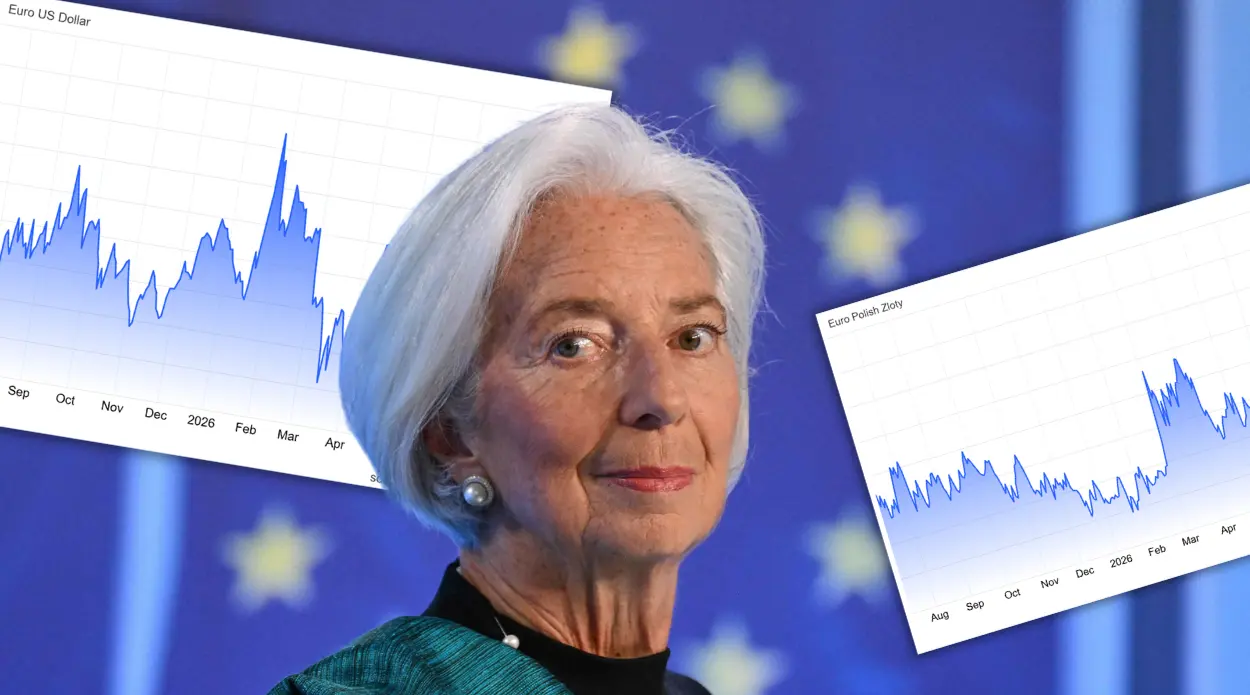
The EURUSD pair is testing the 1.1420–1.1444 level, which on the daily chart appears as a thick, horizontal demand zone repeatedly defended since summer 2025. The RSI is approaching 30, suggesting a potential technical rebound, but the moving‑average setup remains clearly bearish — all three EMAs (50, 100, and 200) are above the rate, creating dynamic resistance.
The Polish zloty feels this pressure directly: EURPLN has already broken 4.27, exiting the 4.22–4.26 range it had held for nearly three months.
May data from the domestic economy do not help — retail sales rose only 3.0% YoY versus expected 4.3%, and wage dynamics (5.8%) surprised in the negative, limiting the risk of a second round of inflation, but also providing no arguments for strengthening the zloty.
If key support on EURUSD is broken from below, the move could accelerate — both toward 1.13 on the main pair and further weakening of the zloty against the dollar.