Is the "peak office" also behind us in Poland?
• The market is stabilising at a lower post‑COVID demand level with a quickly decaying supply side, and for several more years the market will feel the effects of post‑COVID tenant restructuring.
• Warsaw’s CBD is increasingly diverging from the rest of the country in terms of demand potential, and relatively low vacancies provide a basis for the first significant rent increases in the post‑COVID period.
• By the end of 2025 modern office space resources in Warsaw and the eight analysed regional markets reached 12.96 million m², of which 6.23 million m² were in Warsaw.
• Year‑on‑year, resources fell by 118 000 m², the first annual decline of modern office resources in history.
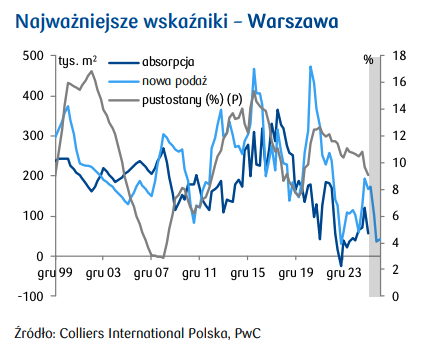
• We predict that resources will also shrink in 2026, with the most noticeable decline in the capital.
• In 2025 new supply was only 186 000 m², falling year‑on‑year by 18.5%. Supply in 2025 was the lowest since at least 2005. The decline in resources is due to an increasing trend of removing older buildings from the inventory, mainly demolishing them for residential development.
• The vast majority of new supply in 2025 fell to the capital. In subsequent years new supply in regional markets will slightly rebound. Overall, for 2026 we forecast new supply in the country at a record low of only 140 000 m².
• Absorption in the country, despite the recorded decline in resources, remains essentially continuously positive, but well below the level of the early post‑COVID years (2020‑23) and pre‑COVID.

• In 2025 absorption was 54 000 m² after a 50% year‑on‑year decline.
• The falling year‑on‑year absorption occurred under extremely difficult supply conditions and with sharply falling resources (especially in 2H25).
• The leading indicator for future absorption trends is gross demand; in all of 2025 gross demand in the country was 1.84 million m² (up 26% year‑on‑year).
• Vacancy ratios have been in a sideways trend for almost three years, but the end of 2025 brought improvement, with an average vacancy ratio of 13.15% (down 120 bps year‑on‑year, down 109 bps in 2H25).
• Overall vacancy ratios from the end of 4Q19 to the end of 2025 rose in the country by 449 bps (738 bps in regions and only 127 bps in the capital).
• In our view the rental market will remain structurally weak until 2027‑28 (delayed COVID effect), and the supply side will be similarly weak. We expect vacancies to stabilise at the current level of about 1.7 million m² by the end of 2026.
• According to Savills data, the European market saw a 40 bps year‑on‑year rise in vacancy ratio (to 9.0%). The peak vacancy occurred in 3Q25 (9.3%).
• In 2H25 rents (expressed in EUR), both effective and headline, largely remained unchanged.
• Real office rents, calculated as a percentage of office worker wages, remain at record low levels and continue to fall.
• According to C&W, in Central Europe rents rose by 4.3% in 2025 (2% in 2024).
• In subsequent 2026 quarters we foresee rent stabilisation in regional markets and a modest rise in Warsaw’s CBD.

Resources and new supply

By the end of 2025 modern office space resources in Warsaw and the eight analysed regional markets (Wrocław, Kraków, Tricity, Poznań, Katowice, Łódź, Szczecin and Lublin) reached 12.96 million m², of which 6.23 million m² were in Warsaw. Year‑on‑year, resources fell by 118 000 m², the first annual decline of modern office resources in history.
The decline in resources in 2025 occurred both in regional markets and the capital. Due to low new supply forecasts and accelerating (especially in regions) removals from the inventory, we expect resources to shrink in 2026 (mainly in the capital).

In 2025 new supply was only 186 000 m², falling year‑on‑year by 18.5%. Supply in 2025 was the lowest since at least 2005 (average new supply from 2021‑24 is 501 000 m²).
In 2H25 new supply was also very low, at just 99 000 m², down 4% year‑on‑year and slightly above 55% of the multi‑annual average (2021‑24).
The vast majority of new supply in 2025 fell to the capital. In subsequent years new supply in regional markets will slightly rebound.
Nevertheless, for 2026 we forecast new supply in the country at a record low of only 140 000 m². In the capital, a certain renaissance of new supply will occur in 2027‑29.
Lower but still positive absorption in the country
Absorption in the country remains essentially continuously positive (in many Western European countries absorption has been negative since 2020), but well below the level of the early post‑COVID years (2020‑23) and pre‑COVID.
By the end of 2025 absorption in the 4Q snapshot was 54 000 m² (the previous year it was almost 110 000 m²).
In 2H25 absorption was 38 000 m² (previous year 82 000 m²). Annual absorption was well below the post‑COVID multi‑annual average of nearly 205 000 m², and the pre‑COVID average of over 700 000 m² per year for 2017‑19.
Nevertheless, it should be noted that falling year‑on‑year absorption occurred under extremely difficult supply conditions and with sharply falling resources (especially in 2H25).
Considering the above (and the structurally binding future supply), the absorption situation can be considered healthy. The leading indicator for future absorption trends is gross demand.
This indicator in 4Q25 shows a moderately upward trend, at 559 000 m² versus 464 000 m² a year earlier (up 20%). Year‑on‑year growth in the capital was 27%, while in regional markets it was 13%. Overall, in all of 2025 gross demand in the country was 1.84 million m² (up 26% year‑on‑year).