Concrete gold and empty windows. Will the Singapore model save Polish streets?
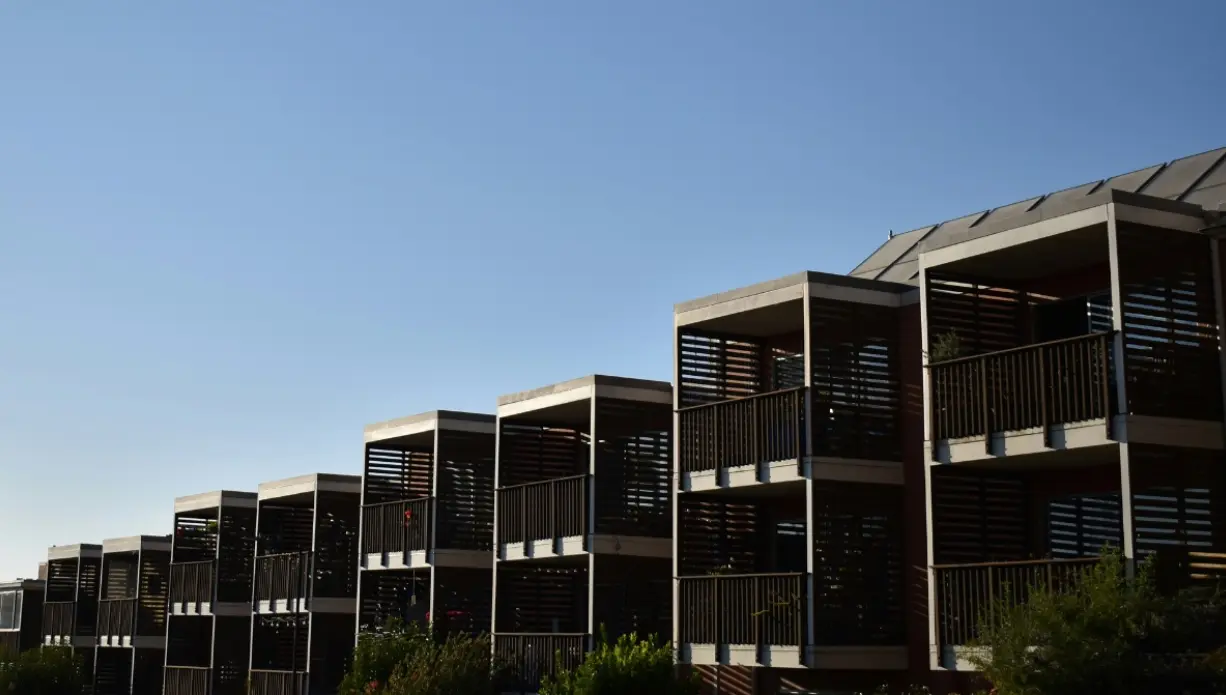
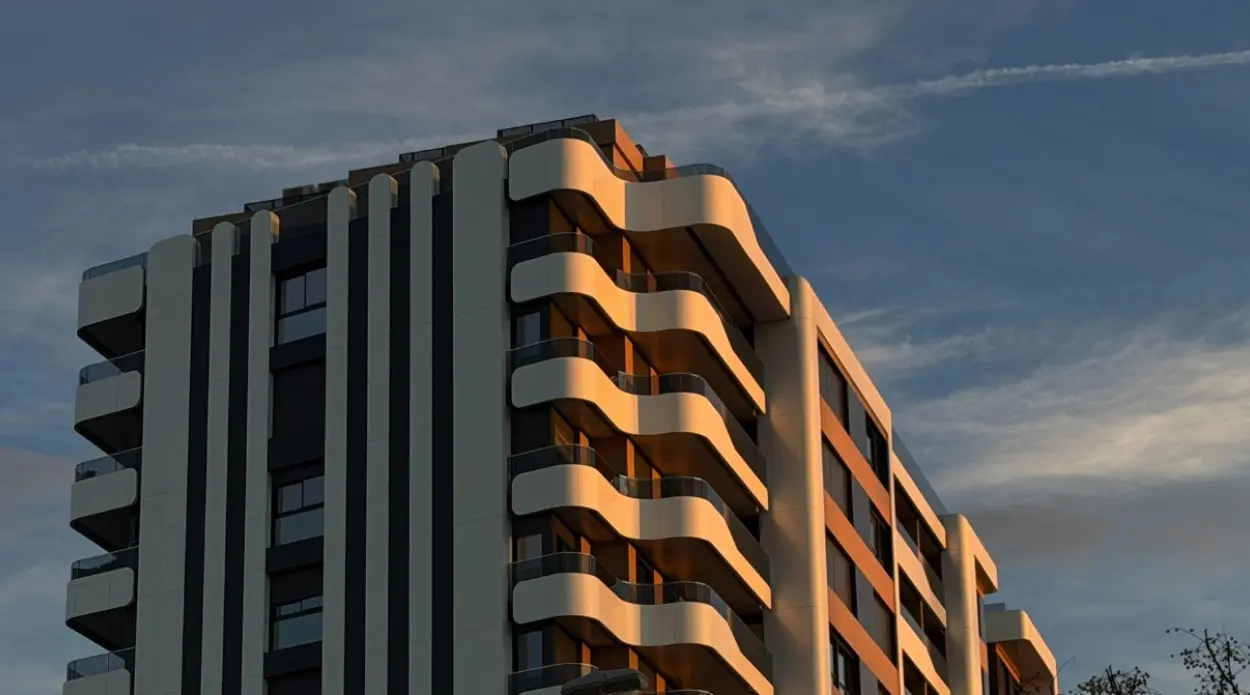
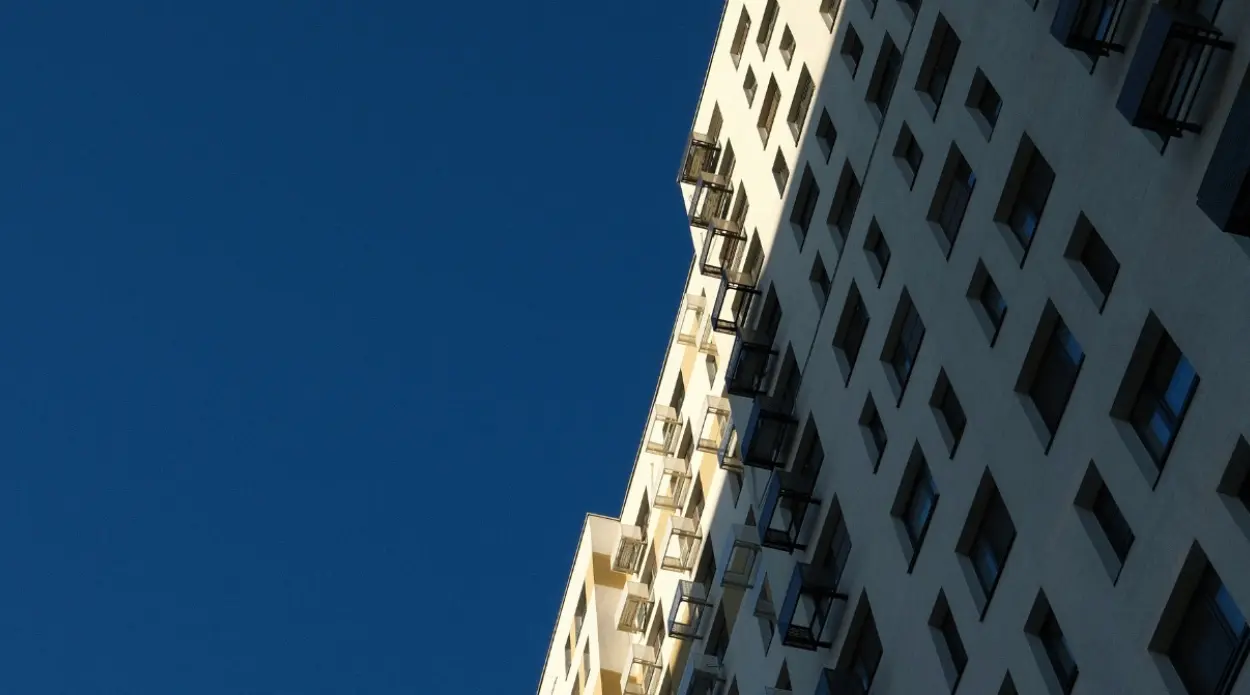
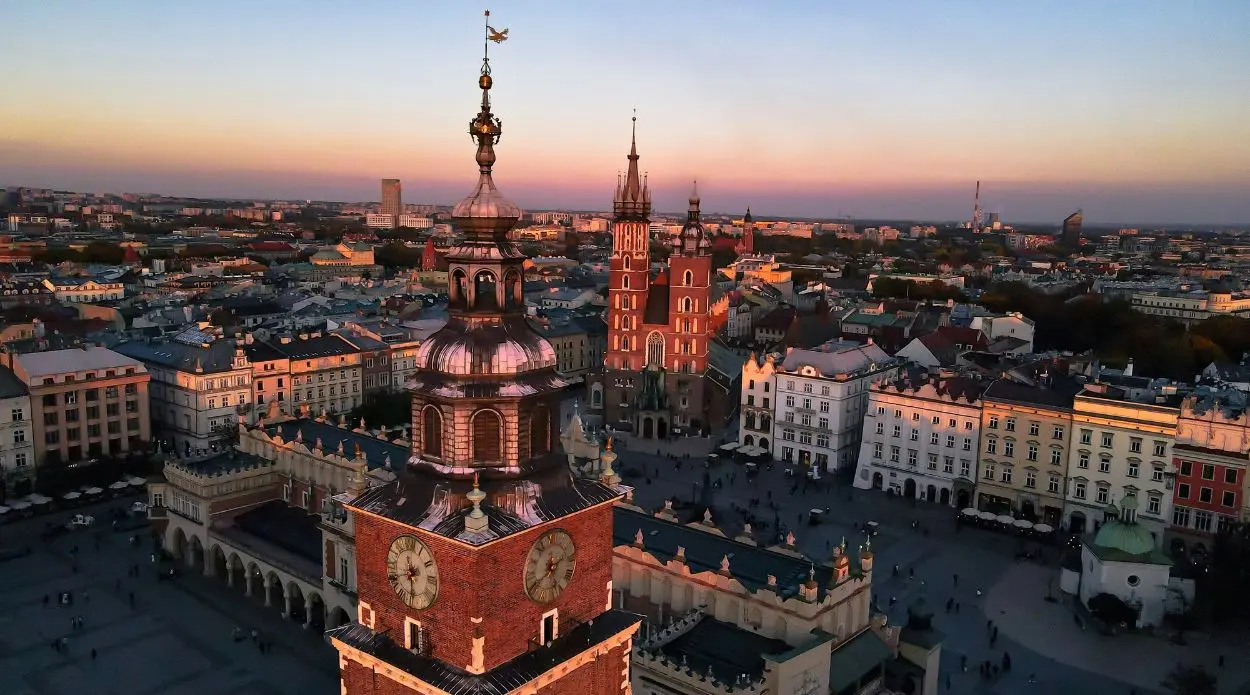
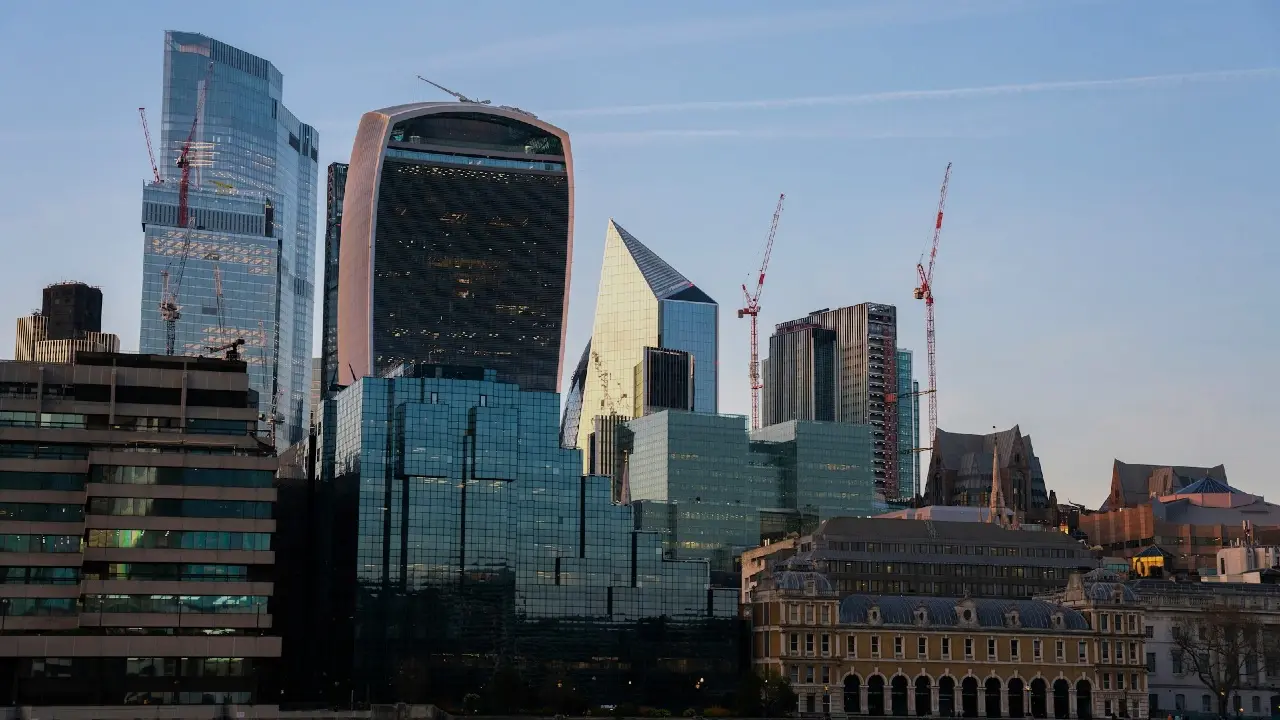
Walking in the evening through the new neighborhoods of Warsaw, Kraków, or Gdańsk, it’s hard not to feel that we live in city‑mirages. Every other window is a black hole, even though developers long ago posted “sold” signs. It’s not demography that disappoints us, but the fact that housing has ceased to be a roof over our heads in Poland and has become the most predatory investment of capital.
While the younger generation crunches mortgage calculators, the system allows “wholesalers” to amass concrete gold with almost zero maintenance costs. And here we hit the wall: according to NBP data, the average rent price in Warsaw is already 79.1 PLN per square meter. For a 50‑square‑meter apartment we pay 3,955 PLN per month – a tax for living in a city where half the windows are dark because they serve as safes. While the tenant fights for survival, the owner of a portfolio of apartments laughs at the system. Is the only cure for this fever a furious property tax?
Exclusion mathematics: 0.48 meters per salary
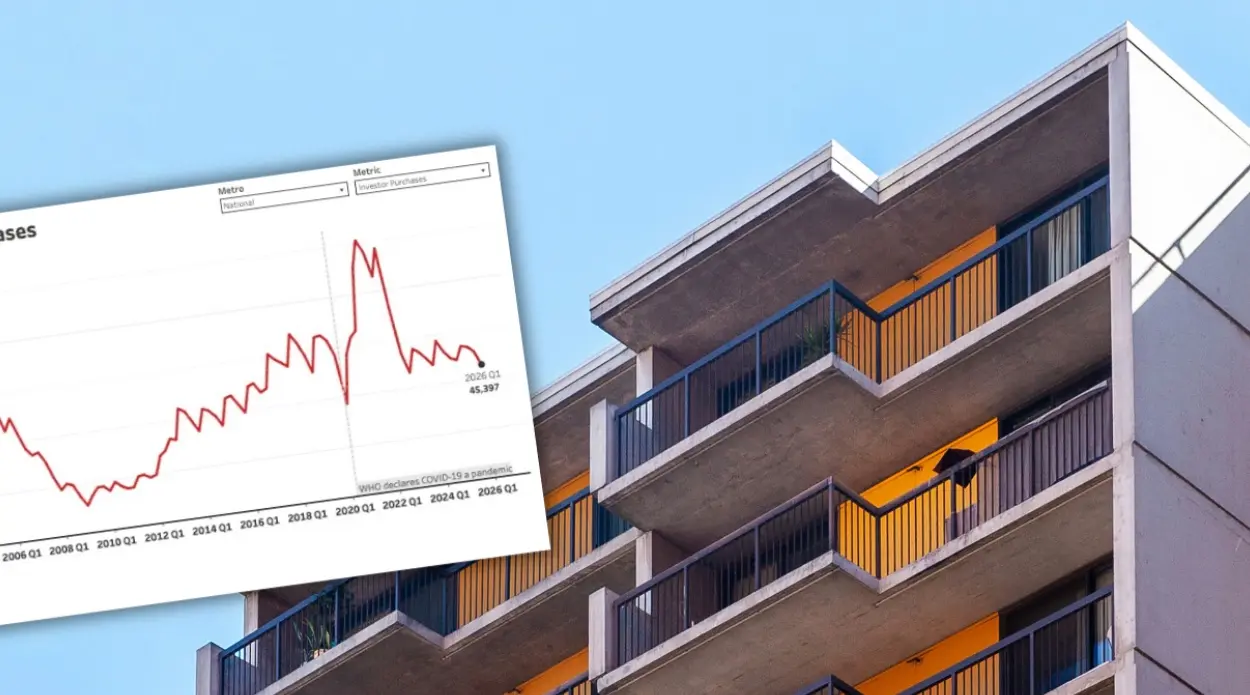
The numbers published by the National Bank of Poland are ruthless: we have become a nation of key collectors. According to the NBP report for Q3 2025, nearly half of purchases (46%) are cash transactions. This is an army of investors bidding for every square meter with young families, looking for a safe harbor in the walls against inflation. The brutal imbalance of power is best illustrated by pure mathematics. According to the Warsaw Statistical Office, the average gross salary in December 2025 was 10,933.28 PLN.
After the tax hit, this translates to a real net of 7,783 PLN. Meanwhile the average price per square meter in the capital has broken the ceiling, reaching 16,294 PLN. A typical Warsaw resident could buy only 0.48 m² of their own space with their entire monthly salary. The market has completely detached itself from wage fundamentals, becoming inaccessible to people living from their own work, not from asset turnover.
Lesson from Asia: Surgical cutting instead of a hammer
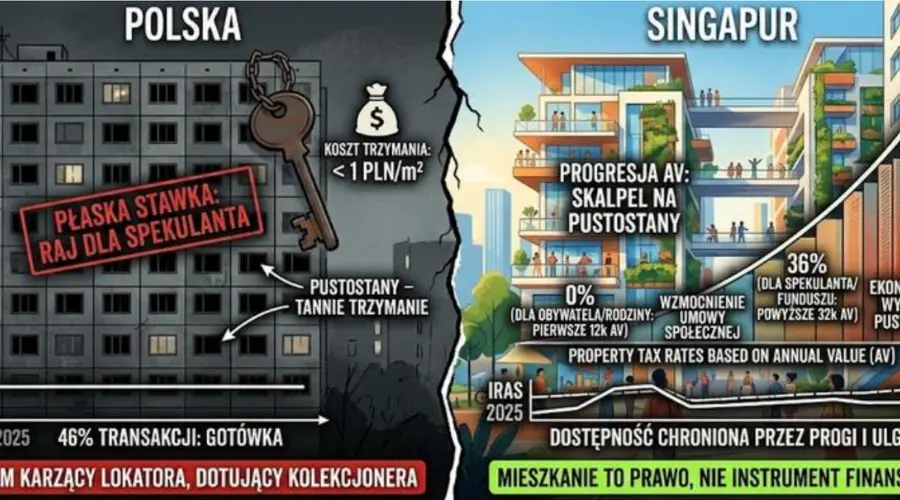
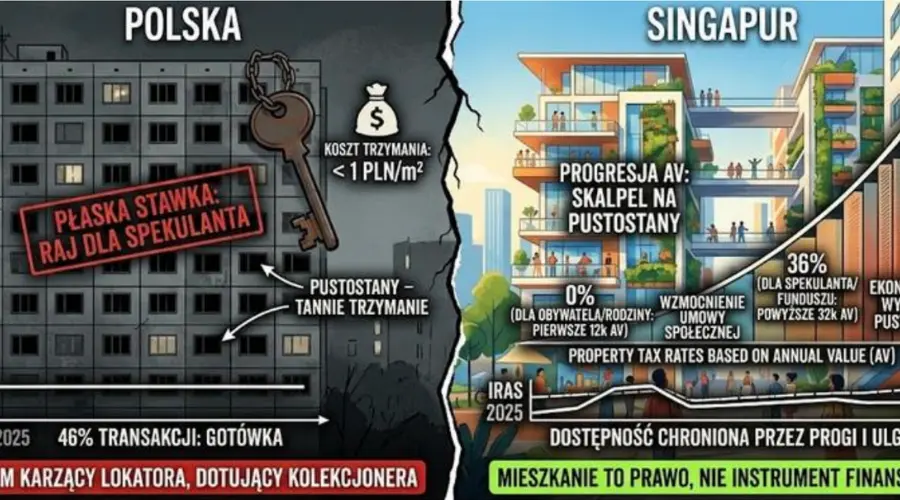
In the Polish public debate, “cadastral” is a grenade that triggers fury and cheap demagoguery about “devouring pensioners’ savings”. Meanwhile Singapore – a global symbol of the free market – proves that a smart property tax is not a cash grab but a brutally effective discipline that protects the foundations of civilization. The Singaporean tax authority has what Poland lacks: cold logic that distinguishes a home from a safe. Since January 1, 2025, the system has become even more precise, based on Annual Value (AV), i.e., the estimated annual rent a property could generate. If you truly live at your address, the system treats you as a citizen, not a milking cow – the first 12,000 SGD of rental value is taxed at 0%, so an ordinary person pays the state nothing for the right to have a roof over their head.
The tax only wakes up for luxury residences and bulk purchases, where rates for investors and funds exploiting vacant properties soar up to 36% of rental value. This is not a plea for solidarity, it is an economic death sentence for speculators – in Singapore holding “dead square meters” while waiting for price increases became financial suicide. The 2025 budget also introduced protective mechanisms (rebates) that ultimately cut the discussion about the harm to the poorest, rewarding those who truly live in the city, not just “park” capital there.
While Singapore cuts speculative tumors with cold logic, Poland cultivates a joyous (laissez‑faire), feeding “wholesalers” at the expense of young families. The Ministry of Finance Singapore (2026) is eye‑watering: the tax is meant to strengthen the social contract, not tear it apart. In Poland, meanwhile, the owner of a luxury penthouse in the center and the holder of a modest studio on the outskirts contribute to the municipal budget in almost identical, symbolic ways. This is not a free market – it is a playground for capital that does not need a home, only more digits in a spreadsheet.
Institutional hunger – Poland’s Wild West
Why do PRS (Private Rented Sector) funds love Poland so much? Because in the absence of a progressive cadaster, Polish apartments are a “safe harbor” for them with returns far higher than bonds. The current property tax structure invites speculative capital. Lack of progression means that maintaining hundreds of vacant units generates marginal costs, which combined with rising land values creates an investment game at the expense of ordinary residents.
This makes “cheap holding” of vacant properties a national sport for the richest. The absence of a value tax means entire blocks disappear from the market before they reach ordinary citizens. We become a playground for capital that – unlike people – does not need a roof over its head, only a position in an investment portfolio. The Singaporean cadaster does not hit “Mrs. Grażyna from the ground floor”, but the funds that treat our cities as a Monopoly board.
Summary: Housing is not Bitcoin. Housing cannot be “Bitcoin in walls”. If we do not introduce a smart, progressive cadaster modeled on Singapore, tomorrow the keys to our cities will be held only by fund algorithms, and we will become a nation of lifelong tenants. Poland needs a tax that is “surgical” – it saves the first and second unit, the family’s life’s work, but ruthlessly taxes speculation and dead square meters. This is not an attack on ownership, it is an attempt to restore normality in a market where the only value ceased to be a person and became solely a return on investment. It’s time to stop fearing the word “cadaster” and start fearing cities where no one can live.
Katarzyna Kozioł
Footnotes (Bibliography):
1. National Bank of Poland, Information on housing prices and the situation in the residential and commercial real estate market in Poland in Q3 2025, Warsaw 2025.
2. Warsaw Statistical Office, Statement on the socio‑economic situation of the Masovian Voivodeship in December 2025, No. 12/2025, p. 1.
3. Own calculations based on: Salary calculator Group Pracuj, as of February 2026.
4. Inland Revenue Authority of Singapore (IRAS), Property Tax Rates for Owner‑Occupied and Non‑Owner‑Occupied Residential Properties from 1 Jan 2025, official portal iras.gov.sg. Inland Revenue Authority of Singapore (IRAS), Property Tax Rates, https://www.iras.gov.sg/taxes/property-tax/property-owners/property-tax rates, 27.02.2026.
5. Inland Revenue Authority of Singapore (IRAS), Property Tax Reliefs, https://www.iras.gov.sg/taxes/property-tax/property-owners/property-tax-reliefs, 27.02.2026.
6. Ministry of Finance Singapore, Budget 2025: Strengthening Social Compact through Property Tax Reforms, 28.02.2026.
7. Eurostat, Real estate tax revenues in EU countries 2024, Brussels 2025.