The proposal is to replace the property tax, whose maximum rates are set by the Ministry of Finance, with a cadastral tax whose amount would depend on the value of the property.
Are Poles paying too low taxes?
Such is the view of officials from the European Council, who issued recommendations on economic policy in Poland, as well as social and budgetary policy. In the document published once a year, EU officials pointed out that Poland is one of the few “community” countries where the property tax is set by the government rather than calculated from its value. In their assessment, this leads to negative consequences such as lower state budget revenues and soaring property prices, which have become a capital investment.
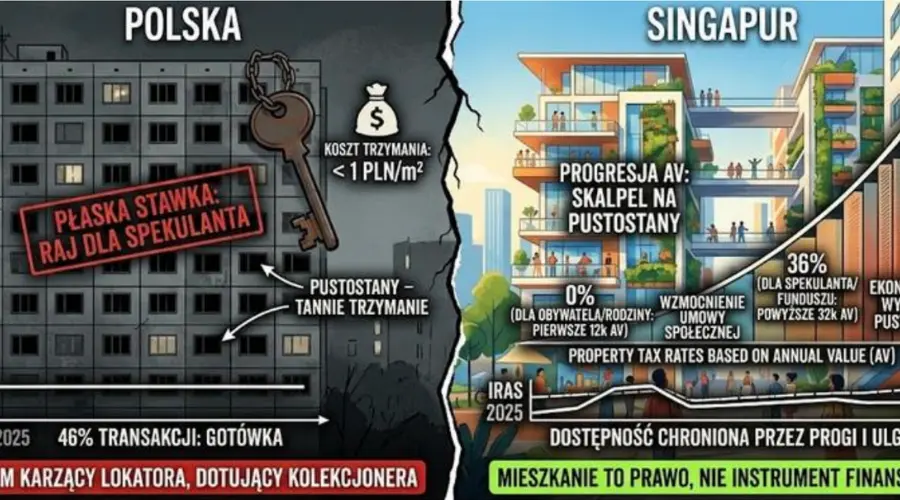
"Poland remains one of the few member states that base property tax on a very low maximum fixed rate set centrally by law, rather than on property value. This creates a regressive property tax system and contributes to speculative investment demand, because properties are taxed much lower than riskier financial assets such as shares, which increases property price inflation," the EU officials read in the document.
In the EU Council’s view, the current method of calculating property tax in Poland means that an owner of a Warsaw apartment worth several million zlotys could pay a similarly low tax as an owner of a property in a small Polish town whose value is several times lower. The change would be brought about by a cadastral tax, where owners would pay tax based on the value of the apartment or house, not its size, as is currently the case. It should be emphasized that the government, as well as Finance Minister Andrzej Domański, maintains that they do not plan to introduce a cadastral tax in Poland. Even during the election campaign, Karol Nawrocki vetoed the introduction of such a levy. One can therefore expect that the Polish president would also not support such a solution.
The New Left wants a cadastral tax
In Polish politics, emotions run high over the introduction of a cadastral tax. The greatest opposition comes from Confederation politicians, who argue that this levy is not justified for Poles. New Left politicians, however, want to introduce the tax, claiming that the lack of it keeps housing prices too high. The party has prepared a draft law to introduce a cadastral tax, but the Sejm has not yet addressed it. The New Left proposes replacing the current tax based on maximum rates set by the government with a tax dependent on property value. It would be 0.02% of market value. That is far more than today. For a 50‑square‑meter apartment, for which the maximum property tax can currently be just over 60 zlotys per year, the proposed tax would be almost 100% higher. Tax rates would rise with additional apartments. From the third and each subsequent apartment it would start at 0.5% and increase by 0.1 percentage points each year up to a maximum of 1.5%. In practice, this could mean an annual tax of up to 8,000 zlotys.
Experts believe this method of levying would not necessarily reduce housing prices or block vacant units on the market, which are treated as capital deposits. In their view, potential tenants would bear these costs, with monthly rent rising dramatically.
See also: Can property owners get more? The Treasury’s liberal approach to this type of business