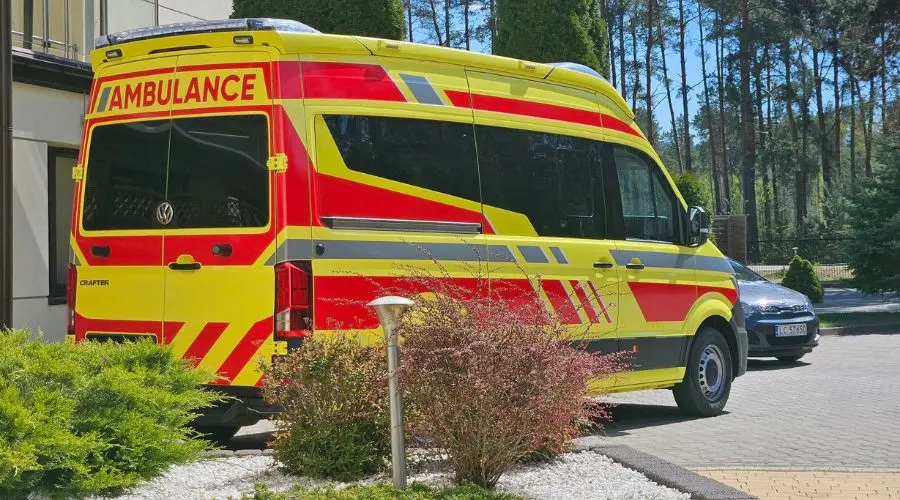
In medical vehicle offers it is easy to focus on what is immediately visible: the base van brand, the cabin colour, the type of signalling, the number of cabinets or the names of medical devices. Yet for the user the more important question—often not visible in the catalogue—is whether this ambulance will fit the real way of working for the next years.
That question changes the entire purchase logic. An ambulance for planned patient transport, a rescue vehicle for a basic team and a specialist ambulance for transporting a severely ill person may be built on a similar car base, but they are entirely different tools. They differ in working space, installations, equipment mounting, patient access and service requirements.
Therefore a well‑prepared analysis starts not with the question “Sprinter or Crafter?” but with defining the tasks. Only then does it make sense to review the ambulance offer for medical work, choose the vehicle type and discuss the cabin, equipment and maintenance costs.
Ambulance as a safety system, not a van variant
An ambulance is a special vehicle because it combines transport, medical and organisational functions. In the same compartment must fit the patient, staff, stretchers, equipment, oxygen, power, disposable materials and surfaces that allow disinfection. Every element should have its place, and its use must not hinder the team’s work.
In practice safety is decided by details: whether heavy equipment is securely mounted, whether staff can access the patient while driving, whether cabinets do not restrict movement, whether lighting allows work after dark, whether installations will not require costly modifications after a few months of operation.
That is why a modern ambulance should be evaluated as a system. The base car is important, but without a well‑designed cabin it remains only a platform. Only the combination of chassis, medical compartment, equipment, documentation and service creates a tool ready for work.
PN‑EN 1789: a common language for manufacturer and buyer
In Polish discussions about road ambulances PN‑EN 1789 frequently appears. It is a reference point that orders technical requirements for road medical transport and helps distinguish a professional medical vehicle from a regular delivery van with equipment elements.
The significance of this standard does not reduce to formality. It concerns construction, patient compartment, mounting, testing, equipment and the conditions under which the ambulance must be safely used. For a journalistic audience the simplest explanation is: the standard defines the framework in which an ambulance can be designed as a safe workplace and transport.
However, compliance with the standard does not solve all decisions. Two vehicles may refer to the same requirements yet differ significantly in ergonomics, material quality, service scope and readiness for future upgrades. The standard is a basis for discussion, not a ready answer for every operator’s needs.
A, B and C and T, P and S: abbreviations that must be read carefully
In ambulance literature two naming systems appear. The first are types A, B and C used in road ambulance classification. The second are Polish practical and system terms: transport, basic and specialist ambulance, often written as T, P and S.
These concepts can be compared, but they should not be reflexively equated. Types A, B and C primarily describe the vehicle’s function and the level of medical compartment preparation. The P and S designations relate to the Polish State Medical Rescue system and teams, whose organisation of medical rescue teams follows separate rules. T is in practice closer to sanitary or medical transport than to system rescue.
|
How to read the designation?
|
Most common practical sense
|
Risk of simplification
|
|
Type A
|
Transport of stable patients and planned transports
|
Should not be treated as a cheaper rescue ambulance
|
|
Type B
|
Basic rescue actions, treatment and monitoring
|
Does not replace specialist configuration for severely ill patients
|
|
Type C
|
Advanced treatment, monitoring and specialist transport
|
May not always make economic sense for simple transport
|
The safest approach is therefore to describe the task, not just the abbreviation. A vehicle for transporting stable patients looks different from an intervention ambulance, and a unit prepared for intensive monitoring during transport looks yet another way.
Type A: medical transport that also requires a professional design
Type A is often seen as the simplest ambulance variant, but that does not mean it can be treated lightly. It is a transport vehicle for stable patients, used for inter‑facility transfers, post‑hospitalisation transport, diagnostic trips, dialysis, rehabilitation or planned procedures.
In such an ambulance the most important are stable stretchers, a comfortable loading system, easy caregiver access, thermal comfort, ventilation, lighting and surfaces that resist intensive cleaning. A well‑designed type A does not pretend to be a rescue ambulance. Its task is efficient, safe and repeatable transport.
This solution can be particularly rational for private medical transport operators, care homes, rehabilitation facilities and medical entities performing planned transfers. The condition remains proper cabin design and service, because intensive transport quickly reveals construction weak points.
Type B: daily compromise between capabilities and ergonomics
Type B is a vehicle harder to design than it might seem. It should be a basic rescue ambulance, yet it must remain functional, not overloaded and maintainable in readiness.
In such an ambulance the logic of staff movement matters. A defibrillator, suction, oxygen, rescue kits, disposable materials and breathing equipment should be quickly accessible without searching cabinets or moving around the vehicle. Good ergonomics is not an add‑on – it shortens operation time and reduces errors.
Type B is often the best choice where a full‑spectrum rescue ambulance is needed but there is no justification for the most elaborate type C configuration. That is why in this segment it is especially easy to make a mistake: order a vehicle that is either too bare or unnecessarily overloaded.
Type C: when the vehicle becomes a mobile space for intensive monitoring
Type C is intended for the most demanding scenarios. It is a cabin for advanced medical monitoring, where you must anticipate not only transport but also intensive work by several people, equipment power, device mounting and patient access in a severely ill or unstable state.
In practice this means space for a monitor‑defibrillator, ventilator, infusion pumps, capnograph, advanced rescue kits and additional accessories. It is also important that devices not only fit in the vehicle but are available at logical points and safe during driving.
Type C should not be presented as the “best ambulance for everyone”. It is the most advanced, but also more expensive, heavier organisationally and more demanding in service. It works where the job profile truly includes severely ill patients, inter‑hospital transports or specialist tasks.
Catalog trap: more equipment does not always mean a better choice
When buying an ambulance - https://kgspecialperformance.com/pl/ambulances/ it is easy to get the impression that the longer the equipment list, the better the vehicle. In reality excess equipment can worsen ergonomics, reduce load reserve, hinder disinfection, increase service costs and create chaos in the patient compartment.
On the other hand, a too modest configuration quickly proves limiting. An operator after a few months of work may need additional mounting, power, cabinets or space for a new device. Therefore the cabin design should anticipate not only the day of vehicle handover but also several years of intensive use.
The best configurations are not the biggest or most expensive. They are coherent. Every element has justification, a specific place, staff access and a planned servicing method.
The chassis matters, but does not solve everything
Mercedes‑Benz Sprinter and Volkswagen Crafter are among the most frequently considered bases for ambulances. Both models can operate in various configurations, but the choice should come from the overall vehicle design, not from brand preference alone.
Before deciding, it is worth checking the permissible gross weight, load reserve after cabin installation, drive version, length and height of the body, patient ride comfort, local service availability, fuel consumption and warranty conditions after cabin installation. A poorly chosen base can limit even the best interior design.
That is why the base car should be chosen in parallel with the cabin manufacturer. Buying a van “in reserve” before agreeing on the medical layout can end up with problems in weight, space or installation integration.
What does the market expect today? Documentation, service and predictability
The ambulance market is maturing towards greater technical responsibility. Buyers increasingly ask not only about price and delivery time, but also about documentation, compliance certificates, tests, origin of cabin components, parts availability and after‑sales support.
This is understandable because an ambulance works more intensively than a standard passenger car. Opening doors, heating and air‑conditioning operation at idle, using lighting, chargers, oxygen installation and equipment mounting stresses the vehicle and cabin every day.
Every day of ambulance downtime is an organisational problem for the operator. Therefore predictable service and quick repair capability can be more important than a one‑time saving at purchase.
Cabin manufacturers are increasingly competing on competence
In the medical vehicle segment the cabin manufacturer’s role is crucial. They are responsible for transforming a passenger car into a medical workplace: with installations, furniture, mounting, control panels, lighting and documentation.
One example of companies active in this area is KG Special Performance, which presents solutions for road ambulances and vehicles of types A, B and C built on popular passenger bases. In a broader view this shows a market shift: the mere presence of a model in a catalogue matters less, and competence in designing a complete vehicle matters more.
From a buyer’s perspective it is therefore worth asking the manufacturer not only about the offer, but also about documentation, experience, mounting standards, service availability and upgrade possibilities after several years of use.
Short list of questions before signing a contract
- What real work profile should the ambulance have: transport, rescue or specialist?
- Does the configuration correspond to type A, B or C and does it avoid mixing T, P and S unnecessarily?
- Which documents confirm the cabin’s compliance with the proper requirements?
- What will be the vehicle’s weight after cabin installation and what load reserve will remain?
- Are the heaviest equipment’s mounting points safely planned?
- Does the cabinet, seat and device layout suit the specific team’s work?
- What is the cabin, installation and equipment service after purchase?
Conclusion: a good ambulance must fit the work, not just the budget
Buying an ambulance is a technical, medical and organisational decision all at once. Price, chassis brand and equipment list are important, but they should not obscure the fundamental question: will the vehicle safely and comfortably perform the tasks it was bought for?
In Polish realities, where alongside the public system hospitals, private carriers, medical security operators and specialist transport providers operate, there is no universal answer. That is why a good ambulance is designed from the work scenario, not from a ready list of accessories.
Source: KG Special Performance’s study on ambulance selection and editorial work based on the submitted material.