The business model currently benefits from cumulative favorable factors such as a high number of settlements, shortened proceeding times, and reduced appeals by banks, resulting in sustained profitability and strong cash flows.
At the same time, the Company is preparing for diversification by gradually developing new areas that in future years could significantly complement the expiring CHF portfolio, such as free credit sanction (SKD) or the transmission easement project, which may become an additional revenue component in the medium term.
In the free credit sanction area we observe a unique race between banks and law firms, which could be crucial for the segment’s growth pace. On one hand, banks take measures to limit dispute risk, including withdrawing or modifying contracts that could become Votum’s subject of lawsuits.
On the other hand, law firms and borrowers intensify efforts to shape a client-friendly jurisprudence line, using, among other things, the latest EU Court of Justice rulings as arguments in court disputes. In our view, the outcome of this process in the coming quarters will be key to the scale and dynamics of SKD revenue.
We believe that the recent EU Court of Justice ruling in case C‑744/24 could be a turning point for consumer loan claim recovery, as it unequivocally challenges the widespread practice of charging interest on credit costs, which banks have widely applied. The decision introduces a clear distinction between capital actually provided to the consumer and credit costs, potentially affecting the validity of many contract structures. In our view, this ruling lays the groundwork for a potential reversal of the existing jurisprudence line in free credit sanction cases.
At the same time, the EU Court of Justice did not mandate automatic application of SKD, leaving national courts to assess the impact of violations in specific cases. Nevertheless, the ruling significantly strengthens consumers’ position in disputes with banks, and the ruling itself, along with the pro-consumer stance of the financial ombudsman, increases the chances of changing the previously unfavorable jurisprudence line, which in turn prompts us to start accounting for success‑fee revenue from this area.
Fundamental Recommendation: Buy
We raise our fundamental recommendation for Votum to Buy (previously Hold) due to a revision of our current target price, which after updated forecasts indicates further growth potential. We see greater chances than before for reactivating the “second leg” in the banking segment, i.e., claim recovery based on free credit sanction after the EU Court of Justice ruling in case C‑744/24. Although only the next quarters will provide an answer on how national courts interpret the ruling, and past rulings are largely unfavorable to borrowers, we believe the chances of change are highest so far.
In our view, for the first time it is justified to include success‑fee charges in financial forecasts for claims based on free credit sanction, which raises our banking segment earnings forecasts for the coming years. At the same time, we believe 2026 will no longer be record‑setting in terms of results (2025 was), neither for the banking segment nor for the entire Votum Group, due to the natural gradual depletion of the abusive foreign currency loan client portfolio. Nevertheless, the results level remains historically high and should allow the Group to maintain above‑average profitability this year.
Relative Recommendation: Outperform Maintained
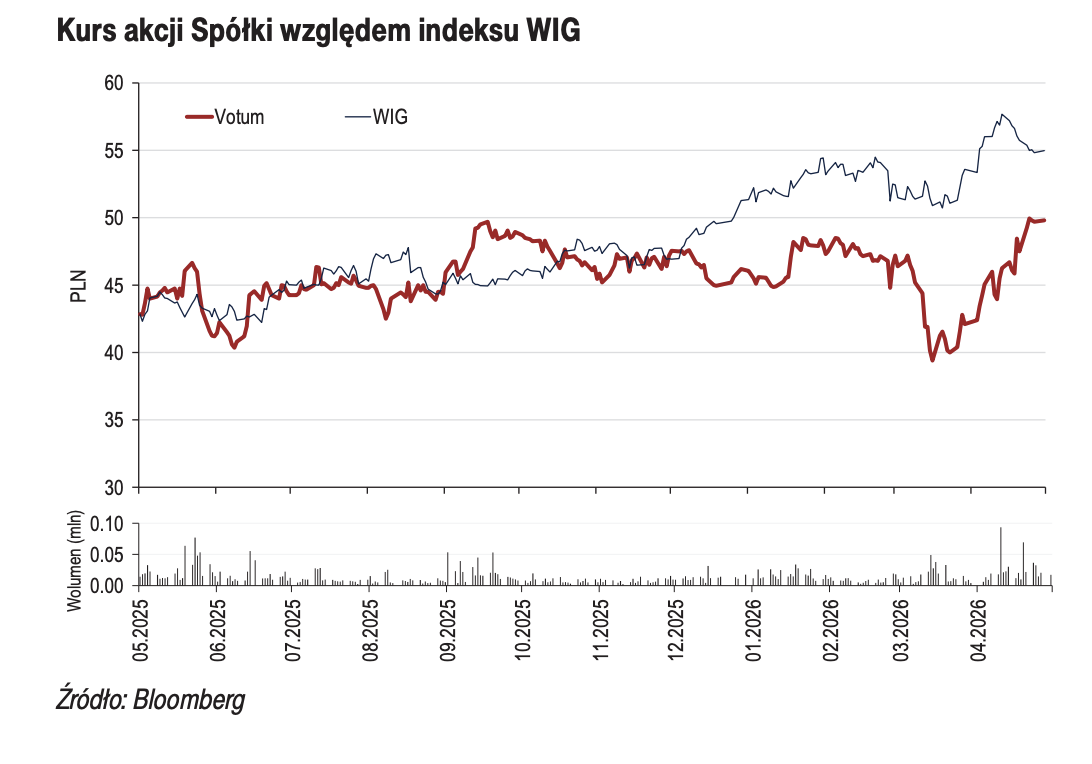
We believe that in the short term shares may outperform the market, aided by expectations of good results in Q1, but above all by further EU Court of Justice rulings in the free credit sanction area (e.g., the planned June ruling C‑831/24), where we see a high probability of further pro‑consumer decisions. A subsequent favorable ruling for borrowers would accelerate the formation of a client‑friendly jurisprudence line, potentially unlocking the segment’s potential and significantly improving medium‑term prospects for the Company. Moreover, recent dividend policy changes suggest the possibility of higher payouts than we assume.
Quarterly Results Below Expectations
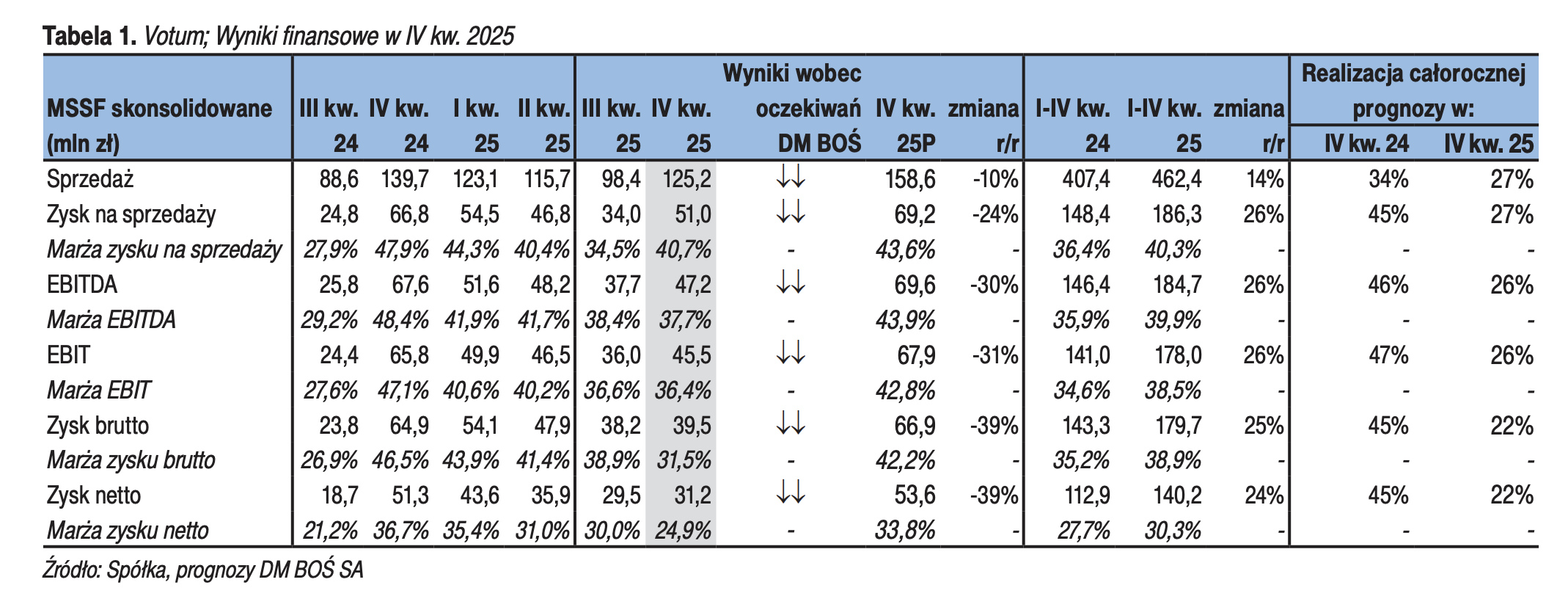
Votum’s Q4 2025 results were clearly below our forecasts at every level of the income statement: revenue reached PLN 125.2 m, operating profit PLN 45.5 m, and net profit PLN 31.2 m. The scale of the negative deviation is due to several factors:
- (i) fewer court rulings in the quarter,
- (ii) changes in success‑fee estimates,
- (iii) a goodwill impairment (PLN 3.5 m), and
- (iv) lower net financial income than expected.
Margin Pressure
Operating margins deteriorated significantly compared to the very high Q4 2024 base – EBITDA margin fell to 37.7% (48.4% a year earlier), and net margin to 24.9% (36.7% in Q4 2024).
At the same time, margins remain relatively stable quarter‑on‑quarter, mainly due to the high base effect and one‑off factors, while typical seasonal effects did not occur at this scale as in the previous year.
Net Result
In Q4, the Group’s net financial income was –PLN 6.0 m versus –PLN 0.9 m in Q4 2024. The effective tax rate was 19%, as expected.
Consequently, the Group’s net profit of PLN 31.2 m was considerably lower than our expectations. We also note that the negative deviation in Q4 2025 should be transitional and is amplified by one‑off factors (goodwill impairment, success‑fee revision), especially as fewer rulings shift revenue to subsequent periods. At the same time, the high level of cash flows is noteworthy.
Banking Segment: Main Driver of Results
The banking case segment generated nearly PLN 400 m in revenue in 2025, supported by a record number of about 8.8 k rulings and a high procedural success rate above 99%. The revenue recognition model (at the first‑instance ruling stage) causes a shift in cash inflows, but the Company indicates a gradual shortening of this lag thanks to an increasing number of settlements and rulings becoming final.
Swiss‑Franc Project Outlook
The Board assesses that the Swiss‑Franc case market is only in the middle of its cycle, and at the beginning of 2026 the portfolio included about 16 k cases with no recognized revenue yet. The Company assumes that 2026 revenue will remain at a level similar to 2023‑25 (i.e., PLN 300‑400 m annually), with continued growth in settlement numbers (20‑30% YoY) and cases concluding with payment. At the same time, the YoY drop in rulings in 2025 (‑11%) results from banks increasingly settling before issuing rulings. Votum maintains the ability to acquire about 8 k new cases annually, supported by recommendation effects and intensified marketing (TV, radio).
The Company notes that the market remains wide – about 300 k active Swiss‑Franc loans and a growing group of clients with paid loans (over 50% new cases). Additionally, the importance of new client groups such as EUR‑loan holders, who accounted for 25% of sales in Q4 2025, is growing.
Regulatory and Jurisprudential Environment
EU Court of Justice rulings on parties’ settlements after contract invalidation were deemed neutral for Votum’s business model and confirm strong consumer protection. The Company maintains a litigation strategy based on statute‑of‑limitations and claim offset, protecting clients. The Board also points to the growing importance of free credit sanction cases, where further key EU Court of Justice decisions are expected.
New Growth Areas – Business Diversification
The compensation segment, which generated PLN 30 m in revenue in 2025, has the Board’s view of potential to reach a scale comparable to the banking segment. Key new areas include mining damages, transmission equipment claims, and other property cases. Particularly large potential is attributed to transmission infrastructure claims, where the potential client base could involve millions of properties.
Law Firm Network Development and Technology Use
The strategy envisions evolving 10 specialized firms (Swiss‑Franc cases) into local, multi‑profile legal entities. Key pillars are mass claims, specialization development, and intensive use of technology (AI, automation, process digitisation). IT implementations increase operational efficiency and reduce case handling costs, evident in lower cost dynamics relative to revenue.
Strong Cash Position and Dividend Policy
The Company generates record cash flows, enabling simultaneous investment financing and high shareholder payouts. The new dividend policy assumes at least PLN 60 m per year in 2025‑27. The Board stresses that payout levels do not limit the Group’s investment capacity.
Investments and Development Beyond Law
Investments continue in the rehabilitation and senior care segment, including expansion of a centre in Kraków (launch in 2026). Simultaneously, the Company invests in law firm infrastructure and IT systems, viewing them as a key competitive advantage in a fragmented legal services market.
Costs vs. Sales Network Development
The dynamic growth in representatives (over 1,000 new in Q1 this year versus about 300 in all of 2025) does not generate significant fixed cost increases, as the model is commission‑based (success‑fee), positively impacting revenue with a neutral effect on the cost base.
Financial Forecasts
Considering the published Votum Group results for 2025 and the Board’s 2026 plans, we adjust our 2026 and subsequent forecasts. The main changes relate to higher banking segment revenue in the coming years. At the same time, we assume 2026 will no longer be record‑setting for this segment or the entire Group, due to the natural gradual depletion of the portfolio.
We expect a lower number of closed cases this year (nearly 13 k versus just under 17 k settlements and rulings a year earlier), but the level remains historically high and should allow the Group to maintain above‑average profitability. Over a multi‑year horizon, new initiatives such as transmission easement claim recovery or mining damages may begin to generate contributions, but in the short and medium term we assume limited impact on consolidated results. Consequently, our net profit forecasts for the current and next year change by 29% and 211% respectively.
Banking Segment
In the banking segment’s free credit sanction area we see much greater chances of reversing the trend toward a pro‑consumer stance, as indicated by the EU Court of Justice ruling C‑744/24, which we believe significantly increases the probability of a change in court jurisprudence.
Consequently, we assume the possibility of starting revenue recognition from success‑fee from Q4 2027, provided new rulings appear in the coming quarters. Additionally, we raise assumptions about new client inflow in the foreign currency contract segment this year (assuming 7.5 k new cases in this segment), which should support revenue growth in subsequent years.
Other Segments
In the rehabilitation segment, after expanding the Rehabilitation Centre, the positive impact should be felt already this year, and we anticipate further scale growth. In the compensation segment, we expect higher revenue in 2026, though we remain conservative in assumptions. The key growth driver here is client interest in transmission infrastructure cases and network operators’ approach, as well as courts’ stance. However, this segment may become significant for results earliest in the medium term.
Dividend Policy
Our forecasts assume a dividend per share of PLN 5, matching the minimum set in the updated dividend policy. With sustained strong cash flows, we see potential for positive surprises in shareholder payouts in subsequent years.
Financial Forecast Risk
We assess that in the short term risk is moderate and mainly related to the pace of first‑instance rulings, the shape and profitability of settlements, client acquisition, and upfront fee levels. In the medium term, the free credit sanction area becomes most important, and recent rulings are promising, making upcoming national court rulings and implementation of the EU Court of Justice ruling (C‑744/24) critical.
In the absence of a change in jurisprudence, if future national court rulings do not alter the current trend, success‑fee revenue in the SKD area could not be recognized, and we would need to revise our forecasts. In the long term, key jurisprudence will involve transmission easement or mining damages and new development initiatives.
Valuation
Updating financial forecasts, shifting the valuation horizon, and a lower risk‑free rate caused a clear change in our 12‑month valuation, a combination of DCF FCFF (80%) and comparable (20%) methods, rising to PLN 58.1 per share (previously PLN 50.2). The DCF FCFF method implies PLN 57.6 per share (previously PLN 45.5), while the comparable method gives PLN 60.0 per share (previously PLN 68.7).