Building your own computer has always been a hobby for tech enthusiasts, but the current market situation feels more like an attempt to buy a pontoon at the price of a luxury yacht.
RAM costs and the empty gamer’s wallet
The latest report from the Chinese portal DigiTimes paints a bleak scenario.
The PC market in 2026 has fallen into a lamentable state. The main culprit is component costs. Not long ago RAM accounted for about 15% of the total build cost.
Today that ratio has exceeded 30%. It is worth noting that high RAM and SSD prices will stay with us until 2028.
As a result of these perturbations, computer manufacturers are under pressure because they have two options, one of which is bad and the other even worse.
They can raise final prices by 10% to a maximum of 20% or will be forced to drastically cut the specifications of their computers, which in an era of rising game and application demands is a direct path into the cold embrace of the Blue Screen.
Importantly, weaker sales results will be recorded not only by companies supplying so‑called "ready‑to‑go" kits but also by computer hardware stores and the component manufacturers themselves.
A good example is Asus, which in 2025 sold about 15 million motherboard units, and by May 2026 sales had only climbed to 5 million units.
Although 10 million is still within reach for Asus, this example clearly highlights the market trend – computer hardware is selling increasingly poorly. Other component manufacturers such as ASRock, Gigabyte and MSI also saw year‑on‑year declines.
See also: The return of the silicon king? Deal with Apple, new processors and Intel’s huge stock surge
The silicon hierarchy dictates prices and the layout of the component market
In the tech industry, sentiment does not exist because only margins matter.
Both Nvidia, AMD, and Intel, in the face of an AI infrastructure boom, have made a pragmatic but painful decision for gamers.
The priority has become processors and data‑center architecture. Companies prefer to allocate limited throughput to high‑margin products like the H100 or Blackwell chips rather than fight for fractions of a percent in the consumer market.
Lisa Su, CEO of AMD, says plainly that rising component costs have negatively impacted the production of Ryzen processors.
Forecasts for the PC sector in the second half of 2026 are even more pessimistic, as demand is set to decline systematically. Gamers have been clearly pushed to the sidelines, while the silicon heart of the industry beats to the rhythm of LLMs and machine learning.
The AMD share price closed on Friday, May 8, up 11.44% to 455.19 USD.
In pre‑market trading on Monday the price reached 463.20 USD after a jump of 1.77%.
Chart. AMD share price

Source: TradingView.
See also: The 2026 market is preparing a surprise? "Investors should ensure their portfolios are ready for a bullish trend"
Great GPU stagnation and the 2028 specter
Just a moment ago it seemed that Nvidia would rescue the gaming industry and be the market’s engine.
None of that. This year the "Green" see no sense in refreshing the RTX 50 series because AI profits are so tempting that wasting silicon wafers on hobbyist GPUs is a loss. Consequently, rumors of shifting the RTX 60 series to 2028 seem increasingly plausible.
Are the giants feeling stagnation in the PC market? None of that, because Nvidia, AMD or Intel are recently breaking records.
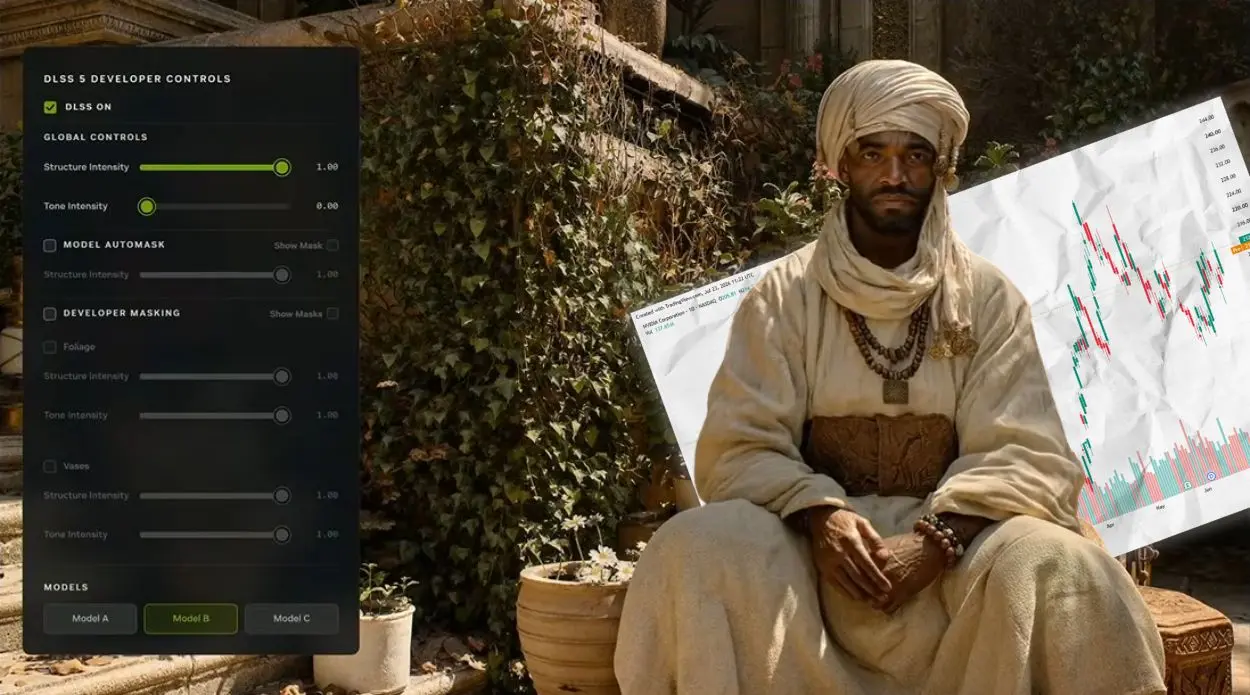
The Nvidia share price rose on Friday by 1.75% to 215.20 USD.
On Monday the price reached 213.44 USD after a drop of 0.8%.
Chart. Nvidia share price

Source: TradingView.
The Intel share price on May 8 rose by 13.94% to 124.74 USD.
In Monday’s pre‑market trading it reached 129.80 USD after a jump of 3.92%.
Chart. Intel share price

Source: TradingView.
See also: Will the market collapse due to the gaming sector? The giant warns! Its shares are now taking an unprecedented direction
Source: TwistedVoxel, DigitTimes.