According to Oracle's latest annual report, as of May 31, 2026 the company employed 141,000 people.
Big cuts for even bigger money
Exactly one year earlier the workforce was about 162,000. This drastic reduction is not a result of a fleeting financial squeeze, but a deep overhaul of the entire business model.
Such a large restructuring costs a lot. In fiscal year 2026 Oracle spent on employee severance and exit costs a staggering US$1.84 billion. By comparison, the same expenses in the previous year totaled only US$374 million.
The corporation officially explains these staffing changes as board changes, portfolio refresh, team efficiency checks, and integration of recent market acquisitions. Yes, it is the typical corporate justification for mass layoffs.
Oracle's case is not an isolated anomaly, but part of a wider, brutal trend sweeping the global tech sector.
Data from Layoffs.fyi shows that since the start of the current year, 196 tech companies have collectively shed over 119,800 employees.
The IT labor market is painfully feeling the shift toward autonomous systems. When traditional programming, administrative, or technical support roles are optimized by AI, corporate boards sign off on massive job cuts without hesitation.
There is also the other side of the coin: mass layoffs caused by the massive hiring during the pandemic.
Today budgets simply don't stretch, cuts are necessary, and AI is a great excuse for layoffs and also serves to show that a company is so technologically advanced it no longer needs employees for certain tasks.
See also: Big Tech financial results. The stock of Amazon, Alphabet, Meta, and Microsoft has started to move.
High‑stakes game for the cloud throne and billion‑dollar debt on the altar of innovation
For many years Oracle was seen as a smaller, somewhat stiff player in the race for cloud dominance. Recent months have shown that the company intends to challenge the market hegemons very aggressively.
To engage in a real fight with powers like Amazon or Microsoft, Oracle signed spectacular data‑center infrastructure deals with leaders of the new AI era: OpenAI and Meta.
This strategic partnership aims to prove to the world that Oracle's architecture has the power to train the most demanding language models. Ambitions, however, come at a cost, and for Oracle the amounts are truly astronomical.
The board officially announced that the expected net investment outlays for the current fiscal year will be nearly US$70 billion. Where to find free funds when the budget clearly doesn't stretch?
The financial plan is simple, though equally risky – the company intends to raise another US$40 billion through new debt and equity issuance. This gigantic amount includes a previously announced new share issuance worth US$20 billion.
Investors remain skeptical of success promises, as seen in Oracle shares falling 5% to US$175.97 at market close on June 22.
Chart. Oracle stock price
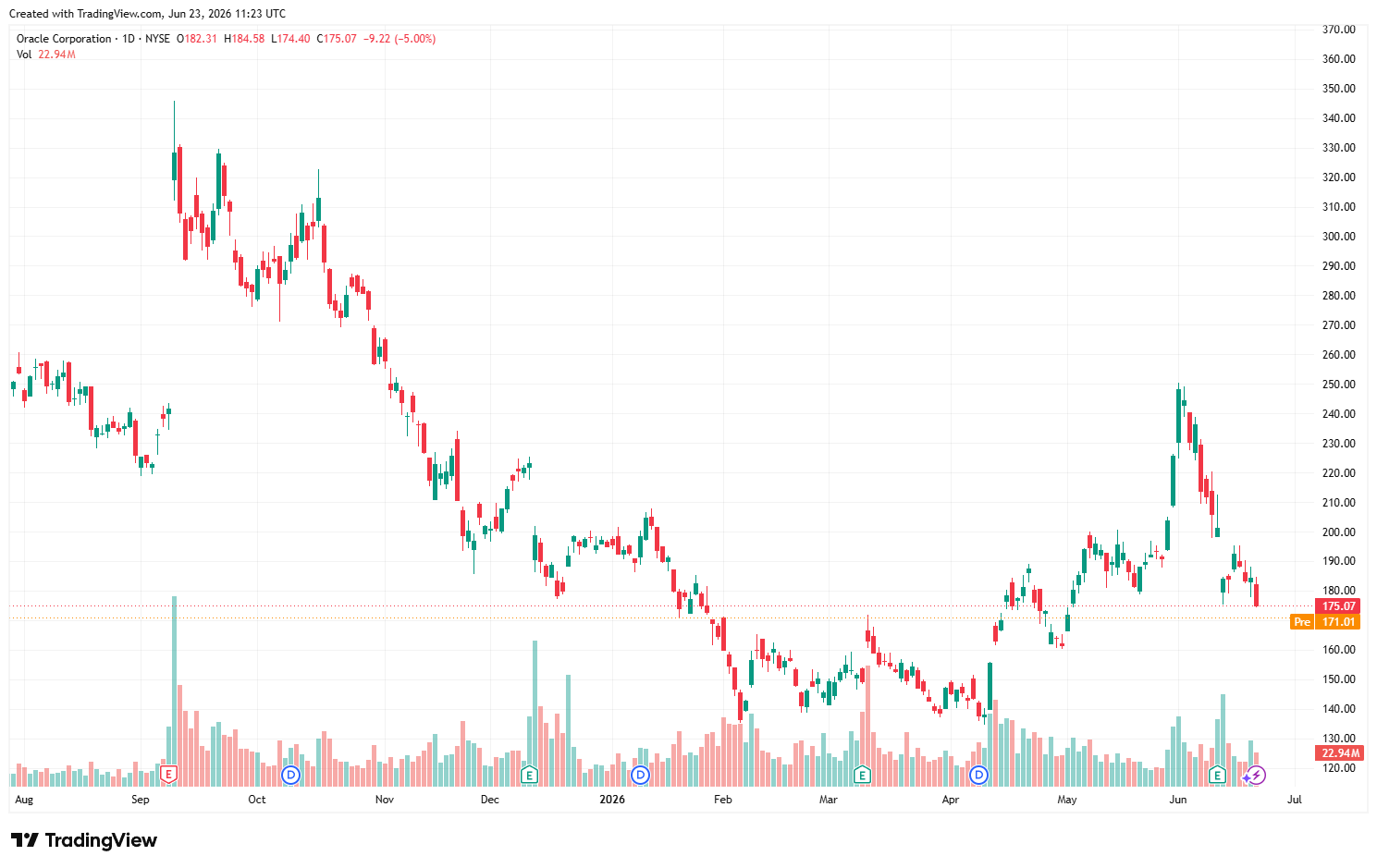
Source: TradingView.
See also: Is the 2026 market preparing a surprise? "Investors should ensure their portfolios are ready for a bullish trend"
Source: Reuters.