Analysts’ forecasts about the future of employment still sound extremely ominous.
The vision of a global job market crash
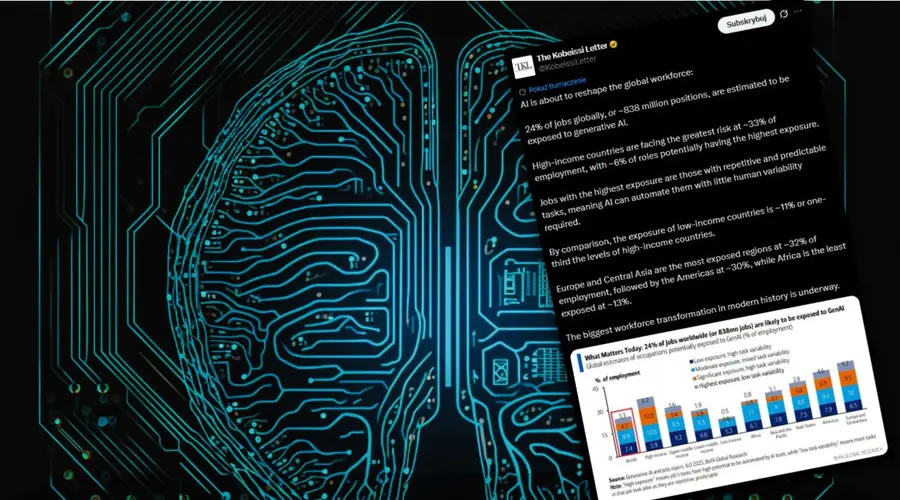
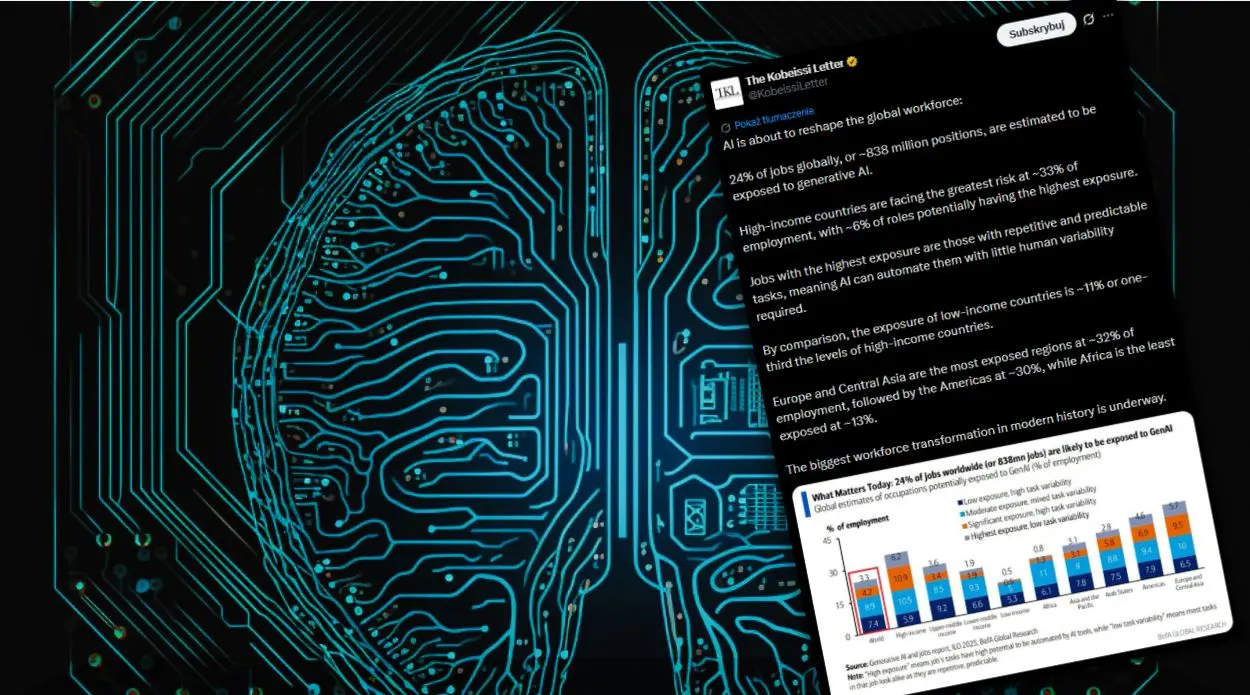
According to data from ILO and BofA Global Research, generative artificial intelligence has the potential to permanently transform up to 24% of global jobs, directly affecting about 838 million positions. The most at risk are high‑income countries, where overall exposure to automation reaches as high as 33%, and about 6% of occupational roles face the greatest risk of displacement. AI is poised to take on repetitive, predictable tasks that do not require human flexibility.
By comparison, the rate in low‑income countries is only 11%. Geographically, the leading risk remains Europe and Central Asia (32% of employment) and North and South America (30%). This was supposed to be the biggest and most fundamental transformation of the workforce in modern world history, but it was halted by a tough economy and unending budgets.
See also: Will artificial intelligence replace local entrepreneurs? Private “human language models”
Reality versus “vibecoding”
The first phase of uncritical excitement around generative AI technology has passed. The market was flooded with a wave of enthusiasm for Anthropic’s advanced Claude model (and its subsequent versions) and the phenomenon of “vibecoding,” which promised rapid app creation without deep coding knowledge. In theory, every manager could become a Full Stack Developer. In theory.
Practice quickly showed that AI generates huge operational costs, and the results can be purely illusory. A perfect example of such a reversal is Microsoft. Despite earlier announcements of investing 5 billion USD in Anthropic, the giant sharply limited developers’ licenses to Claude Code. Why? Because costs outpaced results. Programmers were moved to the cheaper Copilot.
Newer AI models are very token‑hungry and often cost companies a fortune, as Uber demonstrated when it burned its annual AI token budget in just four months according to an internal technology usage ranking. Andrew Macdonald, Uber’s COO, said it hurt directly. He found it incredibly difficult to point to a hard correlation between spending on Claude Code and real innovations serving end customers.
See also: Does artificial intelligence affect the job market? “The question is whether what’s happening in companies now is real optimization?”
Millions burned, absurd figures, and growing frustration
Examples of corporate waste do not end with Uber. Vivek Garipalli of Clover Health revealed a Fortune 500 company’s story where the CEO demanded 1 billion USD in savings at the start of the year—obviously through AI optimization of everything. The team spent 200 million USD on tokens, trying to optimize and cut costs wherever possible. The results were negligible, forcing the board to slash spending dramatically.
In the pursuit of results, even greater absurdities occurred, as the “Financial Times” reported that employees at Amazon, Meta, and Microsoft (yes, yes, the grandmother predicted it) artificially inflated AI usage statistics to meet preset targets.
Amazon introduced a rule that 80% of developers must use AI during the workweek. Although the giant eventually withdrew the idea, memes circulated online about creating AI agents that motivate other AI agents, just to burn an astronomical number of tokens.
Company boards succumbed to marketing slogans and promises of replacing humans with AI agents. It turned out that such a transformation does not necessarily provide a cheaper solution. A live employee demonstrates creativity, engagement, critical thinking, and flexibility.
Meanwhile, AI systems can burn huge amounts of tokens, stalling in place, which is especially evident with inappropriate AI deployments.
A notable example was a McDonald’s bot that, instead of being limited to answering only menu and restaurant questions, could generate code, thereby burning massive amounts of tokens—real money.
Of course, this does not immediately mean the AI bubble is bursting, but companies will certainly start scrutinizing not only the implementation of AI but also its effective use.
See also: Nvidia shares before a painful collapse? The market fears a new technological crisis
Source: ILO