What is portfolio rebalancing?
Rebalancing involves periodically restoring the portfolio to previously established proportions. Technically, this means selling a portion of assets whose share has increased and buying those whose share has decreased. If an investor starts with a 60% equity to 40% bond allocation, and after several years the equity share rises to 70%, they sell some equities and allocate the proceeds to bonds. If, after a bear market, the equity share falls to 50%, they buy equities to return to the original proportions.
Rebalancing can be applied not only to the equity-bond split. The same mechanism controls the share of different geographic regions, sectors, currencies, or asset classes. After strong gains in technology stocks, the sector weight in the portfolio may become several times larger. Rebalancing limits such concentration and maintains broad portfolio diversification, avoiding bets on single trends.
The portfolio composition constantly changes
A natural change in an investment portfolio is well illustrated by a specific example. Ten years ago, an investor split their savings equally between equities and bonds.
The equity portion was based on an accumulation ETF tracking the S&P 500, while the bond portion was an ETF investing in U.S. Treasury bonds with maturities of 7 to 10 years. Initially, each of these assets represented 50% of the portfolio value.
In subsequent years, equities performed significantly better than bonds. Already before the pandemic, their share rose to about 60%. During the COVID panic, the ratios temporarily almost returned to the starting point because equities sharply fell while bonds gained. Later, the difference began to grow rapidly.
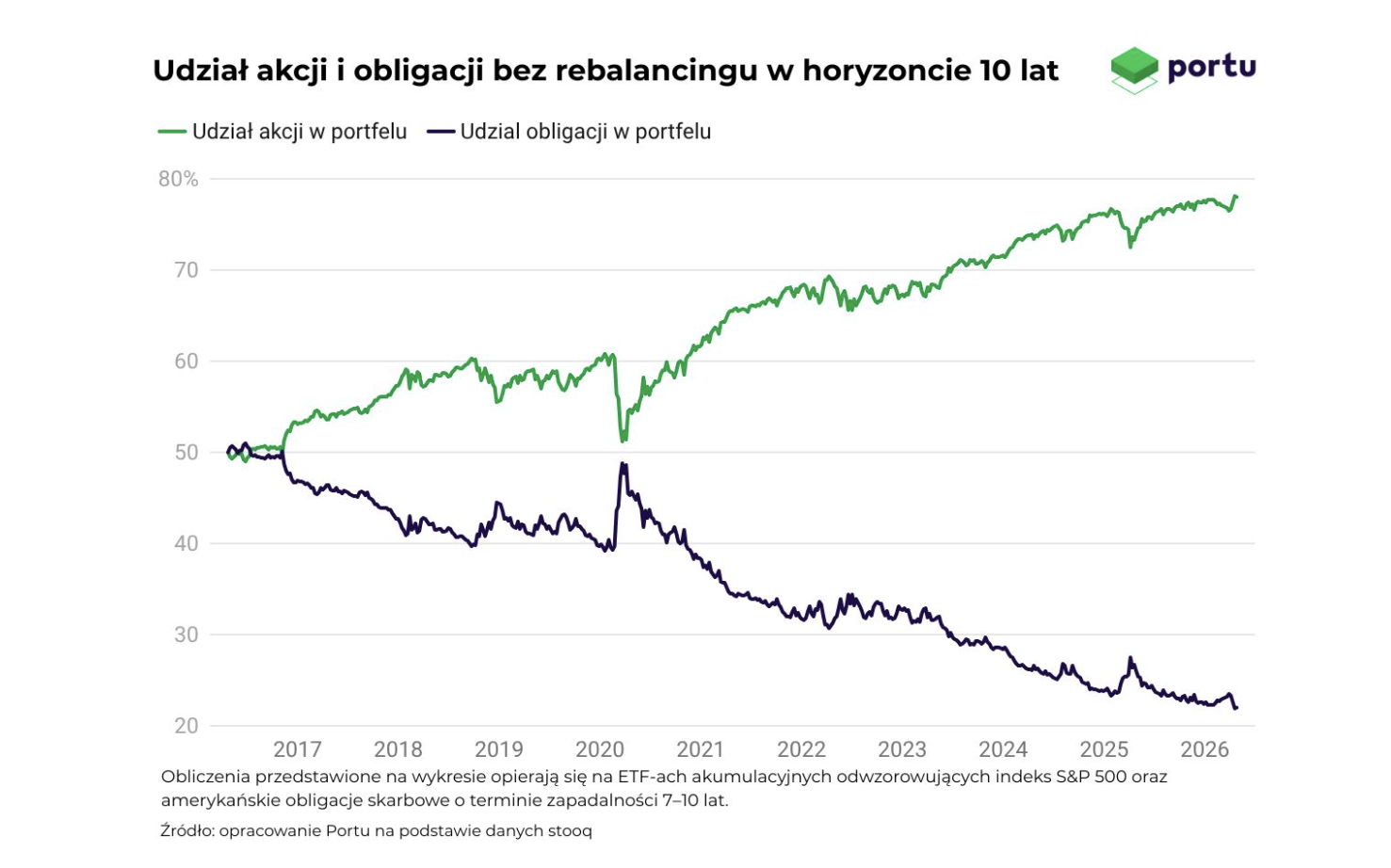
After 10 years without any rebalancing, the equity share reached about 78%, while the bond share fell to about 22%. The investor who started with a balanced 50/50 portfolio inadvertently ended up with a significantly more aggressive one.
Importantly, they did not make any decision to increase risk along the way. They did not buy more equities or sell bonds. It was enough that for years they did not react to the changing portfolio structure.
The lack of rebalancing is also an investment decision. It means agreeing that the market will gradually set the portfolio’s risk level on its own.
How does rebalancing affect portfolio risk?
The goal of rebalancing is not to maximize returns at all costs, but to keep investment risk at a level suited to the investor.
Suppose someone poorly tolerates market volatility and therefore builds a conservative portfolio with a 30% equity allocation. After several years of a bull market, that share may rise to 60%. Such a portfolio becomes much riskier, even though the investor never consciously decided to change strategy.
During a bear market, this means greater capital drawdown and higher volatility. If an investor poorly tolerates market declines, the risk increases that, driven by emotions, they will sell assets at an unfavorable time.
Rebalancing is meant to prevent that. Restoring previous proportions keeps investment risk under control.
Of course, an investor with a long horizon and high tolerance for downturns can choose a portfolio with a high equity share from the start. The difference is that it is a conscious decision, not a random effect of a few years of bull market.
Rebalancing is simple only in theory
While rebalancing is technically simple, it is psychologically difficult. Investors naturally chase winners, which can turn into FOMO. In a bull market, we want to increase the share of the fastest-growing companies or assets. Rebalancing requires limiting exposure to those segments and moving some funds to asset classes that are not currently exciting.
Selling winners and buying losers is often counterintuitive. Therefore, it is worth thinking of rebalancing as a rule set in advance. If we accept that a 60/40 portfolio is right for us, mechanically restoring those proportions should become routine. It limits emotional influence and allows the long-term strategy to work.
How often to rebalance a portfolio?
There is no single ideal rebalancing frequency. Much depends on portfolio structure, transaction costs, taxes, and the scale of market changes. Three approaches are most common.
The first is calendar rebalancing. The investor restores the original proportions, for example, once a year. It is a simple method that does not require continuous monitoring. Its drawback is the lack of response to large changes that may occur between periods.
The second solution is threshold rebalancing. Transactions are executed only when the share of a given asset class deviates from the assumptions by a certain amount. For example, a 60/40 portfolio may be restored to its original structure when the equity share rises above 65% or falls below 55%.
The third approach combines both methods. The investor checks the portfolio regularly, for example, quarterly, but executes transactions only when deviations are significant.
In practice, it is not worth reacting to every small change. If the equity share rises from 60% to 61%, executing a transaction makes little sense. Too frequent rebalancing increases the number of trades, generates costs, and may lead to unnecessary capital gains tax.
However, you do not have to manually monitor proportions and execute subsequent trades. Within the Own and Thematic Strategies in Portu, you can build your own portfolio of equities, bonds, ETFs, and other asset classes, set their target proportions, and enable automatic rebalancing. Portu ensures that the portfolio structure does not drift too far from the accepted assumptions.
How to restore proportions without selling assets?
Selling part of the portfolio involves the risk of paying capital gains tax and transaction costs. Many investors therefore choose rebalancing through new contributions. If the equity share has risen too much, new funds are directed mainly to bonds. If, after a bear market, the equity share is too low, we allocate new money to buying equities. This is how we also try to do it in Portu, to reduce the number of unnecessary trades.
Similarly, dividends, bond coupons, or funds from maturing deposits can be used. This gradually restores proportions without selling profitable assets. The method works especially well during the capital-building stage when monthly contributions are high relative to portfolio value. With a large portfolio, the scale of contributions alone may not suffice, and selling may become necessary.
Rebalancing is not the same as prudent risk reduction
Rebalancing involves restoring previously set proportions in the portfolio. However, it does not mean that a chosen asset allocation should remain unchanged for life. Portfolio management involves adjusting its composition to changing life circumstances, investment horizon, and acceptable risk level.
The closer to the end of the investment horizon, the greater the importance of protecting accumulated capital. In such a situation, it is worth gradually reducing the share of riskier assets and increasing the importance of stable instruments, such as short-term Treasury bonds or short-term bond funds.
For a 20-year-old investing with a view to retirement in a few decades, a 100% equity portfolio is a reasonable solution. The situation is different for a 60-year-old planning to retire in five years. If a bear market hits just before the goal, a high equity share exposes them to losing a significant portion of the capital built over years.
Therefore, in addition to rebalancing, it is worth regularly adjusting the portfolio structure to age, life situation, and the approaching end of the investment horizon.
In Portu both processes can be automated. Automatic rebalancing monitors the portfolio’s target proportions, while the Prudent Risk Reduction function gradually decreases the share of more volatile assets as the investment nears its end.
Thanks to robo-advisors like Portu, investors do not have to monitor proportions, execute additional trades, or make difficult decisions. Automation facilitates consistent adherence to strategy, which in the long run is often more important than trying to perfectly time market entry and exit.
Summary
Rebalancing is a simple yet effective principle that prevents the portfolio from automatically shifting to a different strategy. It does not guarantee the highest returns, does not protect against every bear market, and can sometimes lower performance during a bull market. Its main goal is to keep investment risk at the level we consciously chose.
We cannot control markets, but we can control our portfolio’s structure. With rebalancing, we reduce the influence of emotions, lower the risk of excessive concentration, and keep the investment strategy aligned with our goals. Automatic solutions, such as those offered by Portu, help implement this principle and stick to it consistently.