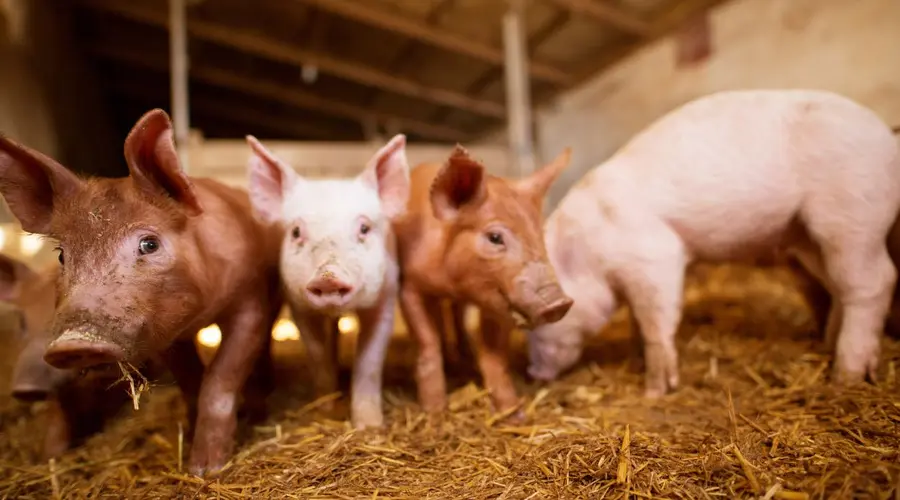
First signs of improvement in the pork market
However, the market is receiving more and more signals indicating that Spain is gradually returning to some non‑EU export markets, which reduces the pressure from Spanish exports on the EU market.
As a result, in recent weeks there has been a slight increase in pork purchase prices. We believe that the price rise will remain in the coming months, helped by the expected further reduction in pork supply and seasonal factors.
Decline in pork production profitability
Throughout 2025, the value of Polish pork exports (live animals, meat and processed products) increased by 2.7% year‑on‑year compared to a 5.0% rise in 2024, due to a clearly higher sales volume, while export prices fell.
The purchase price of live pigs in January 2026 was 4.75 PLN/kg (-17.2% y/y), and the price of pig feed was 1.55 PLN/kg (-14.0% y/y). Consequently, the live‑animal/ feed price ratio in January was 1.55 versus 1.80 the previous year, indicating a clear deterioration in annual production profitability. Taking into account global and domestic factors, we expect the pig purchase price at the end of 2026 to be about 5.70 PLN/kg and 6.80 PLN/kg at the end of 2027.
Small drop in cattle purchase prices
In recent months there has been a slight decline in cattle purchase prices in the EU, while they remain high compared to historical levels. High cattle purchase prices are the result of its low supply in the EU. Initially, the drop in the headcount was mainly due to structural changes occurring in the EU cattle sector reflected in a decline in interest in its breeding, partly due to high regulatory uncertainty and pressure from animal diseases.
Currently, an additional factor limiting supply response, despite record production profitability, is farmers’ concerns about falling prices in the coming quarters. In our view, the last price correction in the cattle market was mainly due to an increasingly strong demand barrier, as well as a slightly higher supply of cows from the dairy sector under worsening milk production profitability. A negative factor for cattle purchase prices is also the situation in the Middle East, which limits demand from that region for halal beef.
Strong growth in the value of Polish beef exports
Throughout 2025, the value of Polish beef exports (live animals, meat and processed products) increased by 29.1% year‑on‑year compared to a 10.5% rise in 2024, due to significantly higher export prices, while sales volume slightly decreased.
The purchase price of cattle in January 2026 was 15.31 PLN/kg (+26.8% y/y), and the price of cattle feed was 1.73 PLN/kg (-10.7% y/y). Consequently, the live‑animal/ feed price ratio was 8.83 versus 6.22 the previous year, indicating a strong improvement in production profitability. Considering the situation in the EU and domestic beef market, we expect the cattle purchase price in Poland at the end of 2026 to be about 15.25 PLN/kg and 14.30 PLN/kg at the end of 2027.

Growing poultry supply drives a decline in purchase prices
Our scenario is unfolding, according to which improving supply conditions in the EU poultry market and the gradual rebuilding of production after losses caused by bird diseases drive a decline in purchase prices. This is aided by historically high poultry production profitability.
For this reason, we believe that purchase prices will remain in a downward trend in the coming quarters, with their decline in the near future being limited by seasonal effects.
High profitability supports production recovery
Throughout 2025, the value of Polish poultry exports (meat, processed products and live poultry) increased by 18.2% year‑on‑year compared to 11.6% in 2024, due to higher export prices and slightly lower sales volume.
The purchase price of poultry in January 2026 was 5.68 PLN/kg (+2.3% y/y), and the price of poultry feed was 1.53 PLN/kg (-8.3% y/y). Consequently, the live‑animal/ feed price ratio was 3.72 versus 3.33 the previous year, indicating a strong annual increase in production profitability. Considering the global and domestic poultry market, we expect the poultry purchase price at the end of 2026 to be about 5.40 PLN/kg and about 5.10 PLN/kg at the end of 2027.
Limited egg supply on the market
Supply restrictions related to animal diseases help maintain egg purchase prices at a higher level. Particularly significant restrictions exist in the cage‑free egg segment. This results from the implementation of declarations by an increasing number of food and trade entities regarding the abandonment of cage‑raised eggs. In Poland, the sector transformation process is relatively slow compared to the EU, due to two factors.
First, a large share of Polish egg production goes to processing, where declarations about abandoning cage‑raised eggs are submitted less frequently. Second, under high egg market prices, the so‑called welfare premium is relatively low, limiting the benefits of cage‑free production. We believe that the coming months will bring a gradual rebuilding of supply on the EU egg market, which will support a decline in purchase prices.
The pace of production recovery is a key factor in the coming quarters
Throughout 2025, the value of Polish egg exports increased by 25.0% year‑on‑year compared to a 2.2% decline in 2024, due to higher export prices and lower sales volume. The purchase price of class M eggs in January 2026 was 66.66 PLN/100 pieces (16.4% y/y), and the price of hen feed was 1.35 PLN/kg (-7.6% y/y). Consequently, in January the price ratio of 100 eggs to feed was 49.41 versus 39.19 the previous year, indicating a very strong improvement in egg production profitability on an annual basis.
Considering the outlook for the EU and domestic egg market, we forecast that the purchase price of class M eggs at the end of 2026 will be about 68 PLN/100 pieces and about 63 PLN/100 pieces at the end of 2027. Risk factors for our poultry and egg price forecasts include the domestic epizootic situation, the pace of supply growth among the largest poultry and egg producers, and the geopolitical situation in the Middle East.