It was largely driven by rising fuel prices. The data structure will be particularly interesting in the context of our estimated March core inflation increase.
According to our calculations, it amounted to 2.7% YoY versus 2.5% YoY a month earlier (official data will be released tomorrow). The details will allow us to assess whether the intensity of inflationary pressure had a broad character and encompassed many CPI components or was concentrated in selected categories.
In our view the data will not provide evidence of second‑round effects, i.e., the pass‑through of fuel price increases to service and many other goods prices. Such an inflation picture would favor the realization of the NBP’s stable interest rate scenario.
After March 2026 the state budget deficit amounted to about 69.5 bn PLN, compared with 48.5 bn PLN after February. This means the implementation of 25.6% of the plan in the 2026 budget act, which totals 271.7 bn PLN. Detailed budget execution data will be released today.
End of Tuesday session with gains in major indices
The session across the ocean yesterday ended with gains in major indices. Market participants expect a continuation of the US‑Iran negotiations and react more strongly to macroeconomic data and company results.
The “Wall Street Journal” reported that in the last 24 hours more than 20 commercial vessels passed through the Strait of Hormuz. At the same time Americans maintain the blockade of Iranian ports since Monday. The US and Iran are discussing the terms of the next round of peace negotiations. Since yesterday’s close the decline in oil prices has slowed.
Decline in yields on primary markets
Meanwhile, the decline in yields on primary markets continued (to about 3% for Bunds and about 4.25% for 10‑year US Treasury bonds). Stronger primary markets are a good signal for the domestic debt market at the opening of today’s session. In the opposite direction, supply will act at the auction. The Ministry of Finance will offer bonds worth 6‑12 bn PLN for sale at the auction scheduled for today.
Today will also publish detailed estimated data on the execution of the March budget deficit. Improvement in European production may favor further strengthening of the euro against the dollar.
The zloty was losing value
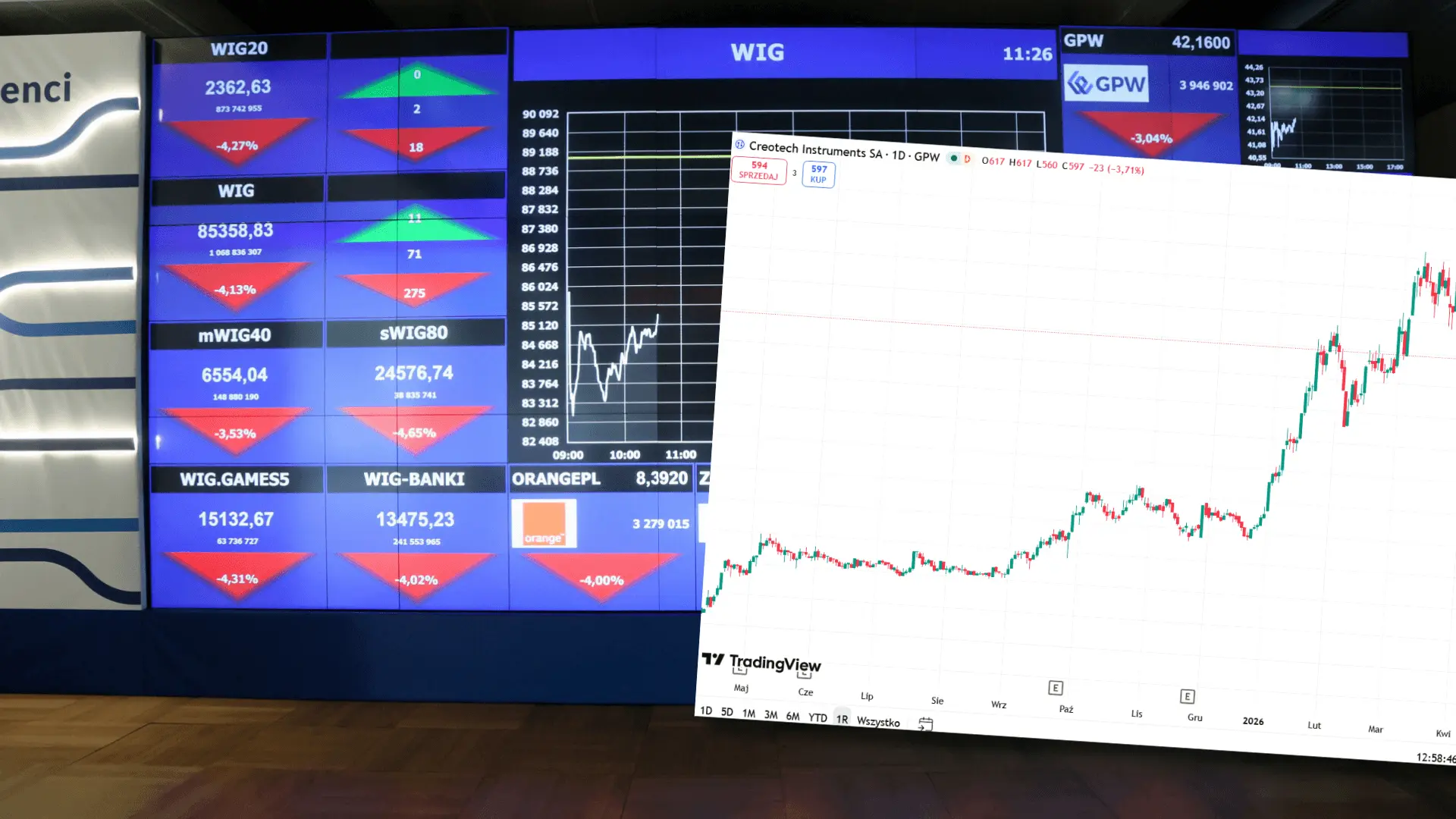
Yesterday’s session saw a mood improvement in equity markets, the WIG index reached a record high. Gains in domestic equity indices were around 0.8‑1%.
In the foreign‑exchange market the zloty initially lost value slightly, but in the afternoon rebounded to about 4.238, close to the significant support line near 4.235.
A slight strengthening of the zloty occurred in the context of the euro’s strengthening against the dollar. Market rates gradually rose by about 4‑5 bp, but in the afternoon fell near the opening. At the end of the day the yield on 10‑year bonds was about 5.53%.
Basic budget deficit data had limited impact on the market, and the realization of the deficit at about 69.5 bn PLN (about 25.6% of the annual plan at 271.7 bn PLN) had limited impact on market rates. EU Commissioner Balazs informed that in the summer the European Commission will present an assessment of the progress of non‑Eurozone states on the path to adopting the common currency. The adoption of the euro is favored by P. Magyar, the party leader who on Sunday received the most votes in the Hungarian elections.
Deputy Prime Minister W. Kosiniak‑Kamysz said that talks with the European Commission on SAFE (total payout pool of about 43.9 bn PLN) are ongoing and that, in his opinion, the agreement could be signed in April, at which point the first advance payments from the total pool granted to Poland at 43.9 m EUR could be released.
Euro‑dollar rate rises to 1.181
During the European trading session, equity indices rose by 0.5‑2%. Optimism also extended to the main currency pair, resulting in the euro‑dollar rate moving towards 1.181 from around 1.176. ECB President C. Lagarde said that the eurozone economy is somewhere between the ECB’s base scenario and added that she does not lean towards tightening monetary policy as the market values it. In her view, the assumption that everything will soon return to normal – given the war in Iran – is “strange”.
Media also reported on the future Fed chair. The Senate Banking Committee will hold a hearing next week on the approval of K. Warsha’s candidacy for Federal Reserve Chair. The International Energy Agency (IEA) said it expects the largest drop in oil demand since the Covid‑19 pandemic in the second quarter due to the uncertain durability of the agreement between Iran, the US, and Israel.
In the German debt market, yields fell at the opening of the session and later in the day the decline continued by another 5 bp. The yield on the 10‑year US Treasury ended the session near 3.02%. In the US market, after a slight rise in the afternoon, yields returned near the opening.