This is not an exception. Among more than 440 thousand Polish companies registered in the KRS there are hundreds with negative equity and debt above 90% of assets. Some of them still actively trade, issue invoices and look for new partners. Every year in Poland more than 2000 bankruptcy and restructuring proceedings are opened. For a listed investor this is a loss of capital. For an entrepreneur – a payment bottleneck that can drag the next company in the chain to the bottom.
Verifying a company’s finances no longer requires hours in Excel. The key data are public and available in a few seconds. You just need to know where to look and which numbers to focus on.
What is available and where it comes from
Every limited liability company, joint-stock company or limited partnership registered in the KRS submits an annual financial statement. Since 2018, these documents are sent to the Ministry of Finance’s repository as e-Statements in XML format. Balance sheet, income statement, cash flow – everything is public, free, for everyone.
Statements contain three key elements:
- Balance sheet – what the company owns (assets) and how it financed it (liabilities, i.e., equity + obligations).
- Income statement (P&L) – how much the company earned, how much it spent and what remained at the end of the year.
- Cash flow – actual cash movement (in larger entities).
The problem lies in the format. Raw XML files from the ministerial portal are unreadable to a normal user. They need to be downloaded, unpacked and interpreted. Manually – it’s a multi‑hour job. That’s why tools were created that automatically parse this data and display it in a readable form.
Four indicators that say the most
A full financial analysis is a semester’s worth of work. But to quickly separate a stable company from a potential problem, you only need to look at four numbers.
Debt (liabilities / assets) – what portion of the company’s assets belongs to creditors. Below 60% is a healthy level. Above 80% – the company is mainly financed by debt, and any interest rate hike hurts double. Above 100% means liabilities exceed assets. This is a state of technical insolvency, even if the company is still settling payments.
Current liquidity (current assets / short‑term liabilities) – whether the company has enough to pay invoices in the coming months. A result below 1.0 is an alarm signal: current debts exceed what the company can quickly liquidate. Optimal values are 1.2‑2.0.
Sales profitability (ROS) – how many cents of profit remain from each zloty of revenue. A negative value means loss. Below 2% – the company earns on the edge of profitability. Above 5% – a solid safety margin. The exact threshold depends on the industry (retail has lower margins than IT), but the direction is universal.
Revenue dynamics (year‑to‑year) – whether the company grows, stagnates or shrinks. A revenue decline of more than 15% year‑to‑year is a warning. An increase above 20% with simultaneous net loss may indicate aggressive scaling at the expense of profitability – common in startups but risky for mature firms.
These parameters do not replace a full analysis, but they act as a quick filter. If any of them lights up red – it’s worth stopping and taking a closer look before signing a contract or buying shares.

Where to find data without paying for a subscription
The official Ministry of Finance portal (ekrs.ms.gov.pl) provides statements, but in raw XML and PDF form. They must be downloaded and interpreted manually. For someone who wants to quickly check a counterparty before signing a contract, this is not a realistic option.
There are several services on the market that process this data into a readable form. Rejestr.io offers relationship graphs and nice visualisations – full access costs about 99 PLN per month. Bizraport.pl goes in a similar direction with its own pricing packages. Aleo.com is primarily a contact database of companies, with limited financial analytics.
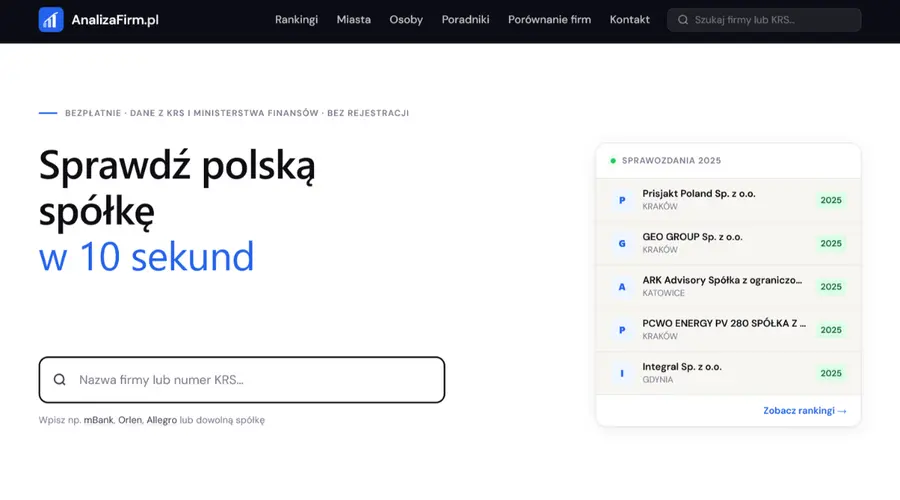
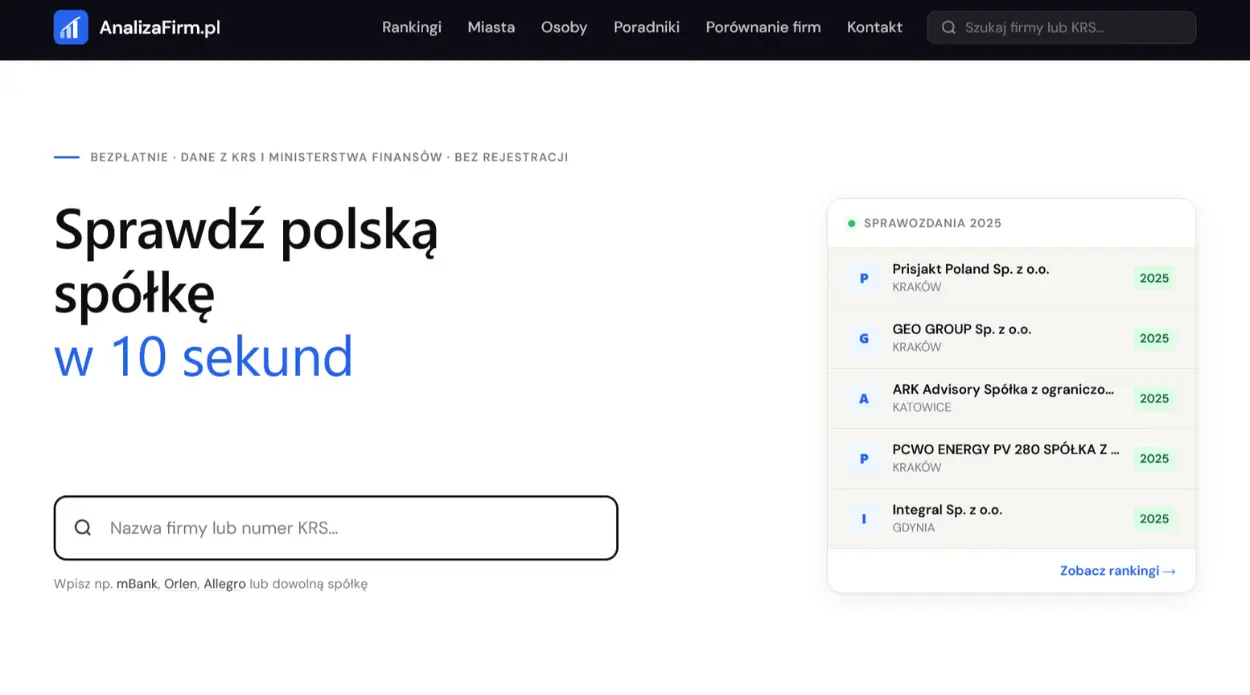
A free alternative is analizafirm.pl. The portal automatically parses e‑Statements from the Ministry of Finance and presents data in a readable form: balance tables, financial ratios, multi‑year trend charts and industry rankings in over 85 categories. It also includes AI analysis of financial condition – an algorithm rates the company on a scale from A (good condition) to E (danger) and generates a textual summary of the situation. The database covers over 440,000 companies, requires no registration and is entirely free.
How it looks in practice
Suppose you are considering cooperation with a company that proposed a contract with a deferred payment term. Or you are analysing a listed company before buying shares.
You go to analizafirm.pl. You enter the company name, KRS number or NIP. A company profile appears on the screen with tabs for revenue, net profit, profitability and debt. Below – the full balance sheet and income statement with year‑to‑year comparison. The trend chart shows how the company grew (or shrank) over the years. The capital relationships section reveals who is a partner and in which other companies the company holds shares.
The whole operation – from entering the name to forming an opinion – takes literally half a minute. No account creation, no payment, no file downloads.

Things to remember
Data from financial statements have limitations that are worth knowing.
Reporting delay. Companies file statements once a year, usually by mid‑next year. When analysing a company in spring 2026, you most often look at data from the end of 2024. Fresher numbers will appear only after a new report is filed.
Industry specificity. A developer may have low liquidity due to the way revenue is booked after an investment is completed. A technology company in an early growth phase will generate losses because it invests in product development. That’s why indicators are best compared with other companies in the same industry – industry rankings help determine whether a company performs better or worse than its direct competitors.
Data scope. Sole proprietorships (public, civil) and sole‑person businesses do not file statements to the KRS. Their finances cannot be checked this way.
Despite these limitations, public financial statements are the most reliable and at the same time the cheapest source of information about a Polish company’s condition. Checking them before making a business or investment decision is not an extra step in the process. It is the absolute minimum that can save serious losses.