2Q25 GDP growth was stronger than what monthly activity data suggested
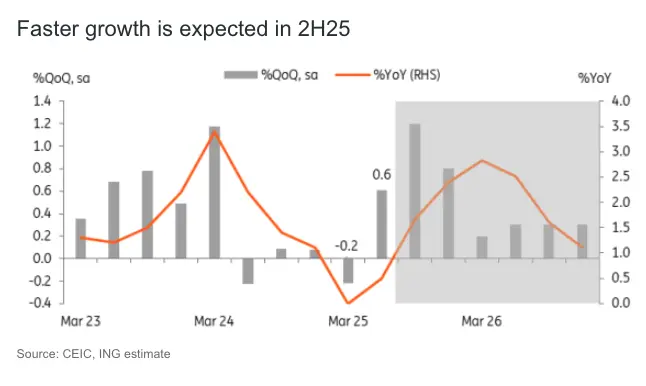
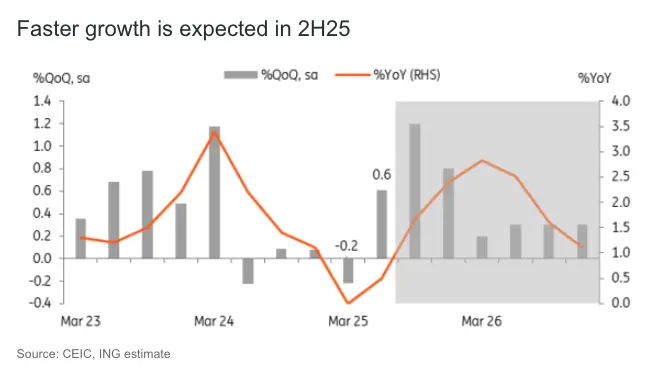
South Korea’s second quarter GDP rose 0.6% quarter on quarter (vs -0.2% in 1Q25, 0.5% market consensus) thanks to a stronger-than-expected recovery in private spending and exports.
Private spending rose 0.5% in 2Q25 after a 0.1% decline in 1Q25. The rebound is likely due to the return of political stability in Seoul and tax incentives for car purchases. Government spending also rose rapidly by 1.2% (vs 0.0% in 1Q25) as health care benefits increased.
Yet weak investment continued to hinder overall growth, with construction and facility investment each declining by 1.5%. Construction contracted for the fifth straight quarter amid ongoing sector restructuring and subdued activity. We expect the weak construction to persist next quarter. The pace of contraction, though, has moderated in the recent quarters, so stabilisation is expected by the end of the year.
Equipment investment contracted for a second quarter, mainly due to lower activity in semiconductor manufacturing and shipbuilding. However, we anticipate a rebound in 2H25 as capital goods imports have increased recently.
Exports rebounded stronger than expected by 4.2% (vs -0.6% in 1Q25), driven by chips, petroleum, and chemical products. Imports also were up by 3.8% (vs -1.1% in 1Q25) mainly due to an increase in energy.
We anticipate faster growth in the second half of the year
We believe that consumption should be the main driver of the anticipated growth pick-up in the second half.
The primary driver to stimulate consumption should be the government’s cash handout programme, which began distribution this week and will expire by the end of November. As such, a sharp increase in consumption can be expected in the 2H25. The Korean equity market has performed well (KOSPI up 32.7% ytd), a dynamic that’s likely to boost consumer spending. The recent improvement in consumer sentiment also supports our view on consumption recovery.
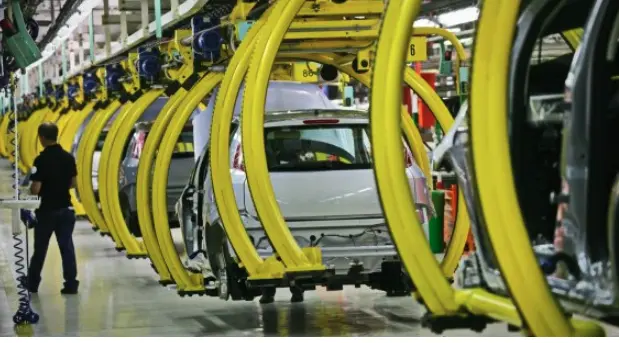
Meanwhile, the outlook for manufacturing and exports remains cloudy. Exports are likely to weaken in the second half due to tariffs and possibly lower US demand. Korea has yet to secure a deal with the US, and the US-Japan agreement creates challenges for Korean exporters. Given the high dependence on car and semiconductors exports, sector-specific tariff negotiations will be crucial. However, the bigger concern is declining global demand, particularly from the US. ING forecasts a sharp slowdown in US growth in 2H25, which could further weigh on Korean exports.
With today’s higher-than-expected 2Q25 GDP results in hand, we have revised up the annual GDP growth for 2025 from 1.0% YoY to 1.2%.
BoK watch
Although growth momentum is expected to accelerate, this is mainly dependent on government support. The outlook for exports is cloudy, though. As such, annual GDP is expected to rise more slowly than the potential growth level. This means the negative GDP output gap continues, thus monetary conditions should be more accommodative. For the Bank of Korea, we expect an October cut to be the base-case scenario.
In contrast to the ongoing improvement in consumer sentiment, business sentiment has declined for two consecutive months. The composite business sentiment outlook index dropped to 88.4 in July (vs 89.4 in June). Small and medium-sized enterprises, as well as firms with a domestic focus, have demonstrated weak confidence. While government policies may support an increase in consumption, businesses still struggle with a slow economic recovery and cloudy outlook. This suggests the BoK may need to ease monetary policy, but it appears they favour facility loans for targeted support over rate cuts.
We have seen the recent housing transactions slow, and also expectations on housing prices have moderated. But August may still be too premature to confirm the anticipated stabilisation of the housing market.