A quiet August?
In theory, financial markets are shaping up for a quiet August – or at least, that’s what the FX market is telling us. Looking at the term structure of the EUR/USD traded volatility curve, expected volatility quickly falls away after this week’s event risks. One-month EUR/USD trades a full one vol under one-week implied volatility.
What’s left on the calendar is Friday’s job report and the 1 August US tariff deadlines. On the latter, the view seems to be that even if tariffs on some countries revert to ‘Liberation Day’ levels, they’re unlikely to stay there for long. The market now firmly believes that tariffs are transactional rather than ideological and that a baseline 15% duty can be secured should trading partners make sufficiently large commitments to spend or invest in the US.
While some strongly argue that the market is too complacent about tariffs, the question will be: what’s going to change in August? Many central bankers, politicians and investors are away this month, and assuming high-profile trade deals – such as the US-China trade truce – are extended for another 90 days, the market default setting may well be ‘let’s pick this up in September’.
Perhaps the biggest risk now is that of secondary sanctions on the likes of China, India and Turkey as Washington tries to turn the screws on Russia and those buying its cheap oil.
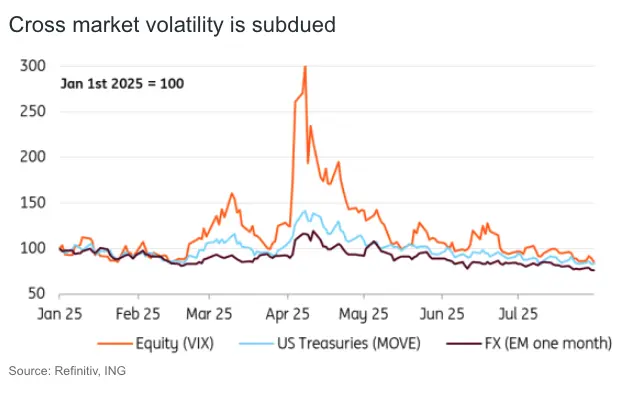
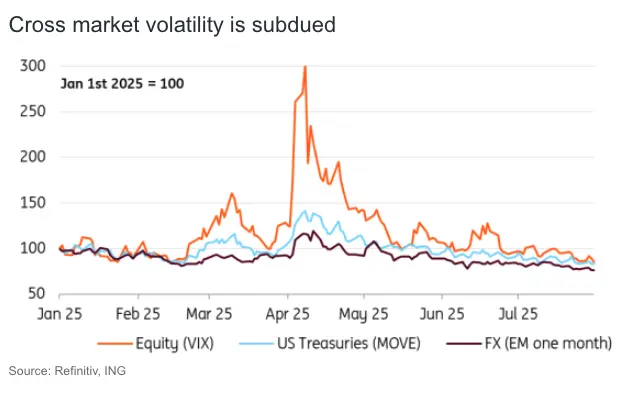
That said, cross-market levels of volatility continue to edge lower and barring some big shock, it looks like volatility levels could remain low this August.
Carry on carry trading
Low volatility inevitably brings attention back to the carry trade and the fundamental view that carry currencies will not depreciate as much as their high interest rates and financial theory suggest. In fact, a currency like the Egyptian pound not only offers annual interest in excess of 20% but has also appreciated against the dollar to deliver a 15% total return year-to-date.
We mention Egypt because a lot of the higher yields are to be found in emerging markets. These countries generally face higher inflation and have higher associated sovereign risks. These typically require higher rates of interest. FX investors can access these higher interest rates through the deliverable and non-deliverable FX forward markets.
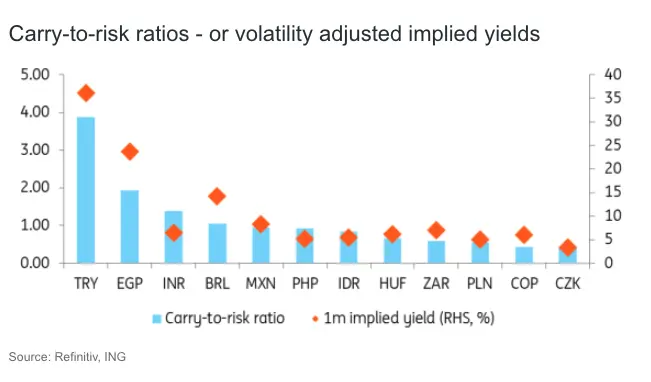
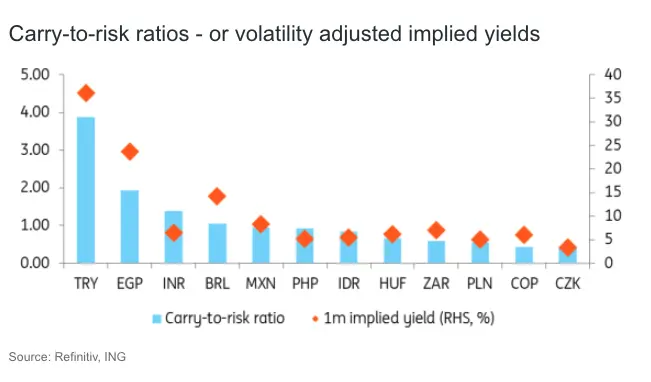
But high yields need to be seen in the context of risk. There’s no point picking up pennies in front of the steamroller, after all. And that’s where the ‘carry-to-risk’ ratio comes in. Below, we adjust the one-month yields available through the FX forwards by implied – or expected volatility through the FX options market.
Leading the pack here are the super high-yielders of the Turkish lira and the Egyptian pound. And notably, the volatility-adjusted Indian rupee is more attractive than the Brazilian real – even though interest rates are twice as high in Brazil as in India.
Back testing – a few important points
Above, we’ve been discussing the high-yielding target currencies for the carry trade. The other half of the equation is which currency to fund from? Here, the focus in the G10 space has traditionally been the Japanese yen, with current borrowing costs at about 0.3% per annum. It is also very inexpensive to borrow in the Swiss franc. Or, for investors with a conviction call on direction, the dollar has been a popular funding currency even though it has been reasonably expensive to borrow with rates above 4% per annum.
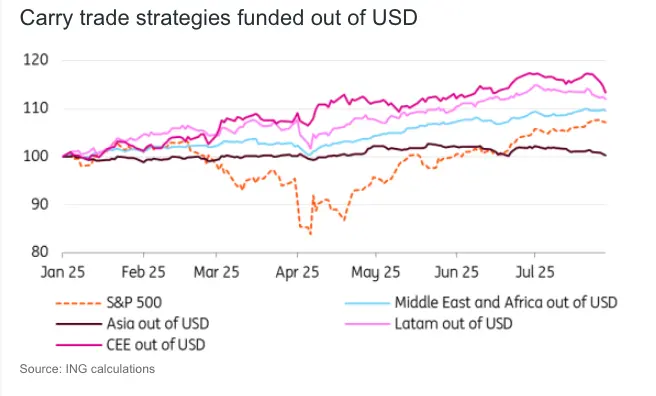
There are a myriad of permutations to look at when it comes to the carry trade, but in this exercise we’re looking at emerging market high yielders in four regional blocs: Middle East and Africa (Turkey, Egypt and South Africa), Asia (India, Indonesia and Philippines), Latam (Brazil, Mexico, Colombia) and Central and Eastern Europe (Poland, Hungary, Czech Republic).
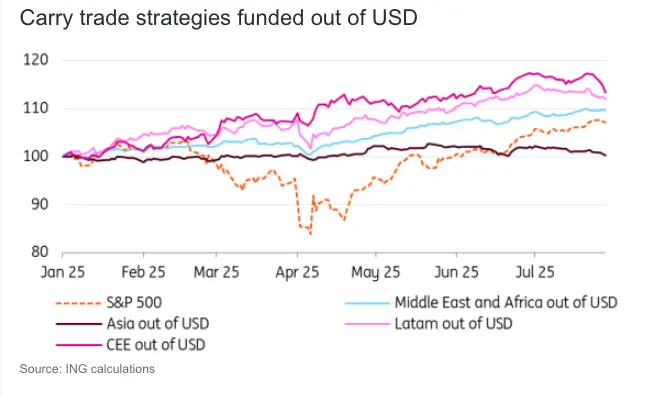
Looking at these blocs in an equally weighted basket (e.g., Latam is 33% each for the Brazilian real, Mexican peso and Colombian peso), we then backtest for the year-to-date performance with funding out of two separate examples: funding out of the dollar alone or funding out of an equally weighted basket of yen and Swiss francs.
Here’s how those strategies have performed.
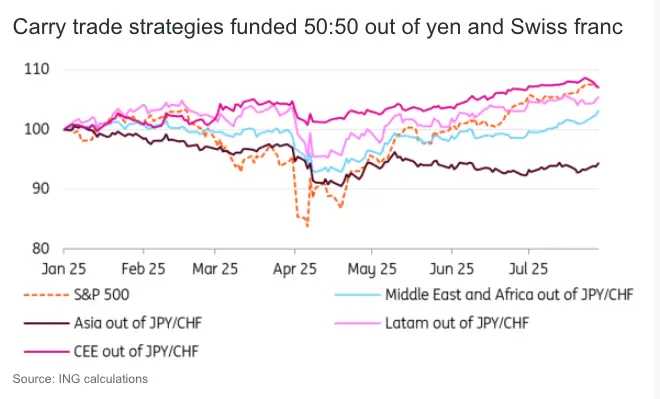
And now funded out of an equally weighted basket of yen and Swiss francs:
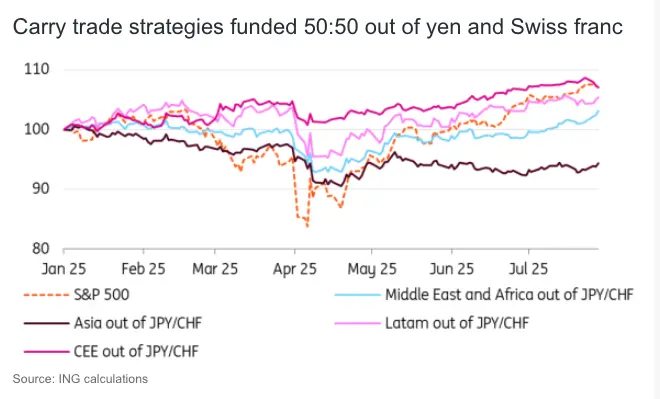
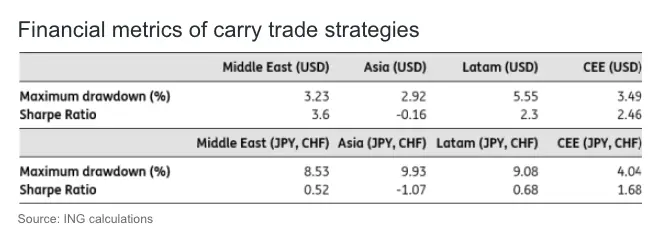
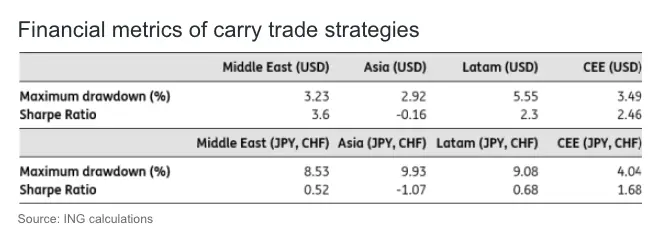
It’s also important to look at some key financial metrics of these strategies, such as the maximum drawdown an investor might have suffered during the life of the strategy and the Sharpe Ratio – a measure of the volatility of those returns.