Here’s a quick snapshot of what the latest data in the Philippines is telling us and what it means for the interest rate outlook.
Trade balance showed a notable improvement in May, surpassing market expectations
The improved trade balance in May was primarily driven by strong growth in exports – the highest in 13 months -- alongside a moderation in import growth. Export performance was buoyed by robust demand for electronic products, other manufactured goods, and gold.
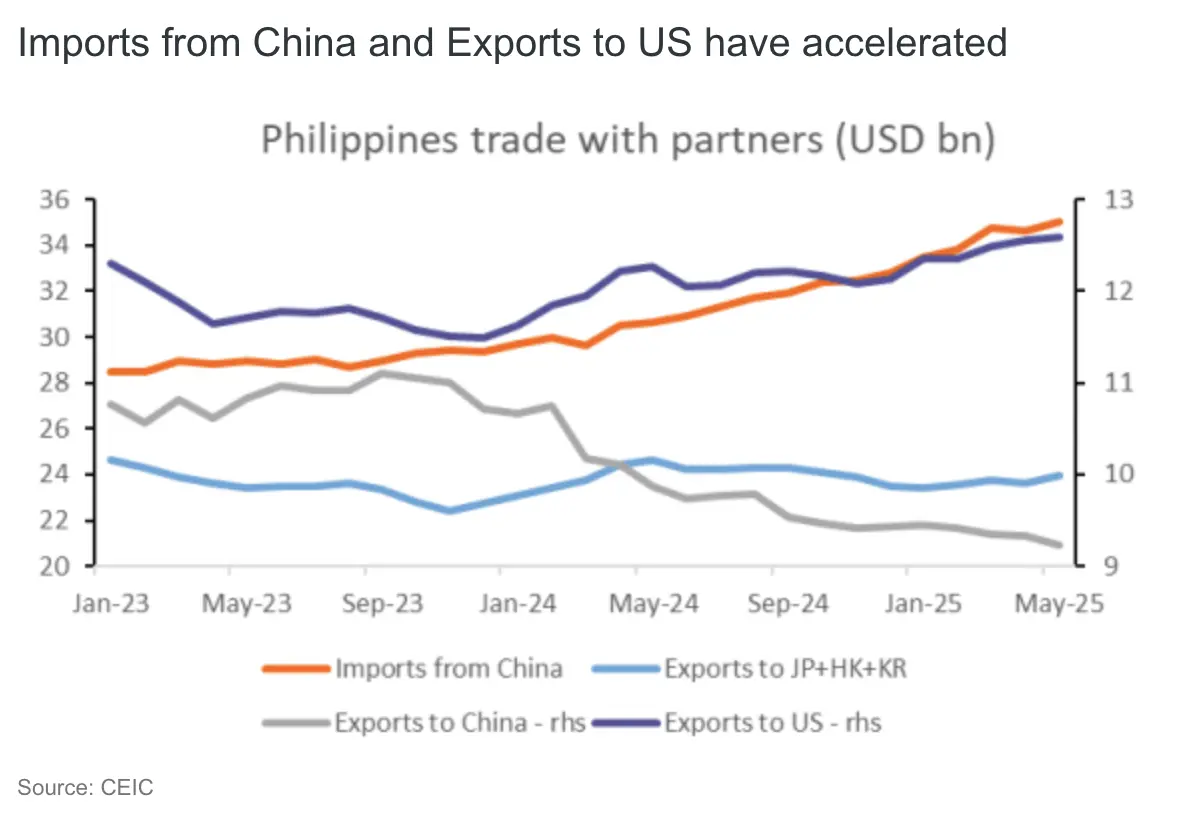
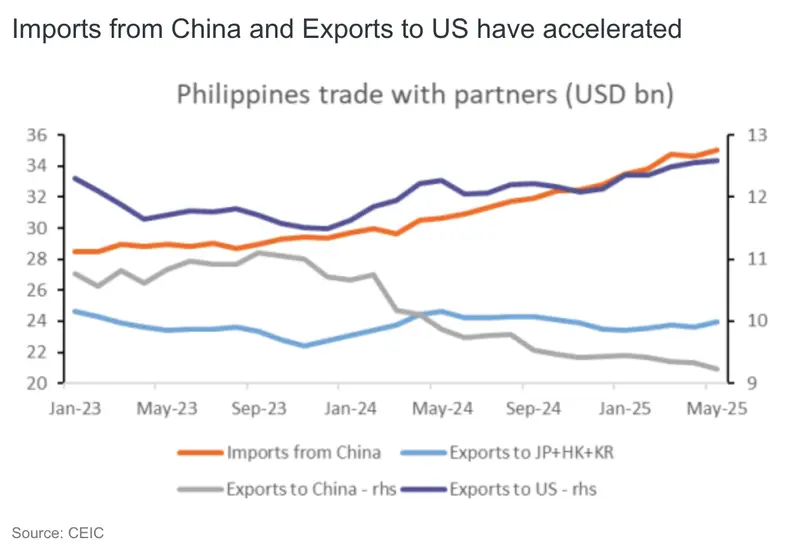
One of the factors behind the export surge (10% year-on-year in 2025) could be the re-routing effects -- a trend also observed in the trade data of other ASEAN economies. Recent trends indicate: (1) Exports to the US have clearly accelerated in 2025; (2) imports from China surged 14% year-to-date, with electronic products continuing to dominate among all commodity groups.
Interestingly, the manufacturing purchasing managers’ index for the Philippines has also been in the expansion zone for most of 2025, while remaining stronger than other countries in ASEAN except Thailand. This suggests that domestic manufacturing could be benefiting from export gains.
Wider fiscal deficit could limit FII demand for longer-end; medium-term bonds more attractive
The Philippines' fiscal balance slipped back into deficit in May, largely due to a pickup in government spending. This is likely linked to mid-term election-related expenditures. While revenue growth accelerated to a solid 13.3% year-on-year, it remains relatively soft when viewed through a broader trend lens. Year-to-date, revenue growth stands at 5.4%, while expenditures have grown at a faster pace of 9.7%.
In response to evolving fiscal dynamics, the Development Budget Coordination Committee (DBCC) recently revised its 2025 fiscal deficit target upward to 5.5% of GDP, from the previous 5.3%. This adjustment reflects a downward revision in revenue projections. Despite the near-term widening of the deficit, the government maintains its commitment to fiscal consolidation, aiming to bring the deficit down to 4.3% by 2028.
We believe the revised 5.5% target is more realistic, given the government’s focus on capital expenditures amid global growth weakness. Slower global growth is likely to weigh on revenue performance and may necessitate further fiscal easing to support GDP growth.
Fiscal concerns and higher bond issuance could deter foreign investor participation, particularly in the long end of the yield curve. This is despite inflation remaining well-contained, which gives the central bank room to continue monetary policy easing. In contrast, short-to-medium-term bonds are expected to benefit from the current disinflationary trend and the prospect of further rate cuts.