Hungary: At a glance
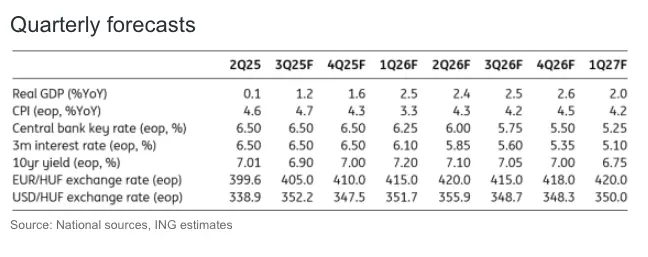
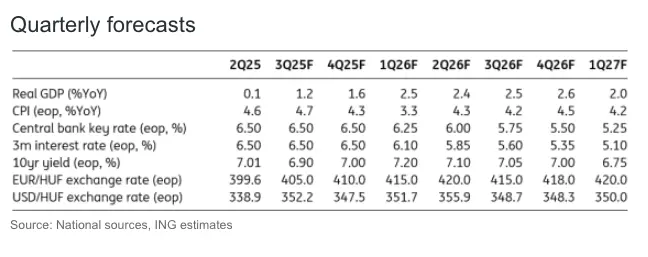
- Second-quarter GDP growth came as a minor upside surprise, yet the first half of the year was marked by stagnation. Confidence issues, a softening labour market and a gloomier industrial outlook have pushed us to downgrade GDP growth to 0.7% and 2.5% in 2025-26, a 0.3-0.6ppt downgrade respectively.
- Retail sales are okay, though the impact of fiscal measures to boost real disposable income will be limited due to low confidence. The industry is still in decline, with order books and restructuring of production plans causing pessimism.
- The labour market has softened, with employment falling as the health of the corporate sector has been hit by three years of stagnation, resulting in silent layoffs.
- Lack of investment activity and relatively low energy prices are helping to maintain favourable external balances for the country, providing constant support for the Hungarian forint (HUF).
- Inflation will fluctuate between 4.0-5.0% year-on-year for the rest of 2025. The government’s price measures are masking an uncomfortable repricing trend, raising concerns about the long-term inflation outlook.
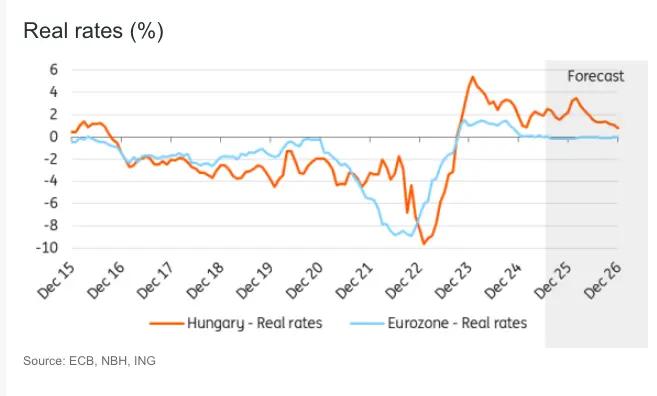
- Loosely anchored price expectations, market volatility and the fiscal outlook will keep the central bank on the hawkish side until the end of 2025 at least.
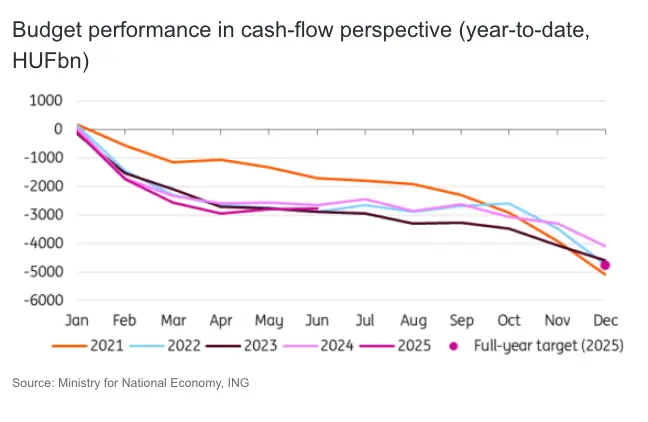
- We believe that the government will try to make the most of its fiscal leeway, so we anticipate a deficit of between 4.5% and 4.8% of GDP by the end of the year.
- The forint remains supported by favourable positioning and carry appeal, but softening inflation and a weak macro backdrop could push EUR/HUF back toward 405-410 by year-end.
- Despite the National Bank of Hungary (NBH) anchoring the front-end, hawkish repricing has lifted terminal rate expectations above our forecast, though we see room for a dovish correction as inflation eases and FX stays stable.
Hungary's economy hasn't taken off just yet
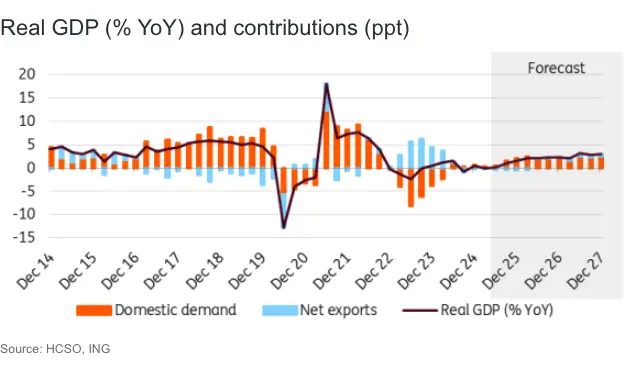
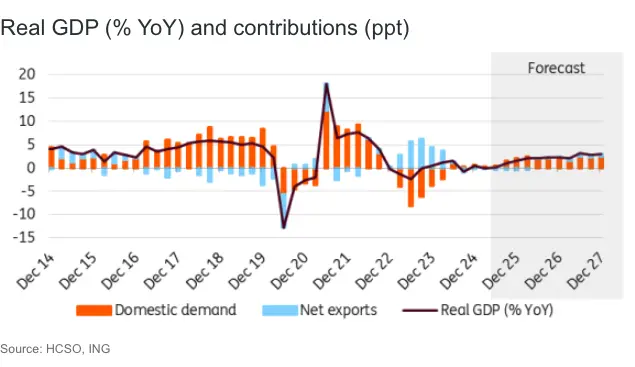
In the second quarter of 2025, the economy practically stagnated, growing by only 0.1% YoY. Quarterly growth of 0.4% was considered a positive surprise. While this helped to avoid a technical recession, the overall picture remains disappointing. The economy's performance was held back most by agriculture and industry, while services contributed to growth.
Despite this slight positive surprise compared to our forecast in the second quarter, we remain pessimistic about the impact of upcoming fiscal impulses due to the ongoing decline in business and consumer confidence. Recent restructuring of industrial production plans has also made us more cautious.
Against this backdrop, we now expect growth of 0.7% for 2025 as a whole and a growth rate of 2.5% in 2026. This represents a downward revision of 0.3 and 0.6ppt, respectively.
Industry provides a glimmer of hope
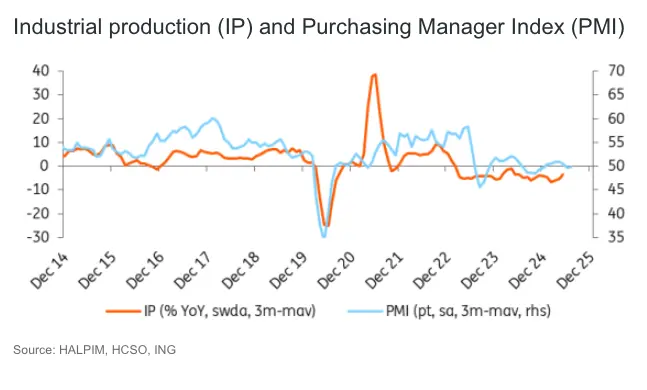
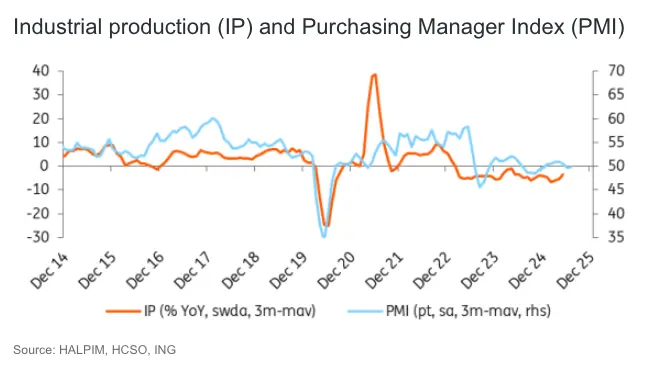
May's industrial data proved that April's positive results were a one-off. Production is now 2.6% below last year's level and 6.7% below the monthly average for 2021. Output fell on an annual basis in the vast majority of manufacturing sub-sectors. While many Hungarian manufacturers are still retaining workers, reports of hidden layoffs are increasing. Unsurprisingly, they are becoming more cost-sensitive, with order books 11% lower than a year ago.
Furthermore, the restructured production plans of factories under construction also worsen the outlook. However, there is a glimmer of hope in the rising market share of battery-electric cars, which increased from 12.5% in the first half of 2024 to 15.6% in the first half of 2025. Nevertheless, industry is expected to negatively impact Hungary’s economy in 2025, though 2026 could be better.
Deteriorating outlook, but still positive retail sales
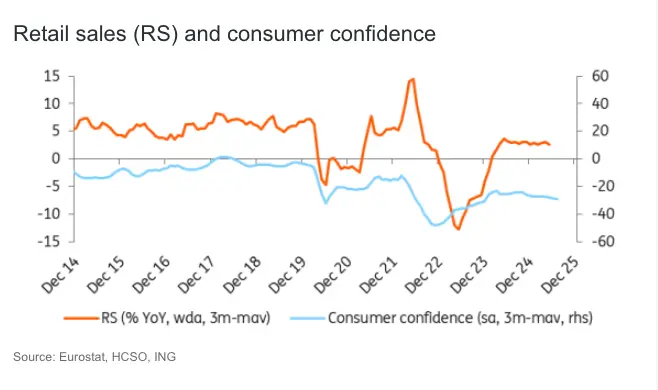
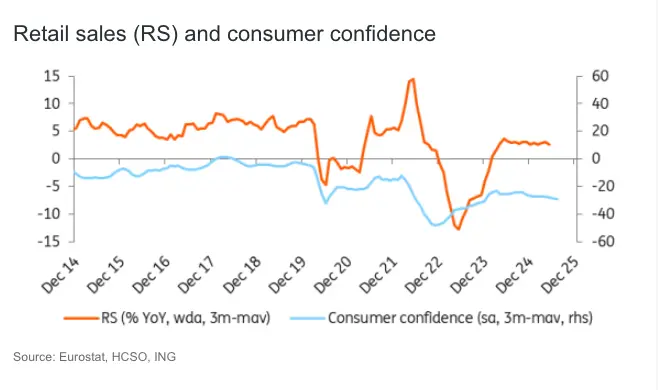
The story told by retail sales in May was similar to that seen in the industry. After a brief uptick, growth slowed to 2.1% YoY. So, volatility is high, driven by one-off effects such as government retail bond payouts, corporate bonuses, and extreme calendar effects. Based on data from the second quarter so far, this is a better result than in the first quarter. Therefore, we can conclude that retail sales remain a positive factor for the economy.
Looking ahead, we anticipate continued growth in the sector thanks to the new government's measures to boost household disposable income through tax cuts, increased allowances and targeted one-off payments or wage settlements. However, given the deteriorating level of consumer confidence, it is difficult to predict the scale of the impact of these measures on the real economy.
Softening labour market
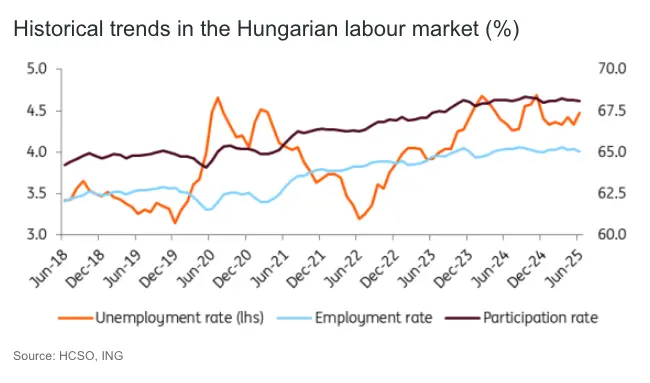
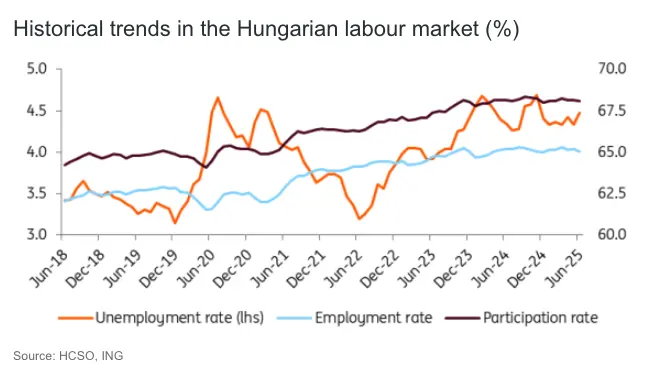
The unemployment rate rose to 4.5% between April and June. Second-quarter data shows that the number of people in employment has continued to decrease, reaching its lowest level since the beginning of 2022. However, this is due to demographic trends and slowing labour market activity; there is no evidence of a drastic change in the employment rate itself. At 65.1%, the second quarter figure is in line with the average of the last two years.
The stagnation of the employment rate clearly indicates that supply constraints are becoming increasingly effective in the Hungarian labour market. The demand side is also weakening alongside the supply side due to the economic stagnation since mid-2022. Looking ahead, we still expect the unemployment rate to be around 4.5% for the rest of the year, however there are risks of the labour market weakening further
Current account remains a silver lining
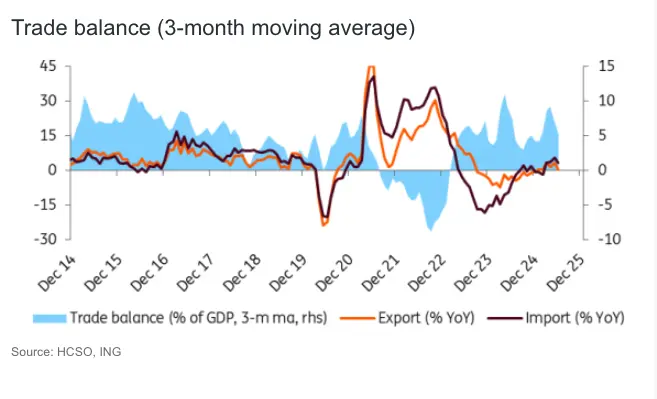
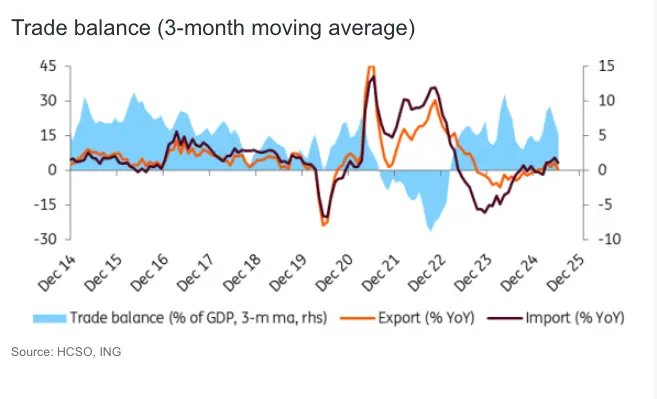
In the first half of the year, the volume of exports increased by 0.7%, while imports rose by 3.7% YoY. Consequently, the external trade balance for goods deteriorated by €957m YoY, reaching a surplus of €6.8bn by the end of June. Looking ahead, it seems less likely that new production capacities will commence this year as previously expected; a more realistic timeframe is now 2026, as manufacturers revise their production plans for the near future.
Given this uncertainty, we have decided to factor in only a minimal positive impact on exports in 2025-26. Taking this into account, we forecast a current account balance of 1.25% of GDP in 2025. We believe that the German investment programme and the increase in EU defence spending will positively impact external demand in 2026-27, thereby improving the current account balance.
Inflation remains high, despite government interventions
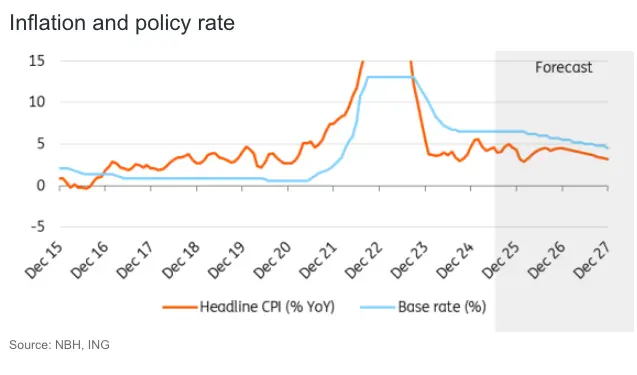
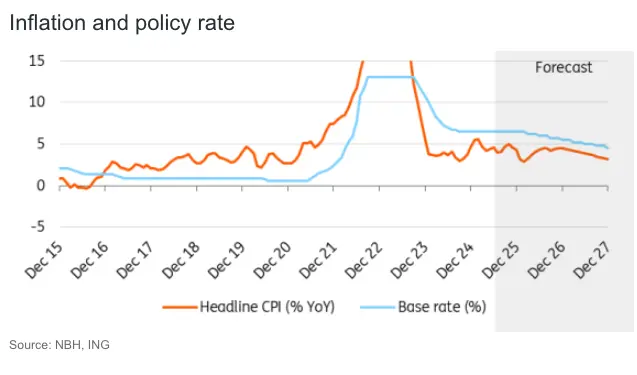
The latest inflation figures were in line with expectations, rising by 0.1% in June compared to the previous month, taking the year-on-year figure to 4.6%. Despite the government’s price interventions, inflation remains above the National Bank of Hungary’s tolerance band, and Hungary continues to have high structural inflation. Meanwhile, core inflation remains at 4.4%.
Looking in more detail, we saw an upside surprise in consumer durables, while the fuel group pulled inflation back the most. The impact of the voluntary price cut on pharmaceuticals is likely to be reflected in July's data. Despite four months of low repricing, household inflation expectations have improved only slightly. We expect inflation to fall to around 4% in the coming months, hovering around 5% towards the end of the year and averaging 4.6% in 2025. Government measures will lower this year's figure, but will incur future costs; hence, we predict inflation will remain at around 4% on average in 2026-27.
A technical adjustment in the monetary policy setup
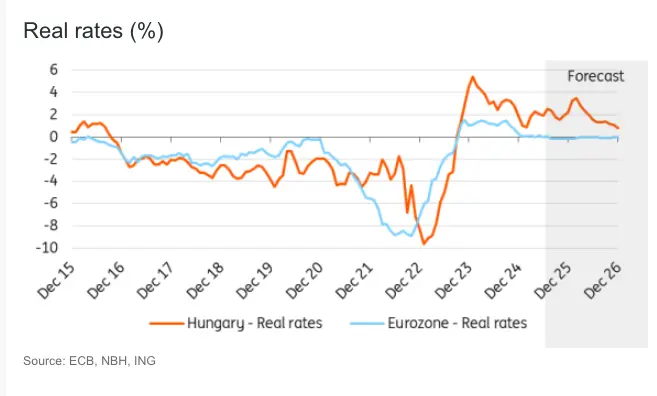
In July, the National Bank of Hungary kept its base rate unchanged at 6.50% for the tenth consecutive month. The general tone remained hawkish, and the message was virtually unchanged from last month. Underlying repricing remains too strong and household inflation expectations remain too high for price stability. Market stability is also a must; however, geopolitical and tariff decisions pose several risks.
The only excitement was the decision to cut the required reserve ratio from 10% to 8%, however, this technical adjustment will not impact the stance of monetary policy. A stability-oriented, cautious and patient monetary policy is still needed, and tight monetary conditions are necessary to achieve price and market stability. We maintain our expectations of no rate cuts for the rest of the year.
We still see slippage risk in the 2025 budget
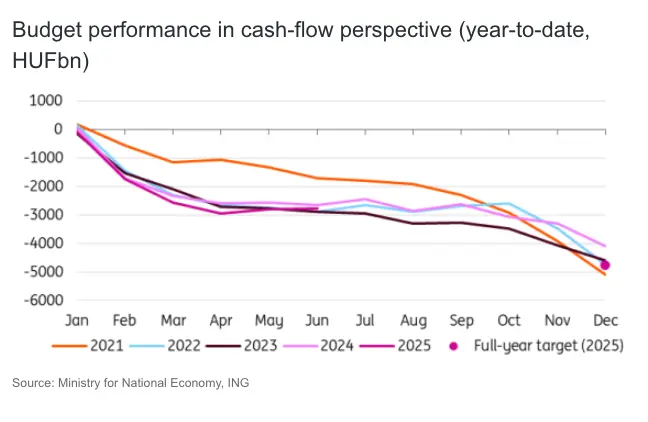
The budget deficit reached HUF 2.77 trillion in the first half of the year, which is approximately 58% of the updated cash-flow plan for 2025. June saw the best monthly balance this century, largely due to dividend payments and a technical coincidence, as the corporate tax payment deadline shifted to June due to calendar effects. Therefore, we believe that the recent monthly surpluses may be somewhat misleading.
We see the government’s deficit target of 4.1% achievable with considerable effort. We expect this year's budget deficit to be around 4.5% of GDP. From an economic perspective, we see more risks ahead, and the upcoming election could also affect spending in the form of more targeted measures. Nevertheless, the government will likely ensure a deficit below last year's level of 4.9% of GDP. However, we don’t expect anything that could jeopardise Hungary’s investment-recommended status with rating agencies.
Summer calm supports forint, but risks loom ahead
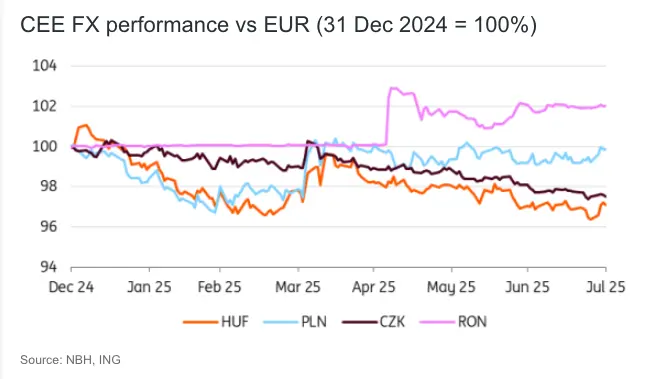
At the end of July, the forint enjoyed the lowest EUR/HUF levels since September 2024, and we have only returned to the 399-400 range because of the global rally in the US dollar. This has been a fair range for us for some time, but we cannot ignore the market favouring HUF within the CEE region and EM space for summer lower volatility and still decent carry.
If the market returns to a risk-on mood, we can't rule out further trips below 399 in the short term, but generally we remain rather bearish, especially towards the end of the year.
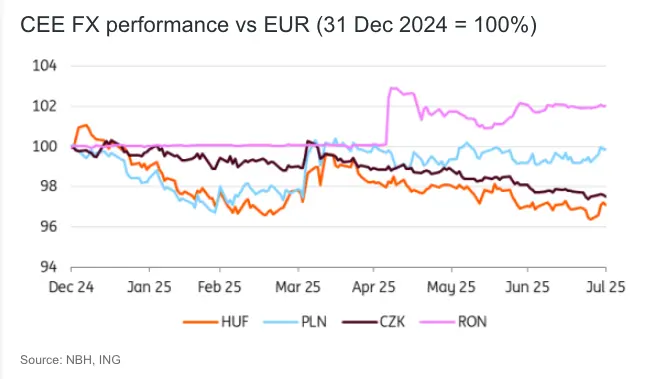
On the other hand, one of the reasons for the currently stronger HUF is hawkish market repricing. The market has largely outpriced rate cuts in recent weeks, supporting stronger FX, and we don't see room for another boost from this side soon. Conversely, the weaker economy story suggests a rather dovish market sentiment despite our NBH rates forecast. In particular, weaker inflation numbers in the summer will put pressure back on EUR/HUF going back to 405-410 levels in the second half of the year, in our view.
Rates market volatility persists despite NBH anchoring
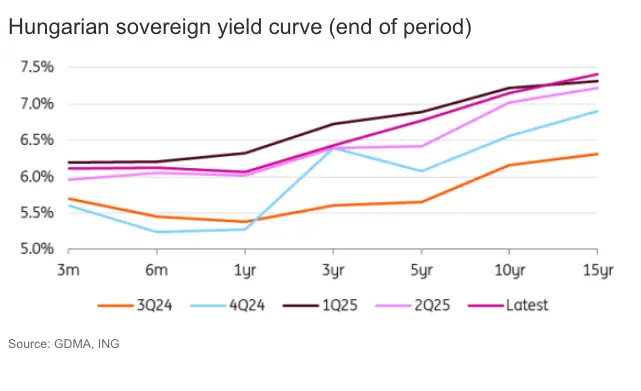
Although the rates market has been trading in ranges all year and the NBH is acting as a good anchor for the front-end, we still see significant volatility versus CEE peers. July ended with a significant hawkish repricing that pushed the final hopes of this year's NBH rate cut off the market. As a result, the priced terminal rate moved to 5.85%, the highest level since the April rally.
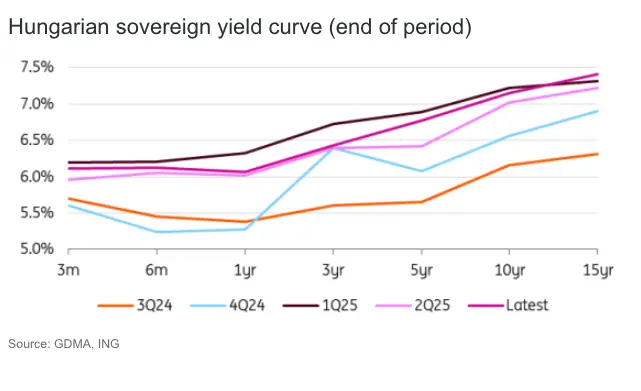
The aggressive hawkish pricing is not just in the front of the curve, but also long-end and Hungarian government bonds (HGBs). We see the 5y5y IRS as a good example with levels at 7.30%, just 10bp below this year's highs, and if we take away a few stressed moments, the highest in years.
On the issuance side, the debt agency is in a relatively comfortable situation, having returned to the market with buybacks in July, and is essentially done with FX issuance. August could thus attract market interest if the global story doesn't create more unnecessary volatility, since HGBs are showing cheap valuations and potentially some dovish tailwinds.